


How should international trade governance evolve when data becomes the primary asset of commerce?
Helen Ruiz Hidalgo
Master in Business Administration
Foreign Trade Observatory (OCEX)
Universidad Estatal a Distancia (UNED)
Digital revolution. Few transformations have been as profound for international trade. During the second half of the 20th century, trade liberalization, the consolidation of global value chains, and the creation of the World Trade Organization (WTO) strengthened a rules-based multilateral system that drove the integration of economies. Today, that landscape is evolving once again. Data has become a strategic asset whose value transcends traditional goods and services, redefining how value is produced, exchanged, and generated in the global economy.
Strategical value of Data. This new reality is altering the way businesses, consumers, and governments participate in international markets. Today, a commercial operation can be carried out entirely through digital platforms; a small business can offer services to clients located on any continent, and millions of transactions depend on the permanent exchange of information between different jurisdictions. Data has thus acquired a strategic value comparable to that of raw materials, energy, or financial capital in other eras.
This brief continues the analysis initiated by the Foreign Trade Observatory (OCEX) on the transformation of international trade amid the rapid advancement of digital technologies. Brief No. 2-2026: Impacts and Challenges of Digital Technologies on Trade examined the main changes and challenges that digitalization poses for the multilateral trading system. Subsequently, Brief No. 3-2026: Costa Rica’s Accession to the Digital Economy Partnership Agreement analyzed Costa Rica’s accession to the Digital Economy Partnership Agreement (DEPA), the first international agreement specifically designed to address the challenges of the digital economy and strengthen cooperation in strategic areas such as electronic commerce, cross-border data flows, digital identity, artificial intelligence, and technological innovation. That brief explained that DEPA complements the initiatives undertaken in forums such as the World Trade Organization (WTO), the Organisation for Economic Co-operation and Development (OECD), and the Asia-Pacific Economic Cooperation (APEC), establishing itself as an international benchmark for developing new disciplines in digital governance.
From this background, a new question arises: how must international trade rules evolve to govern a data-driven economy? Answering this question requires analyzing the role of the World Trade Organization. Since 1995, the World Trade Organization has constituted the main institutional framework of the multilateral trading system (OMC, 2024). Nonetheless, the rapid development of the digital economy raises questions that transcend traditional trade disciplines, forcing a reflection on the multilateral system's capacity to respond to phenomena such as cross-border data flows, cybersecurity, privacy protection, artificial intelligence, and the increasing emergence of national regulations on digital infrastructure.
Understanding this transformation is no longer an exclusive interest for international trade specialists. It has become a necessity for academia, the productive sector, public institutions, and all individuals interested in understanding how the rules governing world trade will evolve over the coming decades.
Data Governance: Trust Became the Primary Challenge of Digital Trade. For centuries, international trade has rested on an element just as vital as the goods crossing borders: trust. From ancient trade routes to the complex global value chains characterizing the contemporary economy, exchanges between countries have only been possible when businesses, consumers, and governments have relied on clear rules, solid institutions, and mechanisms capable of guaranteeing compliance with agreements. The creation of the World Trade Organization (WTO) consolidated precisely that objective. Its establishment allowed for the strengthening of a multilateral system based on principles of transparency, predictability, and the peaceful settlement of trade disputes, offering an institutional framework that facilitated the expansion of international trade over the last three decades (OMC, 2024).
The digital revolution has redefined that trust. In traditional trade, trust was built around tangible elements: product quality, contract compliance, transport security, payment mechanisms, or the stability of trade rules. Today, a large portion of these economic relations develops in digital environments where the asset of greatest value is no longer necessarily the good being commercialized, but rather the information that allows it to be produced, distributed, marketed, and consumed.
This transition constitutes one of the most important structural transformations in contemporary international trade. Digitalization has progressively shifted the center of gravity of commerce from the physical exchange of goods toward the permanent exchange of information (Burri, 2023). Every operation carried out through a digital platform, every international payment, every logistics reservation, every electronic customs declaration, and every service provided online generates data that enables process coordination, optimizes supply chains, and facilitates decision-making. Consequently, economic value no longer stems solely from producing goods or rendering services, but also from the capacity to generate, process, analyze, and utilize information. Data fuels innovation, optimizes processes, and strengthens competitiveness, becoming one of the main drivers of economic growth in the digital age (OCDE, 2024). In the same direction, the United Nations Conference on Trade and Development (UNCTAD) maintains that the global economy is evolving rapidly toward data-intensive production models, where competitiveness increasingly depends on the ability to transform information into knowledge and knowledge into innovation (UNCTAD, 2024).
Data as an Object of Governance. Precisely because data has become a strategic asset, a question arises that seemed unthinkable just two decades ago: who establishes the rules for its international circulation? Unlike a physical commodity, data does not remain within a single jurisdiction. A purchase made from Costa Rica can involve servers located across several continents, digital platforms managed from another country, international payment systems, and globally distributed storage services. All of this occurs in a matter of seconds and without the user perceiving the complex journey their information undertakes. This characteristic deeply distinguishes the digital economy from traditional trade. While goods cross borders through clearly defined customs procedures, data circulates continuously through digital infrastructures whose regulation is still in the process of construction (Chander, 2013).
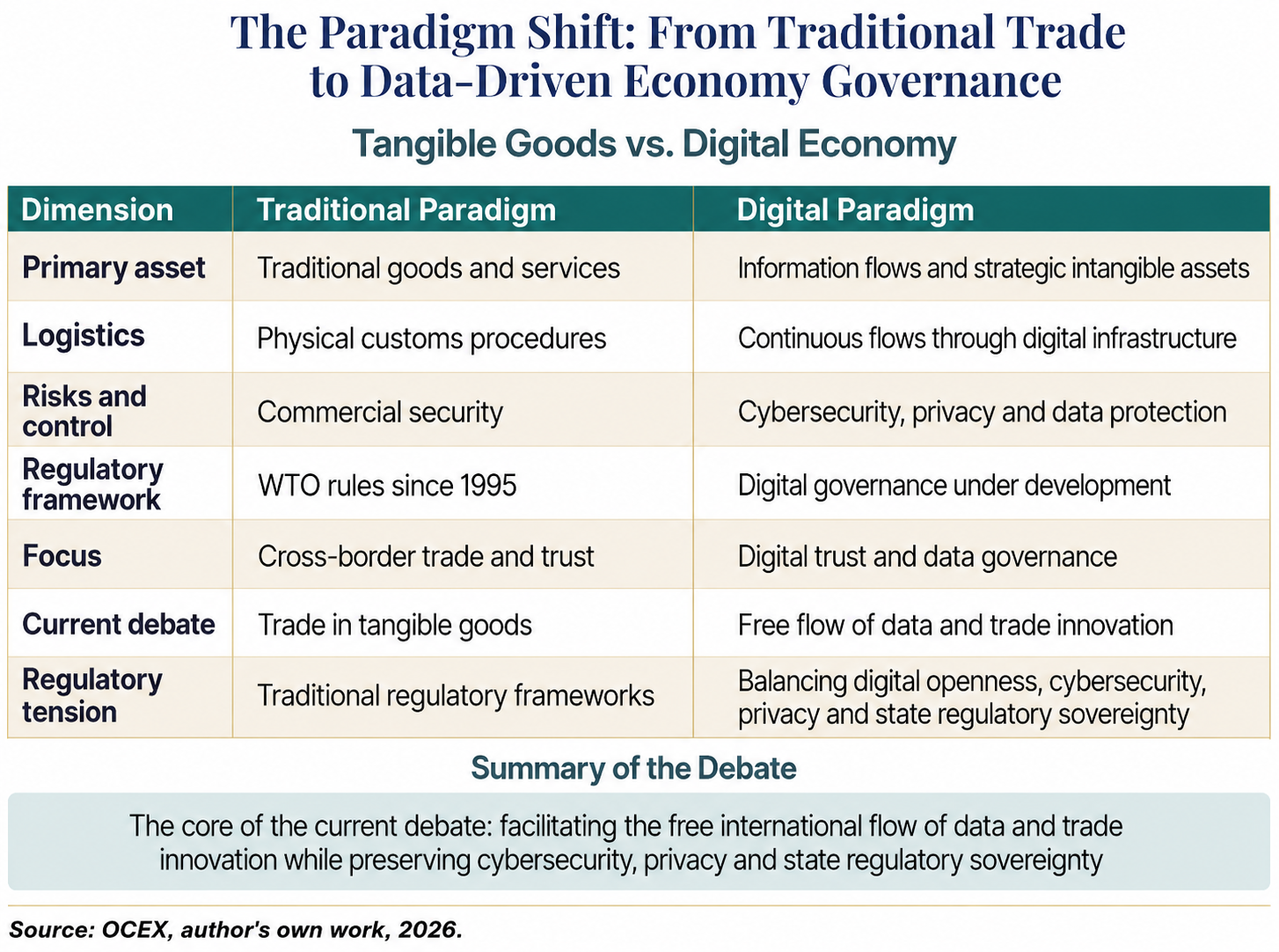
Hence, the concept of data governance has acquired growing importance within the international agenda. Data governance encompasses the set of principles, norms, policies, and institutions oriented toward regulating how information is collected, used, protected, shared, and transferred between different jurisdictions, seeking to reconcile technological innovation, economic development, the protection of fundamental rights, and state security. (OCDE, 2024 b).
The World Trade Organization recognizes it. The development of digital trade depends heavily on the existence of regulatory frameworks capable of generating trust among businesses, consumers, and governments. When rules regarding data treatment are clear and predictable, legal uncertainty decreases, transaction costs are reduced, and incentives to participate in international markets are strengthened. (OMC, 2024). Data governance thus ceases to be an exclusively technological matter and becomes an essential component of international trade policy.
Digital Trust as the New Foundation of International Trade. The growing reliance on data has also transformed how trust is understood in international markets. In the digital economy, trust no longer depends solely on contract compliance or the quality of commercialized goods. It additionally depends on the capacity to protect the information circulating among businesses, consumers, and public institutions. Organizations need to guarantee that their production processes, technological innovations, and customer information remain protected. Consumers, for their part, require certainty that their personal and financial data will be treated responsibly. Finally, governments seek to preserve the security of their critical infrastructures and ensure that the digital economy develops within frameworks compatible with their public policies.
Consequently, information has become an essential resource for coordinating production processes, facilitating trade, and generating innovation. Therefore, data governance inevitably leads to a second challenge of equal relevance: the protection of that data. Because if data represents one of the primary strategic assets of the global economy today, protecting it ceases to be a technological choice and becomes an essential condition for the functioning of international trade itself. Cybersecurity thus emerges as the next great challenge in digital trade governance.
The World Trade Organization Facing the New Paradigm of Digital Trade. The transformation of international trade toward a data-driven economy poses an inevitable question: is the World Trade Organization prepared to govern this new reality? The question does not intend to challenge the validity of the WTO. On the contrary, it recognizes the fundamental role it has played since 1995 as the cornerstone of the multilateral trading system. However, its agreements were conceived in a context where the Internet was barely beginning its commercial expansion, and concepts that are commonplace today—such as cloud computing, artificial intelligence, or cross-border data flows—were not yet part of the international agenda(Mayer-Schönberger & Cukier, 2013).
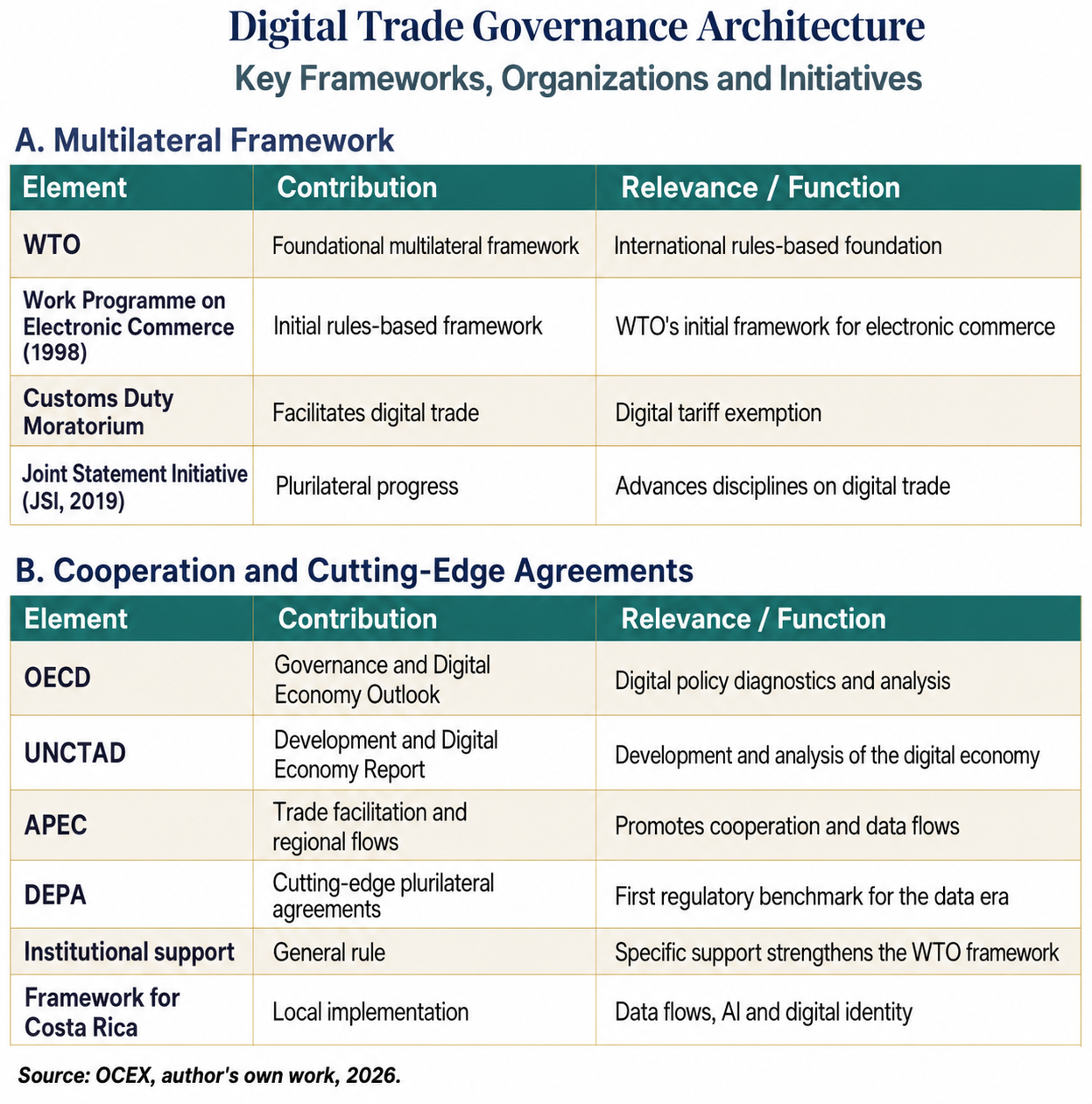
For this reason, many of the challenges posed by the digital economy today do not find an express response within current multilateral agreements. The WTO recognized early on that electronic commerce would profoundly transform international trade. An important first step occurred during the Second WTO Ministerial Conference, held in Geneva in 1998, when members adopted the Declaration on Global Electronic Commerce and established the Work Programme on Electronic Commerce. Through this decision, they instructed various organs of the Organization to study the implications of e-commerce on existing agreements and to analyze the need for future disciplines related to this matter. (OMC, 1998). Although that decision was visionary for its time, the speed with which the digital economy evolved ended up surpassing the initial scope of the Work Programme. Today, the challenge no longer consists solely of incorporating e-commerce into the multilateral system, but of determining whether existing rules suffice to govern a data-driven economy.
The moratorium on customs duties applicable to electronic transmissions constitutes one of the most visible examples of this evolution. Thanks to this decision, countries committed not to impose tariffs on electronic transmissions while negotiations relating to electronic commerce continue. (OMC, 2024). The measure has contributed to offering a more predictable environment for the development of digital trade. However, it has also generated a legitimate debate among the Organization's members. While some economies consider that maintaining an open environment is essential to stimulate innovation and competitiveness, other countries have expressed concerns related to the potential loss of fiscal revenue and the need to preserve sufficient space to design public policies aligned with their national priorities. (Kaukab, 2024, UNCTAD, 2024).
These differences reflect a fundamental reality: digital transformation does not produce the same effects in all economies. Varying levels of technological development, digital infrastructure, institutional capacities, and productive specialization condition how each country participates in the digital economy. As a consequence, international negotiations must reconcile diverse interests, striving to maintain a balance between trade openness, technological innovation, and national development goals. (Kaukab, 2024). With the purpose of advancing in this direction, a group of WTO members promoted the Joint Statement Initiative on Electronic Commerce (JSI) in 2019. This process constitutes one of the most important efforts to update the international regulatory framework against the challenges of digital trade. (Yakovleva, 2021). It seeks to develop disciplines related to aspects such as cross-border data flows, electronic authentication, digital signatures, online consumer protection, digital trade facilitation, and other essential components of the digital economy. (OMC, 2024). The JSI represents a crucial attempt to update the international regulatory framework in the face of digital trade challenges. Nevertheless, it also underscores the complexity of reaching consensus on topics where economic, technological, legal, and political interests converge.
The discussion transcends technology. The true challenge lies in finding an equilibrium between two equally legitimate objectives. On one hand, facilitating the international circulation of data and promoting an environment that favors innovation, trade, and investment. On the other hand, guaranteeing that states retain the capacity to protect individual privacy, strengthen cybersecurity, preserve national security, and develop public policies compatible with their own development priorities. Far from being incompatible goals, both constitute indispensable pillars for consolidating a trusted digital economy. Precisely for this reason, the debate on digital trade governance can no longer be understood solely from the perspective of trade law. It requires integrating elements from economics, technology, data protection, cybersecurity, innovation, and international cooperation.
This evolution also explains the emergence of new international instruments specialized in the digital economy. While the WTO continues to build multilateral consensus, some countries have begun to develop agreements that deepen specific disciplines on digital trade, seeking to respond more rapidly to the needs of an increasingly data-based economy. Far from representing opposing efforts, these initiatives show that international digital trade governance is evolving through complementary mechanisms that seek to strengthen the same objective: providing clear and predictable rules for an economy whose technological transformation progresses with unprecedented speed. The evolution of the digital economy demonstrates that international governance is already changing. While the WTO continues to build multilateral consensus, specialized instruments are beginning to emerge to respond more quickly to new challenges. Among them, the Digital Economy Partnership Agreement (DEPA) stands out, whose accession by Costa Rica constitutes a concrete example of this evolution.
Conclusions. Digital Trade Governance: A Shared Task for the Future. The rules of international trade have never been static. Throughout history, they have evolved to respond to the economic transformations of each era. The data-based economy is no exception. The growing digitalization of production, services, and global value chains poses one of the greatest challenges for international trade governance since the creation of the World Trade Organization.Throughout this analysis, it has been shown how data ceased to be a technological resource and became a strategic asset of the global economy. This shift has transformed the very nature of international trade. Today, facilitating the exchange of goods and services also implies guaranteeing the secure circulation of data, strengthening digital trust, and developing regulatory frameworks capable of responding to risks that just a few decades ago were not part of the trade agenda. In this context, the WTO remains the primary multilateral forum for building common rules that provide predictability to international trade. However, the speed with which the digital economy evolves has driven the development of complementary initiatives that seek to advance in areas where multilateral negotiation requires greater consensus.
The Digital Economy Partnership Agreement (DEPA) stands out, considered the first international agreement specifically designed to address digital economy challenges. Its scope transcends electronic commerce and incorporates disciplines related to the free cross-border flow of data, digital identity, artificial intelligence, technological innovation, interoperability, and regulatory cooperation, configuring a modern framework to facilitate open, secure, and reliable digital trade.
Far from substituting the role of the WTO, the very design of DEPA evidences a logic of complementarity. As exposed by research developed by the Foreign Trade Observatory (OCEX), this agreement strengthens and complements the work currently carried out by international organizations such as the World Trade Organization (WTO), the Organization for Economic Co-operation and Development (OECD), and the Asia-Pacific Economic Cooperation (APEC) forum regarding the digital economy and international governance.
Costa Rica's accession to DEPA acquires a relevance. From this perspective, it transcends joining a new trade agreement. It represents a strategic decision reflecting the evolution of the country's international insertion model and its interest in actively participating in building the rules that will guide digital trade over the coming decades. This decision is consistent with Costa Rica's productive and export structure. The sustained growth of trade in services, the consolidation of knowledge-intensive activities, the attraction of high-value-added foreign direct investment, and the development of companies linked to digital technologies make the existence of modern international frameworks on the digital economy increasingly important for national competitiveness. OCEX's own research highlights that services represent nearly 46% of the country's exports and that approximately half of those exports are carried out through digital means, showcasing the growing strategic importance of this sphere for the Costa Rican economy.
In this context, accession to DEPA strengthens Costa Rica's international positioning as an open, innovative economy committed to developing a modern international trade agenda. Likewise, it favors cooperation in areas such as artificial intelligence, cybersecurity, innovation, digital identity, and international data transfer—topics that will likely occupy a central place in the evolution of world trade over the coming years.
The challenge transcends Costa Rica and DEPA itself. Digital trade governance constitutes a shared responsibility among governments, international organizations, businesses, academia, and civil society. Finding a balance between the free circulation of data, privacy protection, cybersecurity, innovation, and regulatory sovereignty will be one of the most complex tasks of the multilateral system during the upcoming decades. In short, the debate on digital trade does not consist solely of understanding new technologies. It consists, above all, of building the rules that will allow those technologies to generate trust, drive innovation, and contribute to sustainable development. In this field, the comprehensive study conducted by Francisco Chacón and Valeria Tiffer of Costa Rica’s Lead University is particularly noteworthy. The paper by Francisco Chacón González and Valeria Tiffer Hangen stands out for offering a practical, institutional, and hybrid perspective from the heart of the multilateral dynamics surrounding the Joint Statement Initiative (JSI). Unlike the international literature focused on superpowers, the article highlights the dilemmas and urgency facing developing countries and MSMEs in the face of the risk of regulatory fragmentation. (Chacon y Tiffer, 2022)
History demonstrates that international trade has always evolved alongside new institutions and new agreements. Today we witness a similar stage. While the WTO continues to play an irreplaceable role as the axis of the multilateral system, initiatives like DEPA show that international cooperation can also advance through innovative instruments that respond more rapidly to the challenges of the digital economy. Perhaps the greatest lesson of this transformation is that the future of international trade will depend less on the speed with which technologies evolve and much more on the capacity of the international community to build common rules that inspire trust. Because, ultimately, the true innovation of digital trade does not reside solely in data, artificial intelligence, or digital platforms. It resides, above all, in the capacity of countries to cooperate and build international governance that allows this technological transformation to generate prosperity, inclusion, and opportunities for people, no matter where in the world they may be.
Sources consulted:
- Burri, M. (2023). Cross-border data flows and privacy in global trade law: Has trade trumped data protection? Oxford Review of Economic Policy, 39(1), 85–97. En:
https://academic.oup.com/oxrep/article-abstract/39/1/85/7030591?redirectedFrom=PDF&login=false - Burri, M. (2023). Data governance in international trade law: The state of play and the way forward. Journal of International Economic Law, 26(1), 45-63. En: https://academic.oup.com/jiel/article-abstract/26/1/90/6965847?redirectedFrom=fulltext
- Chacón González, F., & Tiffer Hangen, V. (2022). Un acuerdo multilateral para el comercio electrónico: expectativas y realidades. Revista de Derecho Comercial y de las Obligaciones, (312), 45-62. En: https://www.zurcherodioraven.com/images/noticias/e-commerce0122.pdf
- Chander, A. (2013). The electronic silk road: How the web binds the world together in commerce. Yale University Press. En: https://scholarship.law.georgetown.edu/facpub/2297/?utm
- Conferencia de las Naciones Unidas sobre Comercio y Desarrollo (UNCTAD). (2024). Digital Economy Report 2024: Shaping an environmentally sustainable and inclusive digital future. Naciones Unidas. En: https://unctad.org/publication/digital-economy-report-2024
- Ismail, Y. (2020). E-commerce in the World Trade Organization: History and latest developments in the negotiations under the Joint Statement. International Institute for Sustainable Development. En: https://www.iisd.org/system/files/publications/e-commerce-world-trade-organization-.pdf?utmKaukab, R. S. (2024, 30 de octubre). WTO moratorium on customs duties on electronic transmissions: Better understanding developing countries’ concerns. International Institute for Sustainable Development. En: https://www.iisd.org/articles/policy-analysis/wto-moratorium-customs-duties-electronic-transmission?utm
- Mayer-Schönberger, V., & Cukier, K. (2013). Big data: A revolution that will transform how we live, work, and think. Houghton Mifflin Harcourt. En: https://books.google.co.cr/books?id=uy4lh-WEhhIC&printsec=frontcover#v=onepage&q&f=false
- Observatorio de Comercio Exterior (OCEX). (2026). Cápsula N°2-2026: Impactos y desafíos en el comercio de las tecnologías. En: https://www.uned.ac.cr/ocex/index.php/capsulas/944-impactos-y-desafios-en-el-comercio-de-las-tecnologias-digitales
- Observatorio de Comercio Exterior (OCEX). (2026). Cápsula N°3-2026. Adhesión de Costa Rica al Acuerdo de Asociación de Economía Digital (DEPA). Universidad Estatal a Distancia (UNED). En: https://www.uned.ac.cr/ocex/index.php/capsulas/952-capsula-n-3-2026-adhesion-de-costa-rica-al-acuerdo-de-economia-digital
- Organización Mundial del Comercio (OMC). (1998). Declaration on Global Electronic Commerce (WT/MIN (98)/DEC/2). En: https://www.wto.org/spanish/tratop_s/ecom_s/mindec1_s.htm?utm
- Organización Mundial del Comercio (OMC). (2024). Acuerdo sobre Comercio Electrónico: texto final y antecedentes. En: https://www.wto.org/spanish/tratop_s/ecom_s/joint_statement_s.htm
- Organización Mundial del Comercio (OMC). (2024). World Trade Report 2024: Trade and Inclusiveness. En: https://www.wto.org/spanish/res_s/publications_s/wtr24_s.htm?utm
- Organización para la Cooperación y el Desarrollo Económicos (OCDE). (2024). OECD Digital Economy Outlook 2024. OECD Publishing. En: https://www.oecd.org/en/publications/oecd-digital-economy-outlook-2024-volume-1_a1689dc5-en.html?utm
- Organización para la Cooperación y el Desarrollo Económicos (OCDE). (2024b). OECD Digital Economy Outlook 2024 (Volume 2): Strengthening connectivity, innovation and trust. OECD Publishing. En: https://www.oecd.org/en/publications/oecd-digital-economy-outlook-2024-volume-2_3adf705b-en.html
- Vásquez Callo-Müller, M., & Sucker, F. (2026). Evolving approaches to cross-border data flows: Latin American and African perspectives. International Data Privacy Law, 16(2), ipaf037. En: https://academic.oup.com/idpl/article/16/2/ipaf037/8405734?login=false
- Yakovleva, S. (2021). Personal Data Transfers in International Trade and EU Law [Transferencias de datos personales en el comercio internacional y el derecho de la UE]. SSRN Electronic Journal. En: https://brill.com/view/journals/jwit/21/6/article-p881_4.xml