


Boletines-Artículos
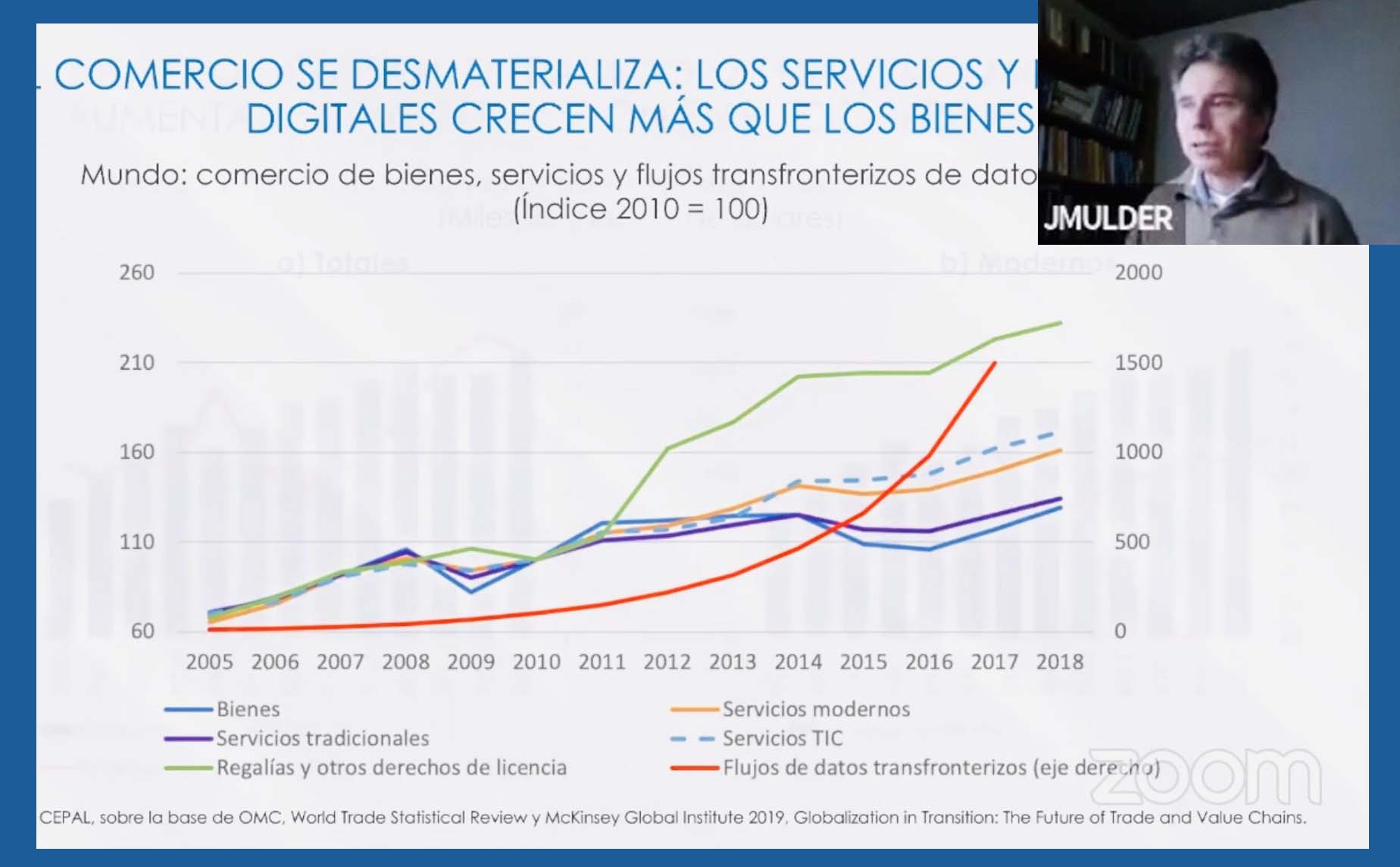
La economía mundial se desmaterializa. El surgimiento de nuevas tecnologías como la manufactura aditiva, la inteligencia artificial, las plataformas digitales y el Internet de las cosas (IoT) permiten, con mayor facilidad, producir, mover y comercializar productos y servicios en todo el mundo.
En los años ochenta, noventa y dos mil se había producido un gran dinamismo del comercio tradicional de bienes. Desde 2010, ese dinamismo se ha trasladado a las actividades facilitadas por las nuevas tecnologías digitales. Desde entonces, la tasa de crecimiento de los flujos transfronterizos aumenta proporcionalmente con su intensidad digital. Sin embargo, nuestra región no está aprovechando en todo su potencial esta revolución tecnológica que ya se ha venido a llamar la cuarta revolución industrial.
 Tomemos en cuenta que el sector de servicios tradicionales ha venido creciendo, en Costa Rica, y concentra ya la fuerza de trabajo y también la generación de empleo. A finales de 2019, previo a la crisis generada por la pandemia del Covid-19, el sector servicios generaba más del 70% de los puestos de trabajo. Esta situación es todavía de mayor impacto en la población femenina. El 84% de la fuerza laboral femenina labora en servicios (725 mil empleos) y fue el sector laboral que más creció en 2019. El sector servicios tiene un fuerte impacto en las pymes, donde el sector de comercio y servicios concentra un 84% de ellas.
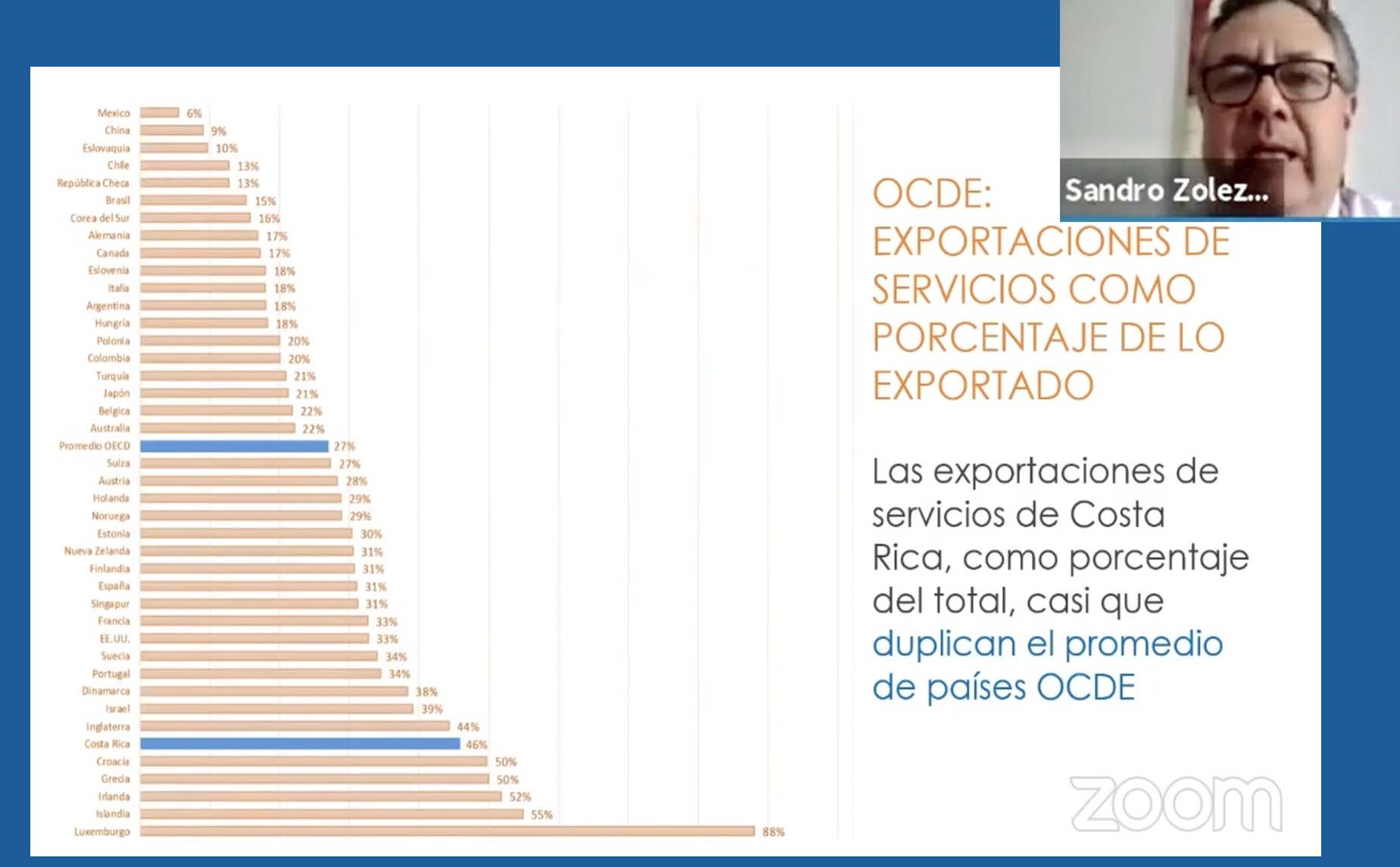
El sector servicios tiene una dinámica semejante de crecimiento en las exportaciones. Entre 2012 y 2019, las exportaciones de servicios tuvieron un crecimiento del 53%. Las ventas de servicios pasaron de US$6.209 millones en 2012, a US$9.503 millones en 2019. También se incrementó su participación en las exportaciones totales, pasando de 42% a 45%.
La mayor importancia de los servicios, tanto en la producción como en las exportaciones totales, es el cambio estructural más importante que ha tenido la economía costarricense. Desde 2016, la balanza de servicios registró un superávit mayor que el déficit permanente en la balanza de bienes. Eso tiene como impacto una mejora de la cuenta corriente de la balanza de pagos, lo que, a su vez, mejora el balance externo del país.
Este crecimiento de las exportaciones de servicios no sólo genera oportunidades de empleo, sino que también aumenta la oferta de divisas en el país, ya que servicios es un sector mucho menos dependiente de las importaciones. Lo contrario ocurre en la exportación de mercancías.
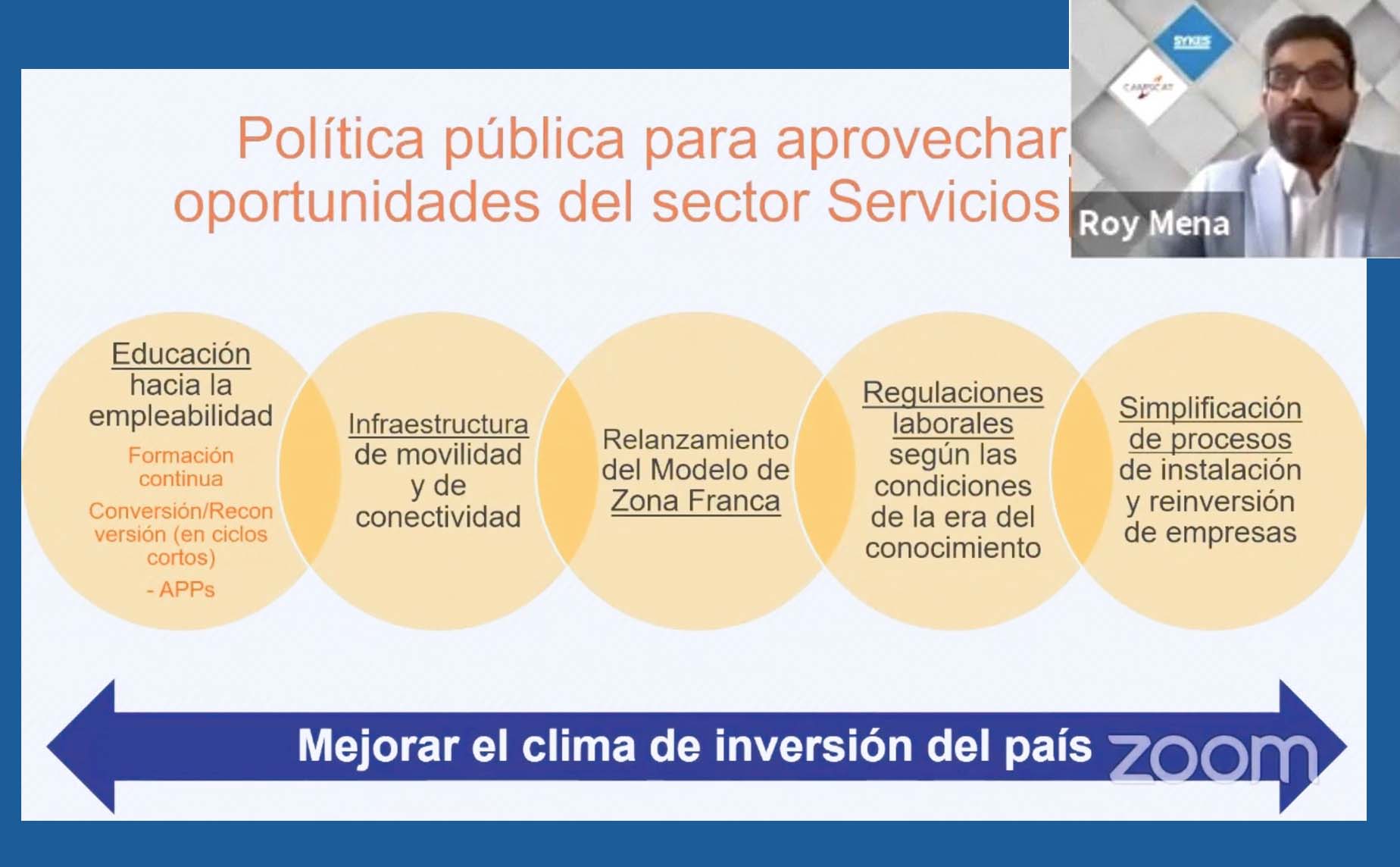
Adicionalmente, y es lo más trascendental, la exportación de servicios es el mejor aliciente para el desarrollo de capacidades humanas, en un espacio decisivo para el desarrollo del país en la sociedad del conocimiento. También representa un enorme reto porque la formación profesional que ofrecen las universidades está en rezago con relación a la demanda de personal calificado de este sector.
 Con esos antecedentes, el 17 de julio de 2020, (OCEX) el Observatorio de Comercio Exterior de la Universidad Estatal a Distancia (UNED), organizó un diálogo con especialistas de primer orden de la región, sobre este novedoso tema: "La Gobernanza de la Exportación de Servicios". En esta videoconferencia internacional se presentó como primicia una investigación internacional de alto nivel, el estudio: “Gobernanza y desempeño exportador de los servicios modernos en América Latina y Costa Rica”.
Se ofreció una robusta discusión de especialistas, que conformaron un panel de alto nivel. Entre ellos, se contó con Nanno Mulder, jefe de División de Comercio Exterior e Integración de la CEPAL, Chile. El señor Mulder nos presentó la investigación titulada: “Servicios modernos en América Latina y la India: La clave de la gobernanza”. (Descargue su presentación: "promoviendo los servicios modernos").
Este evento tuvo como eje una investigación coeditada por nuestro invitado, quien nos presentó una síntesis de ese estudio. (Accesar al PdF del estudio, editorial CEPAL)
Su investigación se enmarca en las actividades del convenio entre la CEPAL y la fundación Konrat Adenaguer, conocida como KAS por sus siglas en alemán. Dentro del Programa de Cooperación de Alianzas para la Democracia y el Desarrollo con América Latina, de acrónimo ADELA.
Éste programa es iniciativa de la Fundación KAS, organismo de la cooperación de los partidos de la Democracia Cristiana de Alemania. Sin embargo, nuestro evento fue de carácter académico, autónomo e independiente de agendas políticas o ideológicas.
 Se inició con las palabras de bienvenida a cargo del señor Vinfrit Veck, director del programa regional ADELA, de la Fundación KAS.
Luego expuso Sandro Zolezzi, gerente de Investigación, Monitoreo y Evaluación de la Coalición Costarricense de Iniciativas de Desarrollo (CINDE). El señor Zolezzi es coautor del capítulo quinto, de esta investigación, dedicado a Costa Rica. En su exposición abordó el éxito de nuestro país. Brindándonos así la visión institucional costarricense. (Descargue su presentación: "Costa Rica: el éxito basado en la coordinación a largo plazo").
Posteriormente, tuvimos al señor Roy Mena, director de Asuntos Corporativos de Sykes. Él es también Presidente de la Cámara de Servicios Corporativos de Alta Tecnología (CAMSCAT). El señor Mena nos brindó, en su disertación, la perspectiva del sector privado costarricense. (Descargue su presentación: "sector servicios corporativos en Costa Rica").
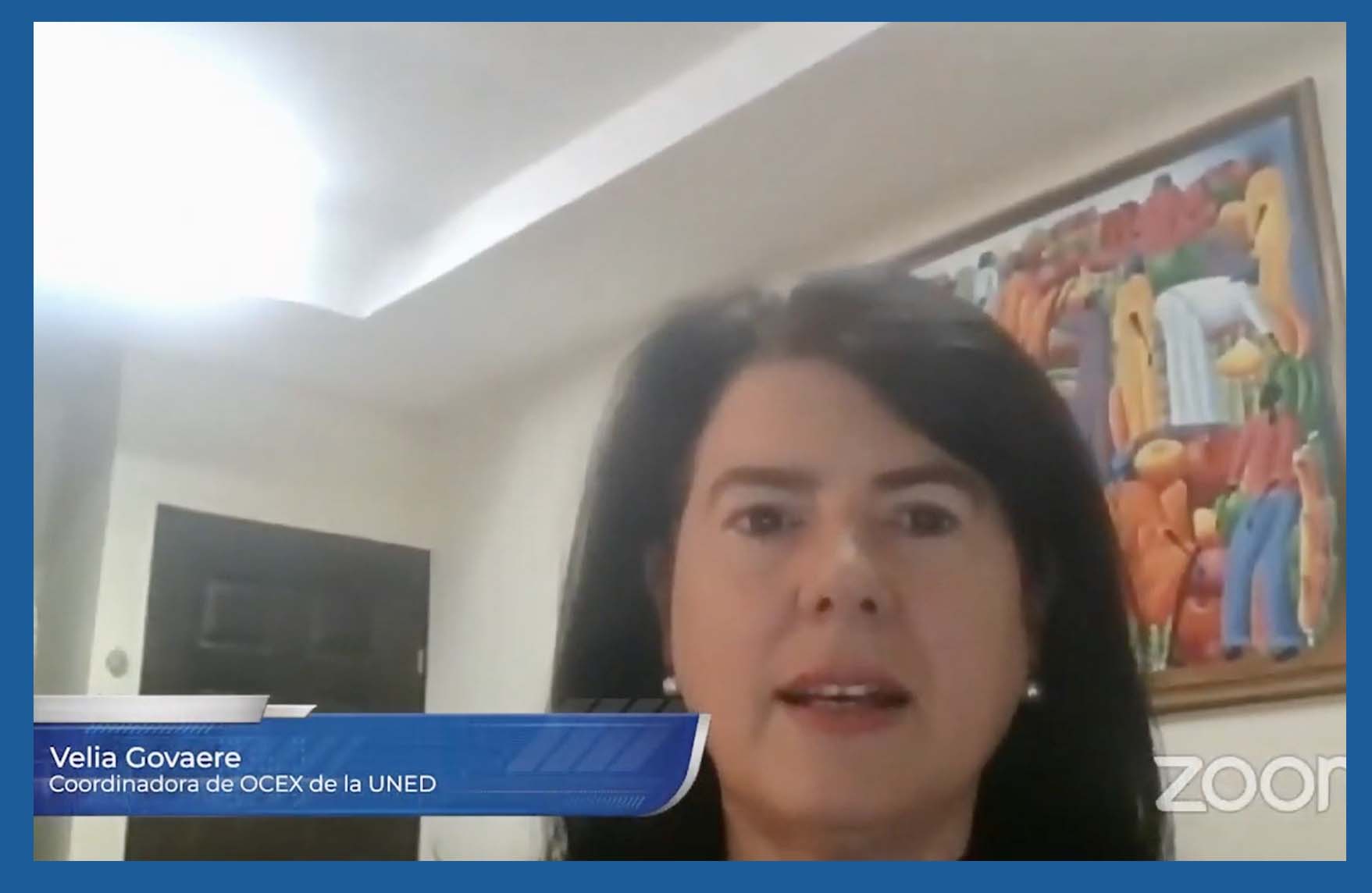
Finalizando las ponencias, Velia Govaere, Coordinadora de OCEX de la UNED, brindó las reflexiones finales y fungió como moderadora. La Dra. Govaere resumió los desafíos de Costa Rica para asumir la vocación no totalmente realizada de convertirse en un proveedor todavía más importante de servicios modernos, señalando que:
“… en todos los terrenos tenemos oportunidades, pero también el desafío de superar brechas y restricciones para competir con efectividad. El mercado global de servicios, en constante expansión, está sometido a una fuerte competencia donde los capítulos fundamentales que determinarán los ganadores están potencialmente presentes en Costa Rica, pero sometidos a grandes limitantes.
 Se consideran determinantes de éxito nacional en el sector de servicios, entre otros, la cercanía de huso horario de los mercados, la afinidad cultural, la disponibilidad abundante de talento humano, bajos costos operativos, estabilidad del entorno sociopolítico, seguridad macroeconómica, políticas públicas con fuertes incentivos (IED), la calidad de la infraestructura de telecomunicaciones, entre las cuales destaca la facilidad de acceso a banda ancha para las empresas pequeñas.
Basta ver esa lista, para entender las exposiciones que hemos tenido esta mañana y que pueden resumirse en la frase: Sí, pero NO y Tal vez. Sí tenemos talento, pero no suficiente, pero tal vez logremos pertinencia y alineamiento. Sí existe interés público, pero no tenemos políticas sectoriales con incentivos, pero tal vez veamos pronto iniciativas de impacto. Sí tenemos estabilidad del entorno sociopolítico, pero padecemos de una fuerte crisis de gobernanza, con un perenne antagonismo tribal del fraccionamiento político y desconfianza entre los sectores y tal vez, después de mucha presión ciudadana logremos alcanzar consensos. Sí tenemos estabilidad macroeconómica, pero no quisiera embarrialar la cancha y, sobre todo, nuestro estado de ánimo, recordando temas fiscales, pero tal vez. Y así en cada tema.”
OCEX ofrece a sus subscriptores el vínculo de esta videoconferencia que podrán enlazar en esta dirección: https://youtu.be/Sx6a2_Qdd2g
El periódico Acontecer, de la UNED, también dedicó una reseña al evento, que compartimos con nuestros usuarios, en el siguiente link: https://www.uned.ac.cr/acontecer/a-diario/educacion/4125-expertos-analizaron-el-tema-gobernanza-y-desempeno-exportador-de-los-servicios-modernos-en-america-latina-y-costa-rica
POR VELIA GOVAERE -
El brutal asesinato policial de George Floyd desató la mayor indignación colectiva universal desde la guerra de Vietnam. Su agonía quedará en la historia como la gota que colmó el vaso del racismo en la consciencia de la población blanca de Estados Unidos y el mundo. La imagen angustiosa de un negro deliberadamente asfixiado por la policía quedó documentada por transeúntes indignados, que exigían el cese de la tortura. Fueron ocho largos minutos de suplicio criminal, a plena luz y vista pública. El impacto simbólico de su voz agonizante dramatiza con inusitado realismo el grito constante de una comunidad que no termina de sufrir las secuelas de la esclavitud. ¡No puedo respirar! encarna el clamor cotidiano de la población negra. Su denominación políticamente correcta de “afroamericana” apenas esconde el carácter injurioso que en esa cultura tiene el color de una piel. Black is beautiful, decía Muhammad Ali. Esa piel no merece que ningún idioma se avergüence de pronunciar su color.
¿Cómo es posible que a esta altura de nuestra evolución ética se tenga que exigir que “Black Lives Matter”? ¿A quién importan las vidas negras? Obviamente a la misma población que ve perder sus vidas con total desprecio, abandonadas en la pobreza, inatendidas en la enfermedad, olvidadas en las cárceles y cotidianamente asesinadas por la policía. El rostro impertérrito de Derek Chauvin es una apología gráfica de la indiferencia por la vida de un negro. Por eso, aquel grito angustioso de no poder respirar es un reclamo moral a la civilización. Y la humanidad entera, con todos sus colores, está respondiendo a la voz agonizante de George que clamaba por su madre. Ese es el sentido más profundo de los acontecimientos del día. La resonancia de ese grito angustiado despertó a los blancos y fracturó su indiferencia frente al flagrante racismo cultural.
Eso hace toda la diferencia con las luchas por los derechos civiles de los años 60 del siglo pasado. En aquella hora, los incendios en el gueto de Watts de Los Ángeles desataron levantamientos de luchas desesperadas en múltiples rincones olvidados de barriadas negras. De la protesta violenta se pasó a la propuesta pacífica y esa logró transformaciones legislativas contra la discriminación racial. Conquistar derechos civiles para los descendientes de esclavos era el sueño de Martin Luther King. Y mucho se logró, en la letra de la ley. Pero esa lucha quedó trunca en la convivencia. No logró hegemonía cultural en el imaginario colectivo de la población blanca.
Eso está ocurriendo ahora. El signo distintivo de estos tiempos es la participación masiva e indignada de blancos en la reivindicación elemental del respeto a la vida de la población negra. La visión del negro comienza a alcanzar la masa crítica que le permite perder su otredad. Ellos, los otros, se convierten en nosotros. Su dolor y su lucha, en las nuestras. Su vida, en nuestra vida. Son los albores de una impronta cultural afectiva que es indispensable para que una nueva generación asuma un ideal que trascienda el color de la piel y se vuelva simple y llanamente humana.
Esta transformación cultural en la América blanca está ocurriendo a escasos meses de los comicios del 3 de noviembre y tal vez será un elemento decisivo. Trump debió, en parte, su victoria del 2016 al respaldo masivo que tuvo entre la población blanca de baja escolaridad. En ese segmento, Donald alcanzó un 31% más de votación que Hillary. Y los blancos con educación universitaria no se decantaron por Clinton como se esperaba.
Frente al asesinato de Floyd, existe indignación generalizada en toda la población blanca. Esto está teniendo un impacto en las preferencias electorales. Así lo señala Nate Cohn (NYT 9/06/2020), analizando un promedio de las más confiables encuestas recientes. Ahí aparece una notable unificación de criterios, independientemente del nivel educativo. Franjas nunca vistas de la población blanca condenan los agravios racistas y apoyan acciones políticas contra la discriminación. El 70% apoya la protesta popular contra el asesinato de Floyd y el 60% censura la conducta de Trump contra los manifestantes.
Eso indica un posible punto de ruptura cultural que podría tener impacto electoral. En la población blanca de baja escolaridad, Trump ya perdió un 10% de intención de voto. Entre blancos con educación superior, Biden tiene ya una ventaja de 20%. Entre ambos sectores, Trump está perdiendo un terreno que puede ser decisivo, en noviembre.
No todo podrá atribuirse a una reacción frente al asesinato de Floyd. Ya se venía arrastrando un manejo dañino de la pandemia, contracción económica y pérdida de empleos. Todo eso suma. Pero su carencia de empatía frente a la brutalidad policial agudiza, de forma particular, el repudio a la impronta de la presidencia de Trump.
Pero Trump es un brujo capaz de voltear a su favor incluso una repulsa en su contra. Eso está intentando. Disfrazó la protesta por el asesinato de Floyd como si fuera una crisis nacional para darle respuesta manu militari. El ejército se negó a intervenir contra civiles. Pero eso no es toda la lógica de su agitación. Necesita galvanizar su núcleo de apoyo, especialmente en los estados fluctuantes, su decisiva base electoral. Trump hace todo por conservarla. Ahora necesita mantenerla en permanente estado de arrebato. Eso marcará desde ahora su campaña. En ella actuará como demonio incendiario. La histeria colectiva es el instrumento de apoyo de masas que necesita como respaldo a su repudio de las elecciones, si su resultado no le favorece. Fue la táctica de Hitler para disolver la República de Weimar. Esa condición de zozobra no le garantiza impunidad. Se toparía con otra indignación que toma vuelo. Trump se sostiene en un terreno de prejuicios. El vuelco moral de la población blanca lo erosiona. La fractura de ese atavismo cultural blanco negará a sus maniobras el asidero racista que lo llevó a la Casa Blanca.
La autora es coordinadora del OCEX y catedrática de la UNED.
Artículo publicado en Periódico La Nación, 12 junio 2020.
POR VELIA GOVAERE -
La historia está marcada por instantes de luz. Sorprenden en medio de las sombras más oscuras. “Justo antes de amanecer”, al decir de Azofeifa. Son brotes de vida que irrumpen en la superficie árida de una tierra seca. Revelan raíces escondidas que, como todo lo esencial, son invisibles a los ojos. Cuando los peores rasgos de la inquina y el prejuicio roban el escenario de la sociedad del espectáculo, un nuevo guion esperanzador se articula detrás de bambalinas.
Son las primaveras de los pueblos. No siempre rompen la crudeza del invierno, pero son síntomas claros de un cambio de siglo. Las acciones públicas de los poderes políticos tienen grandes impactos momentáneos, muchas veces caóticos. Siempre aparecen personalidades nefastas echando al trasto la laboriosa construcción civilizatoria de generaciones enteras. Es el poder de la entropía social, cuando la capacidad destructiva del desorden se acumula hasta el estallido. Pero la fuerza vital de la resiliencia humana boga contracorriente, sumergida bajo la superficie de tormentas.
La presidencia de Trump surgió como expresión de resentimientos ciegos, conservadurismo acorralado y xenofóbicos prejuicios nacionalistas. Su ajustado triunfo develó la pérdida de dinamismo del proletariado industrial a favor de China, en un sector de votantes que resultó decisivo en el colegio electoral. También reflejó su victoria la fuerza insospechada de una contracorriente racista blanca, resentida con el triunfo de Obama. El vigor de Trump en el sur esclavista tampoco esconde ese siniestro componente. Otra fuente de su logro electoral fue el reaccionario conservadurismo evangélico en regiones poco expuestas a influencias cosmopolitas de la sociedad globalizada. Incesantes avances de una cultura de tolerancia habían acorralado las viejas iglesias y sus dogmas. Ellas vieron en Trump, sí, al odioso, misógino y mentiroso Trump, la tabla de salvación de sus prejuicios. Esas tres grandes corrientes son la base electoral de Trump y explican sus políticas para mantenerlas fieles y alineadas.
Por casi cuatro años, Trump ha dominado las tablas, sembrando cizaña, caos y confusión, tanto afuera como adentro. Sus iniciativas y bravatas son olas de contracultura en todos los escenarios. No ha dejado conquista civilizatoria sin mancha. Hacia afuera minó la globalización, destruyó acuerdos, aceleró el cambio climático, promovió déspotas, alienó aliados y quebrantó alianzas. Hacia adentro fracturó la convivencia, alimentó odio y división, defendió racismo, socavó institucionalidad, se saltó la separación de poderes, neutralizó los sistemas de control, denigró la prensa y fabricó “verdades alternativas”. Así corrompió el honor del partido conservador que renegó sus más caros principios.
Pero siempre hay un pero. Bajo la superficie de esa destrucción de valores, se gestaba la crisálida de un renacimiento. Todas las agresiones al imaginario colectivo no pudieron corromper lo mejor del alma norteamericana. Bajo Trump, la democracia mostró sus más dolorosas debilidades, pero también, el vigor que injerta en los pueblos el ejercicio de las libertades cívicas.
La prensa fue gota incesante de denuncia que terminó calando. Las minorías agredidas defendieron sus derechos y sus voces no pudieron ser enmudecidas. Su punto culminante llegó con el asesinato de George Floyd, asfixiado bajo la rodilla sádica de un policía blanco, que nos remontó, de inmediato, a un pasado esclavista con el que no ha terminado de ajustar cuentas la cultura anglosajona.
Aquel grito de “no puedo respirar” fue expresión literal de la condición política en la que Trump estaba hundiendo a Estados Unidos. Con el clamor de Black Lives Matter, la masiva participación de población blanca en las manifestaciones negras fue el primer pregón de un giro cultural histórico. La designación de Kamala Harris en la papeleta demócrata es el otro.
Kamala surge como expresión de otra revolución cultural. Jamás antes había habido tal número y protagonismo de mujeres en la política. En parte, la acción afirmativa ha nutrido esa cosecha histórica de mujeres con carisma. Pero, más que eso, han sido germinación subterránea de la indignación provocada por este presidente.
Mujer de color, hija de migrantes de Asia y el Caribe, Kamala tiene su pelo lleno de los fragmentos de todos los techos de cristal que ha roto. Es la imagen viva de una historia de superación contra las combinadas desventajas de ser mujer, negra y asiática. Fue la primera mujer negra y asiática electa fiscal del distrito de San Francisco y también la primera Fiscal General de California con esas condiciones. Fue electa senadora también como la primera asiática en ese estrado y la segunda mujer negra. Su carrera la ha convertido en una prestigiosa penalista y una política de garra. Por eso, toda su vida la ha preparado para este trance.
Cuando Biden la propuso en su papeleta, ella le respondió: “Oh, Dios mío, ¡estoy tan preparada para esto!”. Lo está. A fin de cuentas ella es fiscal y estas elecciones son un juicio político contra Donald Trump. El jurado es el pueblo. También está lista como política. Electa como senadora cuando pensaba que iba a ganar Hillary, le ha tocado bregar contra corriente, en una evolución que la ha convertido, al mismo tiempo, en reformista clara de sus objetivos, y en realista de opciones viables en el universo complejo de reconstrucción que heredará de Trump. (Y yo digo: oh my God, we are so ready for that!).
Jamás en la historia reciente ha habido tanta claridad sobre lo que se juega el 3 de noviembre. El 83% de los electores registrados dicen que realmente importa quien gane la presidencia. Trump ha logrado cuestionar los fundamentos mismos no sólo de la institucionalidad sino también de la decencia en el ejercicio público. Por eso, estas elecciones son tanto políticas como éticas. No en vano Kamala advierte que a Trump sólo puede derrotarlo una coalición de conciencia.
La autora es coordinadora del OCEX y catedrática de la UNED.
Artículo publicado en Periódico La Nación, 15 agosto 2020.
POR VELIA GOVAERE -
Lugar común, casi apodíctico, es calificar la gestión de Trump como movimiento telúrico del orden mundial. Sus disrupciones son legión. El calentamiento global, percibido como amenaza real, condujo la civilización a un acuerdo decisivo. Trump lo echó por la borda. También dejó paralizado el mecanismo de solución de diferencias de la OMC. Fracturó el sistema occidental de alianzas de la OTAN y socavó el rol de su país, como referente obligado de la defensa europea. Quedó, como idea matriz, Trump contra el mundo.
Su retiro de tropas de Alemania abre un flanco a Rusia, que profundizará su escalada caótica desde Ucrania hasta Oriente Próximo. Turquía fue envalentonada a revivir nostalgias otomanas. En el enrevesado conflicto entre Israel y Palestina, Trump descarriló décadas de diplomacia. Las relaciones entre Israel y Emiratos Árabes refuerzan el frente sunita contra Irán y alimentan una carrera armamentista. Eso es presagio funesto porque Trump rompió el acuerdo nuclear con Irán, dejando sin control lo que puede convertirse en la mayor amenaza mundial. Sin decir nada de la sensación de abandono de los palestinos.
Imposible un recuento corto de impericias que, a palos de ciego, por ignorancia o diseño, dejan al mundo todavía más volátil. En todas partes quedaron truncos procesos de mayor estabilidad. En el desorden resultante, la gran pregunta es hasta qué punto un cambio de conducción de política exterior de Estados Unidos podrá revertir esas tendencias desestabilizadoras.
Nada es más relevante, histórico y estratégico que remediar la caótica conducción de la competencia con China por la hegemonía mundial. China pudo desarrollarse en mercados abiertos dentro de un marco de cooperación y convivencia diplomática. Trump rompió esa armonía. De forma simplista, la asumió sólo como rival en todos los campos. Torpe presunción que desconoce las mil formas en que China se entrelaza en el tejido planetario.
La caída del muro de Berlín abrió un período histórico de estabilidad política, expansión comercial y fortalecimiento de alianzas estratégicas que apuntalaron la estabilidad y previnieron enfrentamientos económicos y conflictos armados. El entorno derivado de ese entramado favoreció el surgimiento de revoluciones tecnológicas que nacieron casi simultáneas.
Así nació y creció la globalización. Bajo sus premisas se alinearon las estrategias de desarrollo de naciones y regiones. Fue imposible sustraerse a sus paradigmas de apertura comercial, movilidad de la inversión extranjera y búsqueda de eficiencia de costos. Con esos signos se consolidó la manufactura, en distanciadas cadenas de valor. Las capacidades humanas rinden servicios transfronterizos cada vez más sofisticados. Las naciones desfavorecidas pudieron optar por acceso a capitales mundiales ofreciendo el propio atraso de su consumo interno como ventaja de inversión.
Ese dinamismo de producción por eficiencia de costos fue ocasión que aprovechó China para conectarse al mundo, sacando ventaja de su gigantesca fuerza laboral, hasta ese momento subutilizada. La llegada masiva de inversión le permitió convertirse en la gran fábrica mundial de bienes y eso fue sólo el primer paso. Su sostenido crecimiento económico y sus propias ganancias por exportaciones se tradujeron en innovación, infraestructura, desarrollo territorial y consolidación de un inmenso capital humano, formado en las mejores universidades del mundo. También pudo engranarse en procesos decisivos, asumiendo liderazgo en la lucha contra el cambio climático y en el desarrollo de tecnologías avanzadas en todos los campos.
Los resultados del desarrollo multifacético de China redundaron en una sofisticada red de impactantes interacciones. China es el segundo mayor tenedor de deuda de Estados Unidos, las universidades norteamericanas dependen de sus ingresos por la matrícula de estudiantes chinos, mucho del valor accionario del capital industrial de las empresas norteamericanas está radicado en China y este país se ha convertido en importante inversionista de la infraestructura de Asia, Europa y América Latina. La Nueva Ruta de la Seda llega ya a Duisburg, al noreste de Alemania, con casi 9 trenes diarios, en plena pandemia. No es simple competidor sino parte integrante de la savia que alimenta las venas de la economía mundial. ¿Quién quiere desangrarse?
Trump malentiende la fuerza de los hilos chinos en el delicado entramado de las relaciones internacionales. Romper uno de sus nodos más cruciales sólo puede debilitar la malla que sostiene el progreso y la estabilidad mundial. No hay un China y un nosotros. Sin China, ninguna política global tiene visos de sostenibilidad. La comprensión de esa compleja realidad es componente esencial de cualquier política sensata.
Pero Trump se disparó en el pie al poner a China como eje estratégico del reposicionamiento de Estados Unidos. Su guerra comercial castigó más a las empresas locales que a las chinas, con un decrecimiento de capitalización de 1,7 billones de dólares, según la Reserva Federal de New York. El ajustado triunfo de Trump reveló el impacto de la pérdida de dinamismo industrial a favor de China. Es parte del problema, pero la solución no es un enfrentamiento generalizado. Cada tema debe abordarse en su especificidad y con estrategias adecuadas. Demasiada finesa intelectual para el inquilino de la Casa Blanca.
Un nuevo huésped en la Oficina Oval tendrá las manos desbordadas de desatinos que reparar. Todos los escenarios demandan redefinición de rumbo. En algunos, como el europeo, existe una historia compartida de respaldo. En otros, como Oriente Cercano, la mala trayectoria previa hace difícil posicionarse con liderazgo. Con China, el panorama no es claro porque la rivalidad es real. Trump la atendió torpemente, pero no es sencillo, tampoco, dar marcha atrás. Después del americano feo, su sucesor tendrá que hacer demasiadas enmiendas y encontrar nuevas vías de convivencia.
La autora es coordinadora del OCEX y catedrática de la UNED.
Artículo publicado en Periódico La Nación, 21 agosto 2020.
MBA. Hellen Ruiz Hidalgo
Strategic Communicator
OCEX-UNED
Evolution of the Covid-19 in Costa Rica
It will be 160 days since the first infection of Covid-19, in Costa Rica. When we put online a balance of results of the measures to contain its infection, we will take into account the most important elements, both of the health aspects, as well as the socioeconomic impacts of the measures to contain it.
From that perspective, we will be able to better appreciate the situation of the country in terms of health, as well as the socio-economic environments left by the struggle against the pandemic.
The presentation of this balance sheet can only be provisional, insofar as there is still no vaccine, we are living in a moment of renewed exacerbation of infections and its impacts on society and the economy have not yet been fully revealed.
In order to have a better follow-up, we will first deal with the most relevant aspects related to health and that will be the first great section of our narrative. In it, the topic will be presented in 6 subchapters. The second major section will analyze the socioeconomic impacts of Covid-19 in Costa Rica. It will analyze 4 relevant aspects.
The order of presentation will be as follows:
1. Covid-19 in Costa Rica: relevant aspects related to health
1.a. Development of international contagion
1.b. Development of the contagion in Costa Rica
1.c. Symptomatology of Covid-19 by occurrence in Costa Rica
1.d. Main pre-conditions for mortality in Costa Rica
1.e. Public University brings a breath of hope
1.f. Plan of containment measures for the month of August
2. Covid-19 in Costa Rica: socio-economic impacts
2.a. Importance of tourism in Costa Rica and the impacts of Covid-19
2.b. Impacts of Covid-19 on Education in Costa Rica
2.c. Macroeconomic impacts of Covid-19 in Costa Rica
2.d. Government plan to address the impacts of Covid-19
1.b. Evolution of infection in Costa Rica
1. Covid-19 in Costa Rica: relevant aspects related to health
1. a. Development of international contagion
It is becoming increasingly clear that the first case of Covid-19, outside China, occurred sometime in December 2019. Since then, the disease has become a pandemic affecting every corner of the globe.
By the beginning of August 2020, the contagion had reached, worldwide, almost 17.8 million cases, with 700,000 deaths. Its focus was first concentrated in Europe, starting with Italy, then Spain, France, Germany and extending, with variations, to all countries of the old continent.
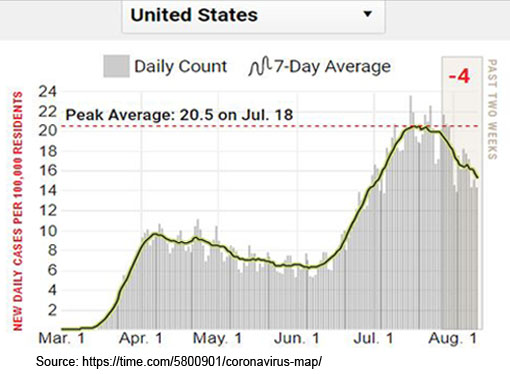
Starting in mid-March, there was a strong acceleration of cases in the United States, which tended to stabilize at a high level of infections of 10 cases per 100,000 inhabitants. In mid-June there was a further acceleration, reaching 20 infections per 100,000 inhabitants. They are currently at that high peak of infection, thus becoming the world's epicenter.
More confirmed cases of Covid-19 have occurred in the United States than in any other country. As of August 2, the United States had more than 4.6 million registered infections and 154,000 related deaths. The United States has almost the same number of infections as the sum of the other three global epicenters of infection, Brazil (2.7 million), India (1.7 million) and Russia (843,000).
The overall mortality rate has been 3.8% worldwide. National differences have been notable, with 3.4% in the United States, 3.5% in Brazil and 10.8% in Mexico.
1.b. Evolution of infection in Costa Rica
1.b. Evolution of infection in Costa Rica
On March 6, 2020, the first two cases of Covid-19 were confirmed in Costa Rica. Since that date, social distancing measures have been adopted and an average of 17 cases per day have been maintained, with the numbers gradually rising to a total of 1744 cases on June 15, with 29 cases on that day.
Since that date, social distancing measures have been adopted and an average of 17 cases per day have been maintained, with the numbers gradually rising to a total of 1744 cases on June 15, with 29 cases on that day.
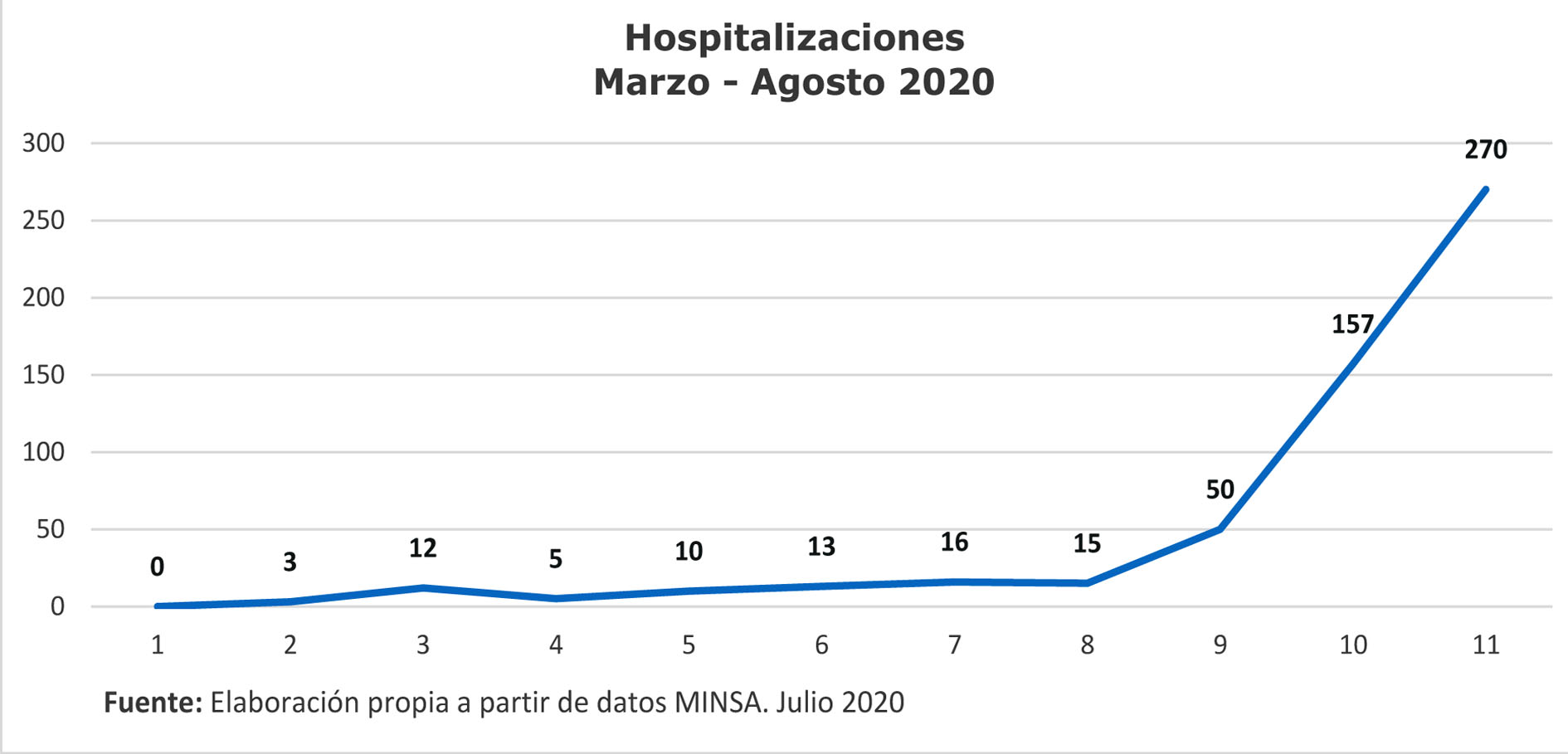
From that date onwards, the number of cases began to rise, with more cases being reported in July, reaching a peak of 931 cases per day on July 25. These data place the month of July with the highest concentration of infections, hospitalizations and deaths. 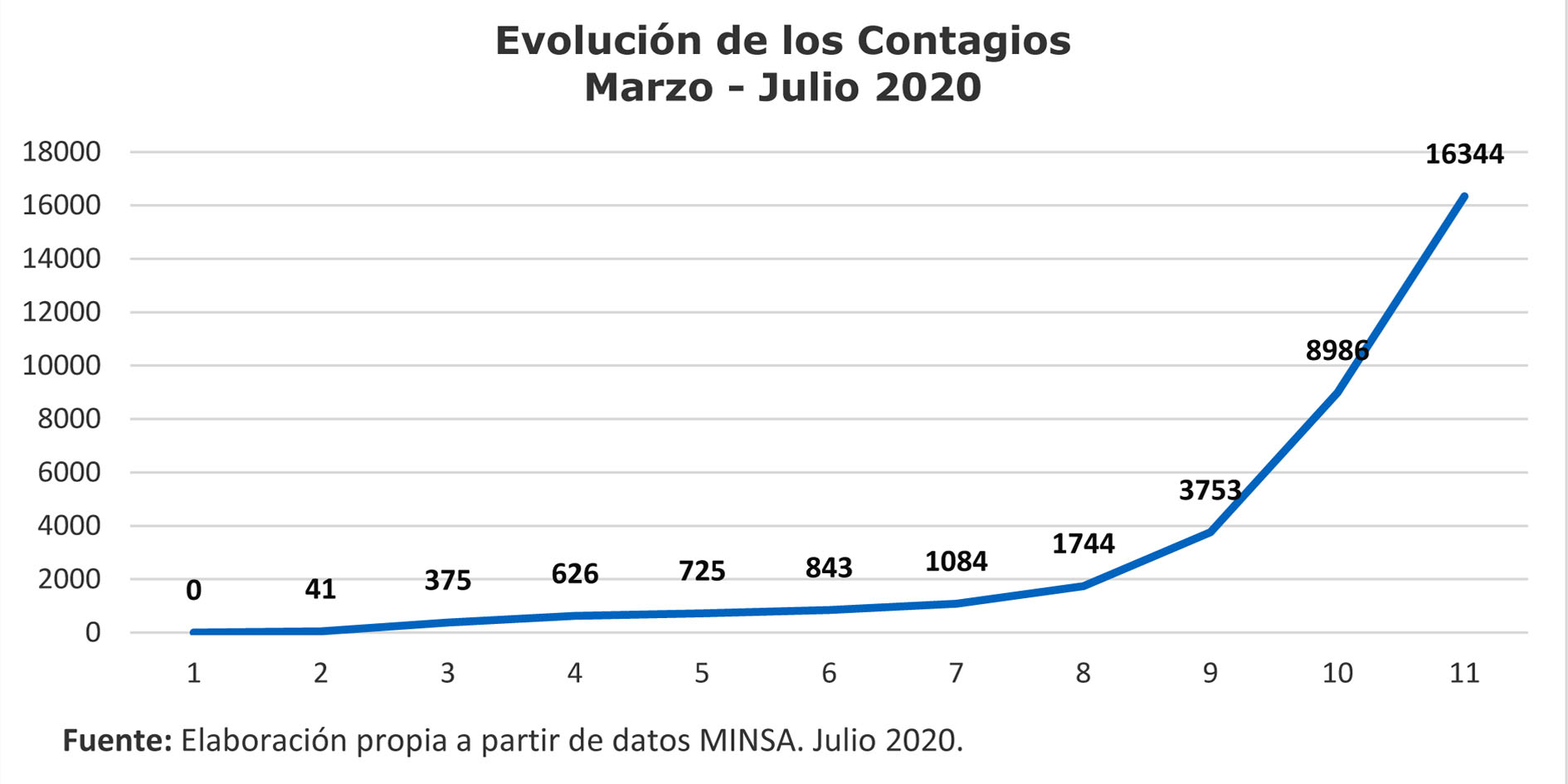 In July, there were 80% of all reported infections. Hospitalizations, which at the beginning of the month numbered only 50 patients, had reached 270 by July 31, that is, 5.4 times more than at the beginning of the month. The accelerated pace of infection growth creates enormous pressure on the limited Intensive Care Units (ICU) for high numbers of patients.
1.b. Evolution of infection in Costa Rica
In July, the number of ICU patients increased from only 6 at the beginning of the month to 75 at the end of the month. That represents 12.5 more ICU patients than at the start of the month. The increase in ICU patients is greater than the proportion of increased infections and hospitalisations.
Estado de Situación a comienzos de agosto 2020
Estado de Situación a comienzos de agosto 2020
1.b. Evolution of infection in Costa Rica
1.b. Evolution of infection in Costa Rica
1.b. Evolution of infection in Costa Rica
Status at the beginning of August 2020
In a single day, between July 31 and August 1, in just 24 hours, the hospital capacity of the ICU was compromised with the admission of 19 new patients, increasing from 75 patients to 94 in the ICU.
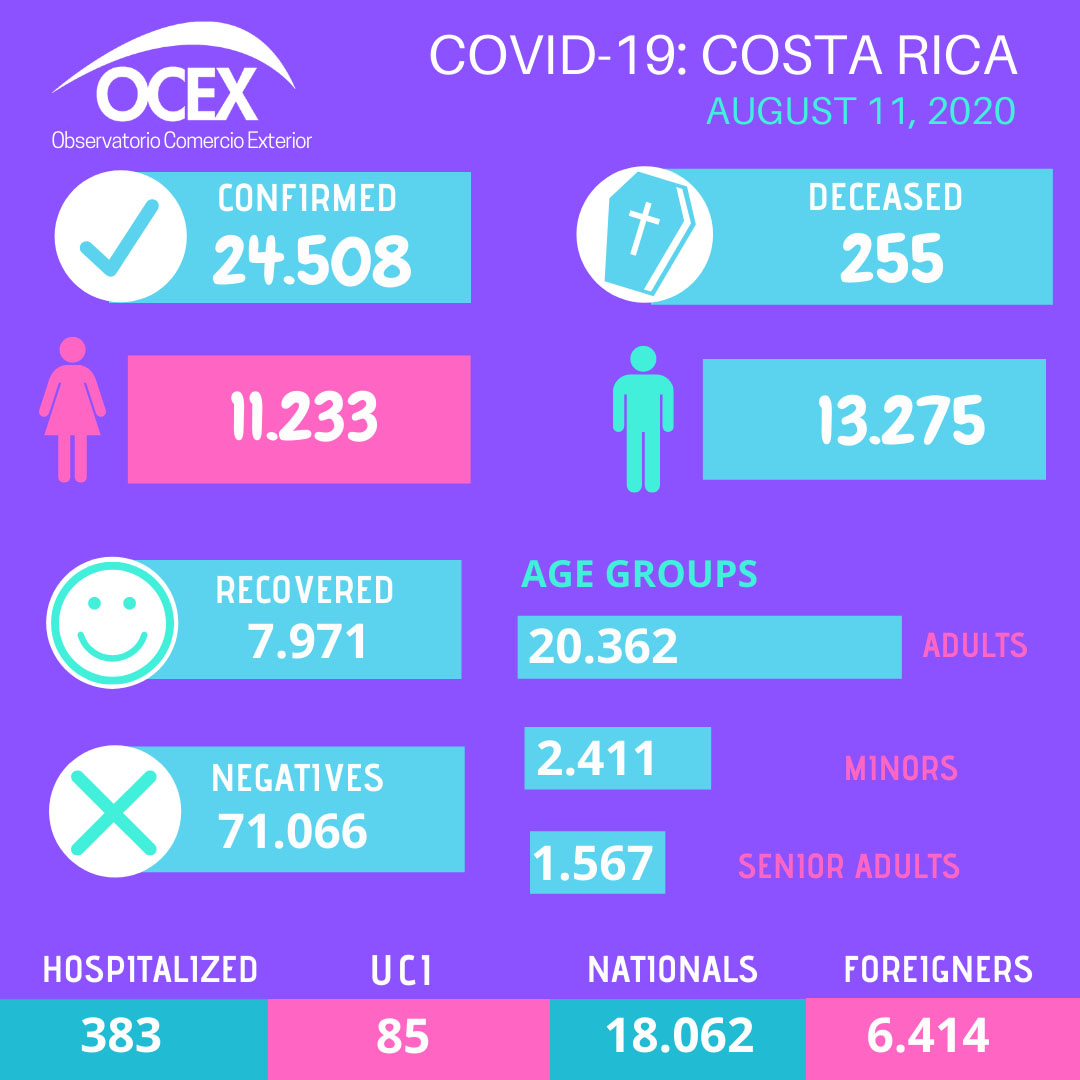
As of August 11, 2020, the national situation is 24508 confirmed cases, with 255 deaths, 383 hospitalized and 85 patients in Intensive Care Units (ICU), with a low mortality rate of 1.04%.
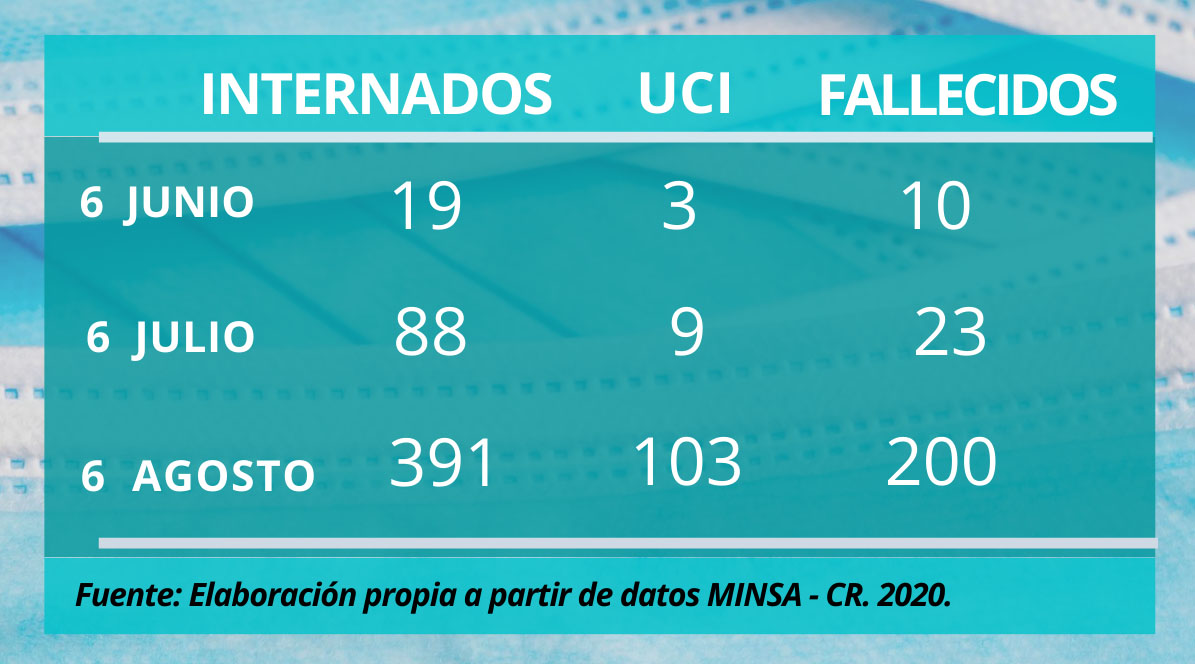
The Costa Rican Ministry of Health confirmed 653 new cases of Covid-19 on August 6. This is the highest number of new cases recorded since August 2, when 788 new cases were reported.
It is important to note how the virulence of the pandemic has accelerated. While it took 144 days to reach the first 100 deaths from Covid-19, in only 11 more days the second hundred were added.
The situation has been getting worse since July, especially in the high proportion of patients who were admitted to intensive care units (ICUs) or who died.
Between Aug. 2 and Friday, Aug. 7, the country reported 515 people diagnosed with Covid-19 on the presumption of contagion due to a nexus with infected persons.
 As of that date, Friday, Aug. 7, health authorities will present new cases per day, differentiating between patients diagnosed by test and cases diagnosed by nexus.
As of August 11, the new confirmed cases are 636, of which 584 were diagnosed by test and 52 correspond to cases confirmed by epidemiological nexus.
The Costa Rican Social Security Institute (CCSS) had 684 respirators before the pandemic. There was a threat of rapid depletion of installed respirator capacity, as had occurred in Italy. Faced with this threat, the CCSS ordered the purchase of 311 new respirators, 144 of which are already in the country. This increased the national capacity to 828 respirators.
This represents a 21% increase in installed capacity. It is expected that in August the remaining 167 new respirators ordered will arrive, to reach an increase of 45.4% of the installed capacity of the institution, at the beginning of the pandemic.
Second Wave. One of the most relevant aspects of the infections in Costa Rica, in its second wave is the source of contagion. While at the beginning the origin of the first infections could be clearly traced to an airborne source of entry of positive cases, the second wave points more to an epidemiological source by land entry at borders, especially in the north. This is why the proportion of foreigners in the total composition of infections is high: 28%, a much higher proportion than their participation in the population, which is only 9%.
The surprising speed of infection can be related to the link between the agricultural population, slum household dwellings and high migrant population, living in precarious conditions where it is highly difficult to maintain social distance and where no special measures were taken to contain the infection.
1.c. Symptomatology of Covid-19 by frequency in Costa Rica
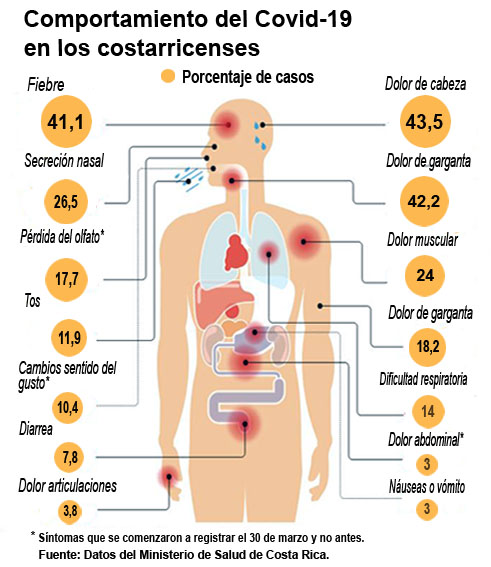
The symptoms of infection in Costa Rica are different from those in the rest of the world.
More than 40% of patients suffer from fever and headaches.
In contrast, in the world, the most common symptoms are fever, cough and tiredness. Here, only 12% present cough, only 18% report fatigue and 8% diarrhea or other gastrointestinal symptoms.
In Costa Rica, there is a lower degree of nasal secretion 26%, muscular pain 24% and respiratory difficulty 14%.
agosto 2020
1.b. Evolution of infection in Costa Rica
1.b. Evolution of infection in Costa Rica
1.b. Evolution of infection in Costa Rica
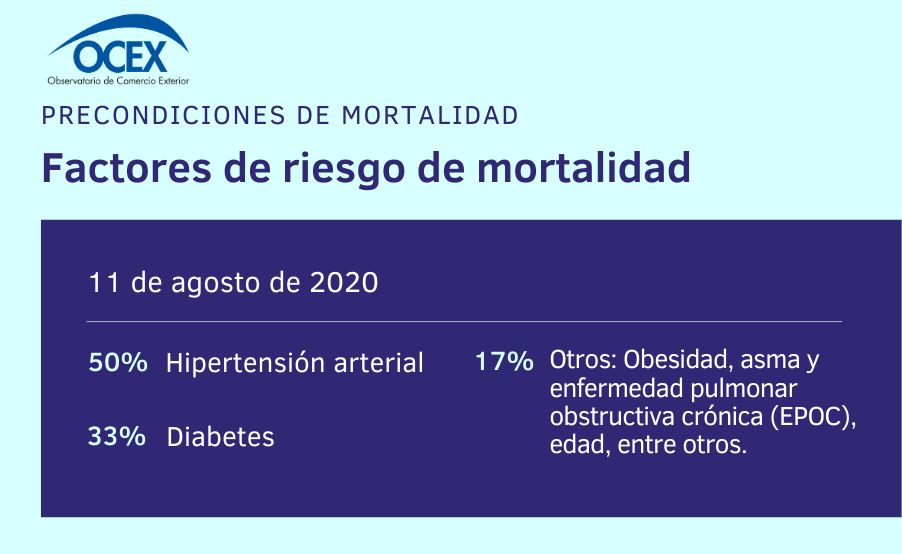
1.d. Main pre-conditions for mortality in Costa Rica
 En Costa Rica se sufre en menor grado de secreción nasal 26%, dolor muscular 24% y dificultad respiratoria 14%. En Costa Rica se sufre en menor grado de secreción nasal 26%, dolor muscular 24% y dificultad respiratoria 14%. En Costa Rica se sufre en menor grado de secreción nasal 26%, dolor muscular 24% y dificultad respiratoria 14%. muscular 24% y dificultad nformaciónión nasal 26%, dolor muscular 24% y dificultad respiratoria
Estado de Situación a comienzos
1.b. Evolution of infection in Costa Rica
More information:
- Details of deaths due to the discovery of the virus before of after the death, suffering associated with Covid-19, by date of death, gender, age and nationality: Download
- Details of cantons and hospitalizations: Download
- Georeferencing of infection data by UNED: Download
1. e. Public University brings a breath of hope
Costa Rica is getting closer to having its own treatment against Covid-19. The Clodomiro Picado Institute (ICP) of the University of Costa Rica (UCR) has a wide experience in the production of antiophidic serum from horse plasma. With that experience, the production of hyperimmunized equine serum against Covid-19 was carried out.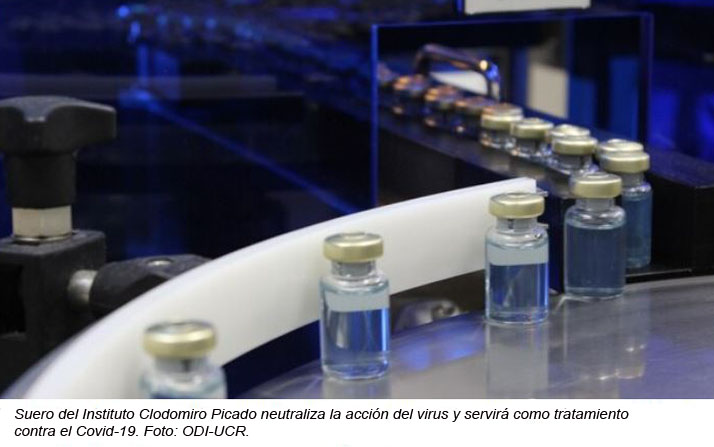 After a delicate process and in collaboration with George Mason University in Virginia, United States, it was possible to determine the safety and efficacy of the serum obtained, according to international quality control standards.
Alberto Alape, the ICP researcher who led the investigation, explained that the process carried out by them allowed the generation of antibodies capable of blocking the spread of the virus in the cells, through the disabling of the proteins that drive its reproduction in the organism.
According to Román Macaya, executive president of the Costa Rican Social Security Institute (CCSS), the quality control tests carried out in the George Mason University laboratories indicate that this serum is at least 100 times more effective than convalescent plasma, which is obtained from the plasma of recovered people.
The next step is to conduct clinical trials to determine its efficacy in humans. This step will be carried out by the CCSS, with the support of the ICP. If everything goes as planned, doctors will be able to reduce the worsening of hospitalised people, lower the pressure of intensive care treatment and better prevent deaths. As a whole, the hyperimmunized equine serum will help prevent hospital services from collapsing.
- Video. Process of immunization of horses - Update Clodomiro Picado.
(Download). - To meet the director of the Clodomiro Picado Institute, Alberto Alape Girón, we shared an interview made in June 2020 in the program SESENTA, of the UCR Channel. (Download).
1. f. Plan of containment measures for the month of August
The Government of the Republic detailed the containment schedule that will govern the entire month of August. The shops will be open to the public for 18 days, with the aim of providing the population with economic relief.
The zones on orange alert will divide their August schedule into two phases of reopening that will alternate. Due to the high risk of contagion, certain activities of massive concentration will remain suspended.
In the following link you can find the data related to the measures by phases and types of alert, according to the level of contagion: (Download).
2. Covid-19 in Costa Rica: socioeconomic impacts
2.a. Importance of tourism in Costa Rica and the impacts of Covid-19
Costa Rica was receiving 12 flights per hour, operated by 28 airlines connecting Costa Rica to the world, before the economic blackout. Since March 18 of the current year and to mitigate the contagion, the government decreed a total closure of the air and sea ports and its land borders.
In 2019, 77% of international visitors entered the country by air, so from an economic, fiscal and labor point of view, the most affected segment was tourism. The Costa Rican Tourism Institute (ICT) reported that 3 million tourists visited Costa Rica in 2019, an increase of 4.1% over 2018.
In order to have an idea of the dimension of such impact, one must appreciate the importance of the tourism activity.
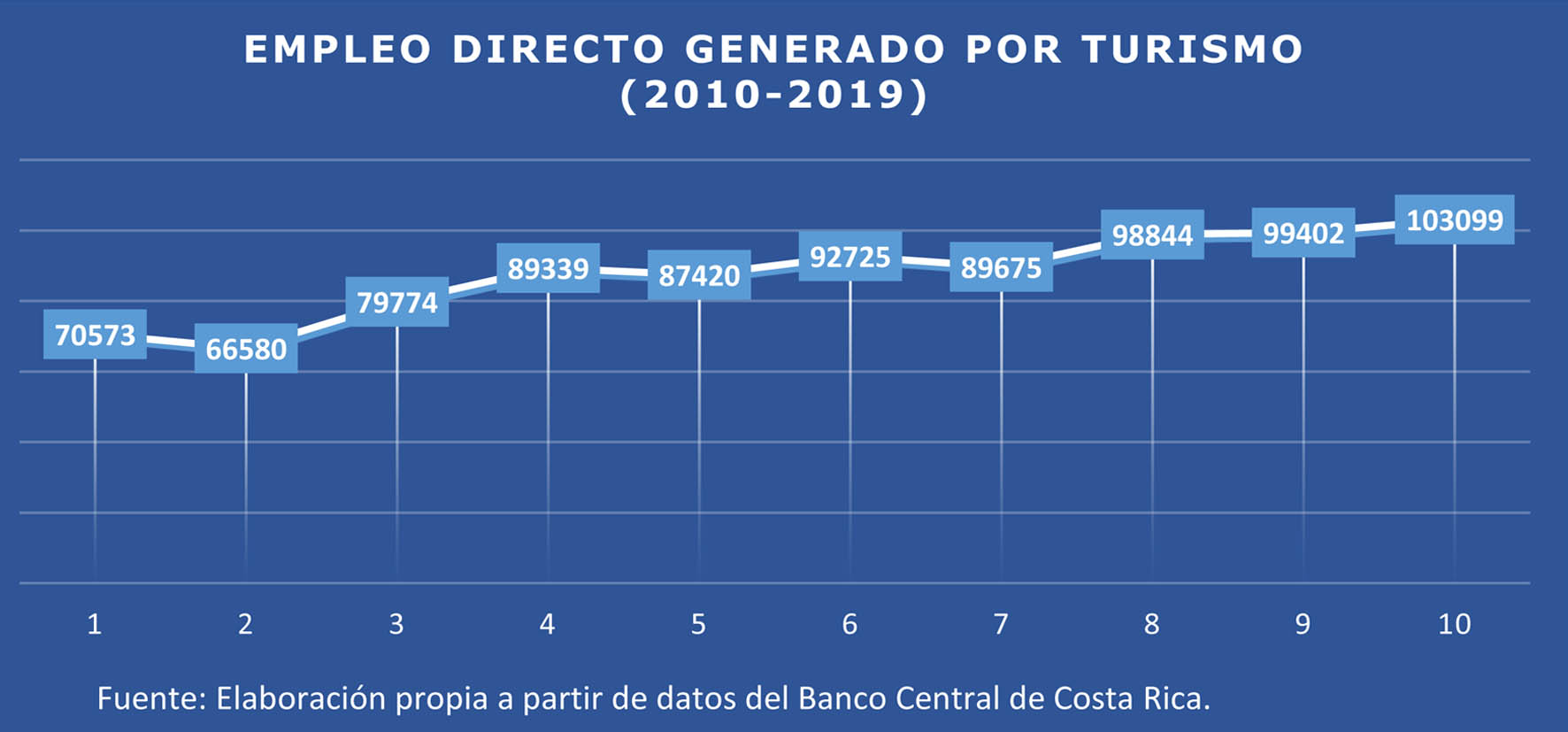 Tourism is made up of 136 productive branches, linked to other activities; 32 of these branches are related to agriculture; 49 to manufacturing and 55 to services.
Before the onslaught of the pandemic, the tourism sector represented 6.3% of the Gross Domestic Product (GDP), that is, ¢2.3 billion per year. In 2019, 512,609 jobs were created in tourism. 170,870 were direct employment and 341,739 indirect employment. That represents 21.4% of the country's labor force, which in 2019 was 2.46 million people, according to the Continuous Employment Survey of the National Institute of Statistics and Census (INEC).
In terms of value added, 86% of tourism production corresponds to services. Seven services account for 50% of aggregate demand for tourism: food and beverages, accommodation, transport, real estate, commerce, artistic activities, rental and leasing.
Importancia del turismo frente a zonas francas. It is convenient to compare the weight of tourism in Costa Rica with that corresponding to the other great economic area of impact, within our development model: the free trade zones.
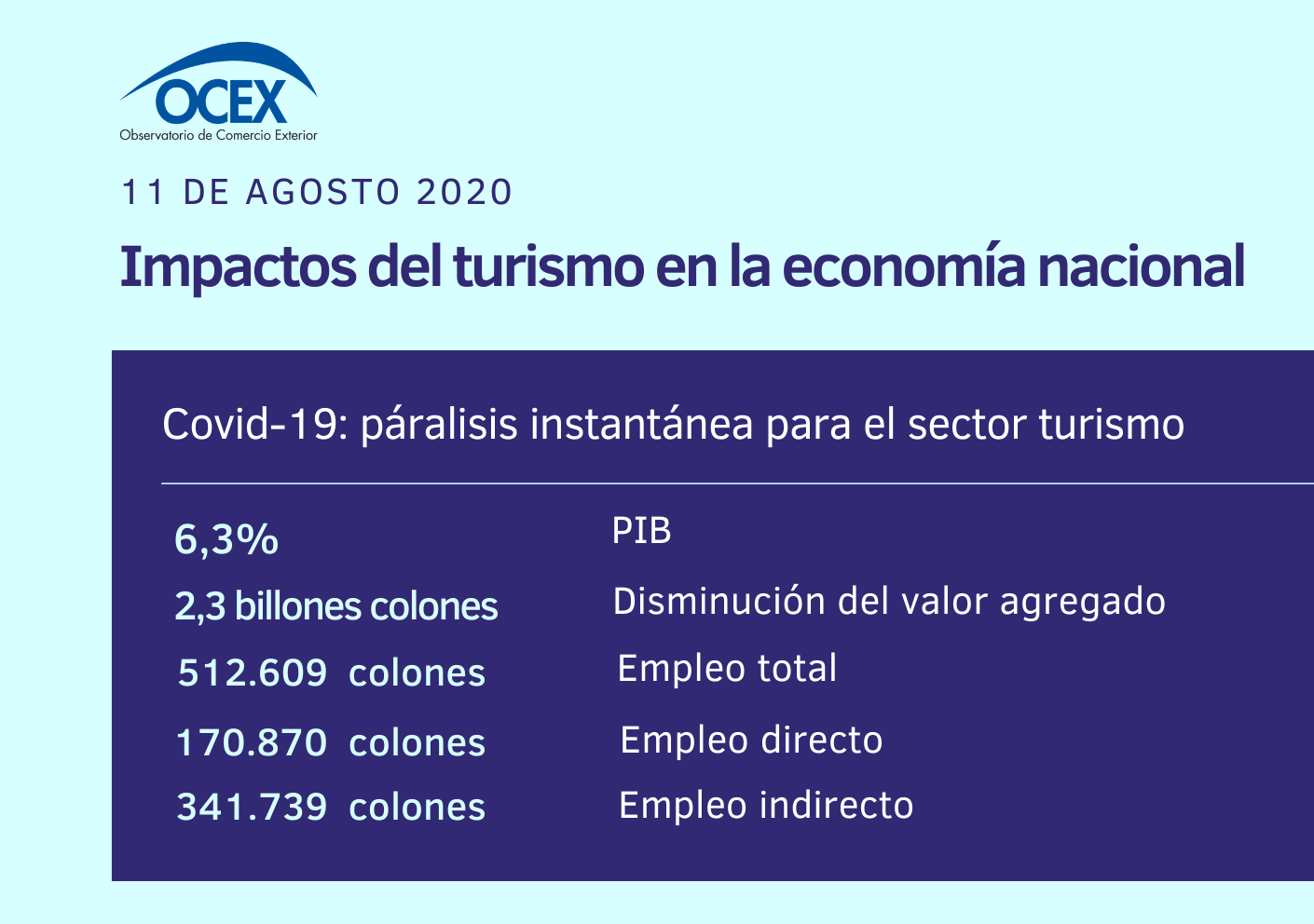 The free zone regime contributes with 7.9% of the GDP. Although the participation of tourism in the GDP is lower (6.3%), the dynamism that tourism gives to the economy is much greater than that of free zones.
The great place occupied by the free zones in the macroeconomic balance of the country is not reflected in the creation of jobs, with the impact that the tourism sector has due to the fact that its link with the rest of the national economy is much deeper. While only 47% of purchases made by free zone companies were to local companies, tourism is made up almost entirely of linkages with local companies, in 136 branches of production; 32 are related to agriculture, 49 to manufacturing, and 55 to services.
The blow that the pandemic has meant for the tourism sector represents the instantaneous paralysis of the most dynamic sector of the economy.
August: first measures to reactivate tourism. Costa Rica obtained the "Safe Travels" certification from the World Travel and Tourism Council (WTTC), which recognizes nations that have implemented safe health protocols for travel in response to the Covid-19.
The partial opening of international flight reception was announced in August. Tourists from Canada, the United Kingdom and the European Union will be received, although this origin has not yet fully lifted the alerts for flights to Costa Rica. The entry of travelers from the United States is still restricted. This is Costa Rica's main market, as it generates 65.9% of the national income from tourism. Europe accounts for only 18.1%.
Although only 10 airlines have so far submitted applications for the resumption of operations, only six of them have a route plan. The remaining 18 confirmed that they will do so later. An average of 5 flights per week will be received.
Air entry requirements for foreign tourists. The Ministry of Health indicated that the following requirements must be met:
- Present a PCR test of Covid-19 with a negative result obtained 48 hours in advance of the departure.
- Complete a digital epidemiological form that will be authorized by the Costa Rican Social Security Institute (CCSS).
- Have travel insurance with coverage for Covid-19. The policy must have international coverage, cover medical expenses equivalent to the costs of hospitalization, for the required time and minimum coverage of 14 days of lodging.
"In case the insurance with international coverage does not meet any of the requirements, the foreign person must acquire a travel insurance offered by one of the insurance companies authorized by the Superintendencia General de Seguros in Costa Rica and duly registered by said authority", states Article 4 of the Executive Decree.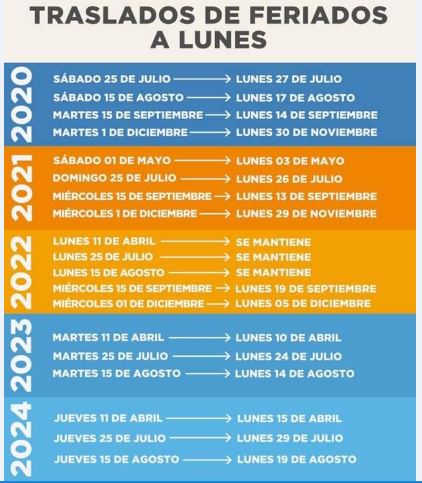
Reactivation of domestic tourism. Law No. 9875 was signed. This law establishes the transfer of weekday holidays to Mondays, in order to create "long weekends" and thus stimulate national tourism during the years 2020 to 2024.
Another measure that will favor the return of tourism activity is the extension of the time spent on beaches, for cantons with a yellow alert, which operated from 5:00 a.m. to 9:30 a.m., was extended, as of August 1, from 5:00 a.m. to 2:30 p.m.
Additionally, outdoor activities such as tours, canopy, hiking, cable cars, rafting, surfing and other similar activities were reopened. They should be developed without mixing social bubbles and with strict adherence to health measures.
2.b. Impacts of Covid-19 on Costa Rica's education
March 16 was the last day of face-to-face lessons in both public and private schools in the country. Since then, more than 147 days have passed without face-to-face lessons for the more than 1,200,000 young people of school age.
More than 80% of students attend the public system. For these, the absence of schooling caused by the pandemic is added to the 89 days that public schools were closed in 2018, due to the strike. This raises a whole generation of students who have had more than 220 days without face-to-face lessons.
The pandemic forced education authorities to make compensatory efforts in distance education. Therefore, the pre-existing inequalities in access to distance education acquire enormous relevance: between public and private education, between regions of greater or lesser relative economic development and, especially, between the differentiated access to the Internet according to the socio-economic standing of the families.
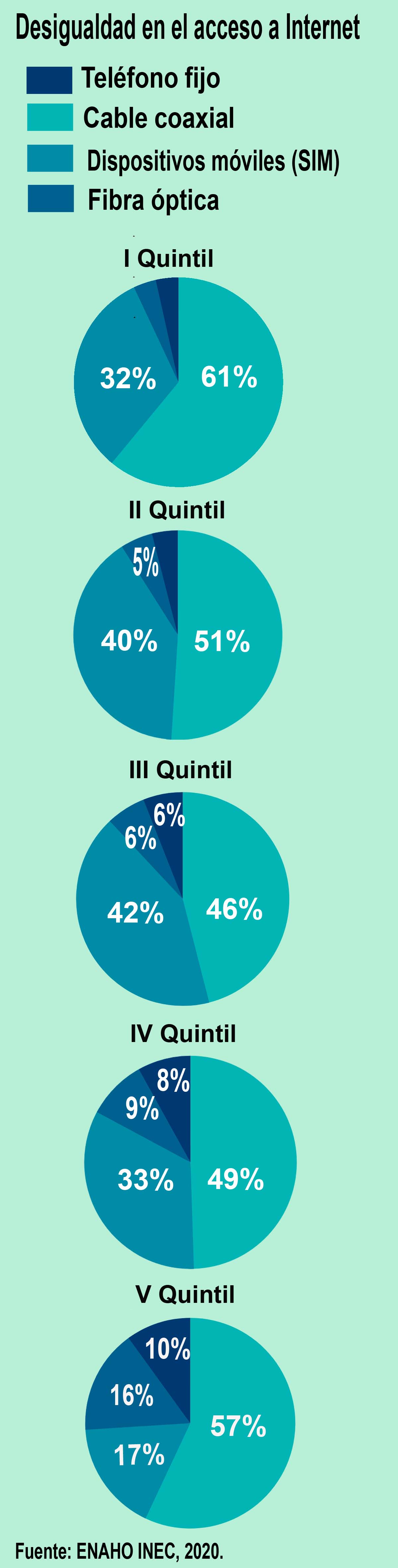
The poorer the family background of the students, the less access to the Internet through appropriate technologies (coaxial cable and optical fiber).
Even in the case of students who may have access to distance learning, it is clear that the educational center cannot be replicated at home and, additionally, there is no experience or teaching preparation to transmit and evaluate knowledge.
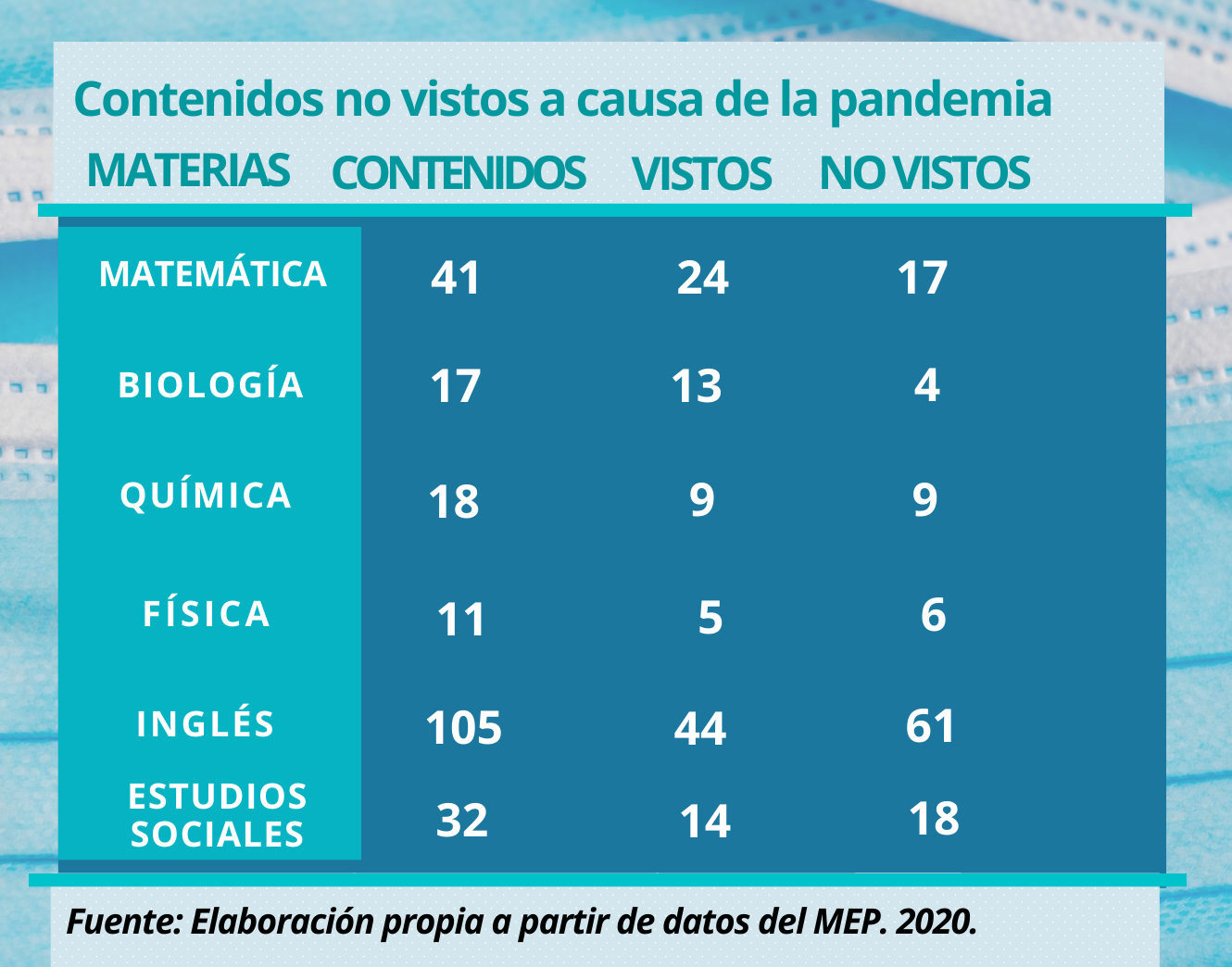
Even in an optimal situation, not all the content of each subject can be transmitted at a distance. Learning is going to have serious limitations depending on the subjects.
This marks a catastrophic impact on national education, with the danger of accentuating the great educational backwardness that the PISA tests pointed to, prior to this crisis, where Costa Rican students were already one year behind in mathematics in relation to the average of students in the countries of the Organization for Economic Cooperation and Development (OECD).
Senior students who were expected to graduate in 2020 will not have time to acquire the necessary knowledge and special plans will have to be made to adapt to the challenges of entering higher education.
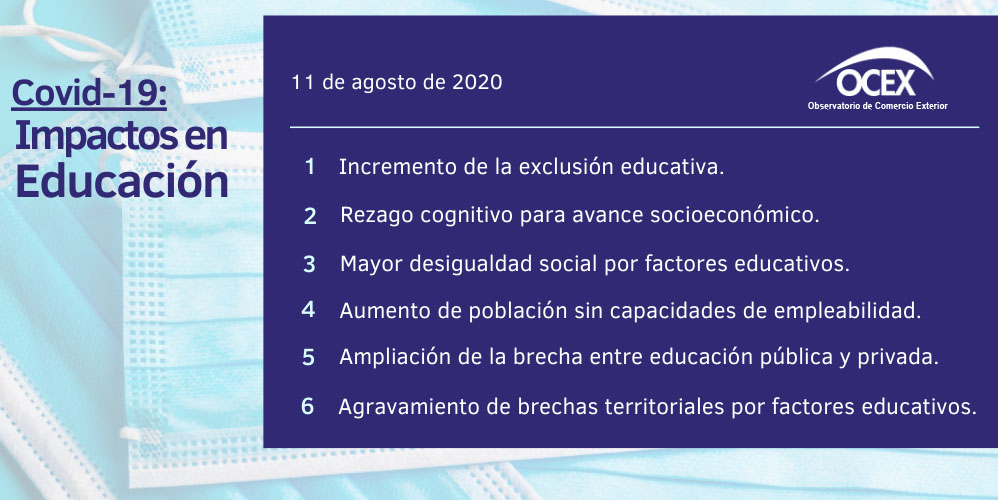
 Exclusion. One of the most serious impacts of the education crisis resulting from the pandemic is the very likely worsening of exclusion. Before the pandemic, the Seventh Report of the "Estado de la Educación" had identified 53,000 young people between the ages of 12 and 16 who were excluded from the educational system. This exclusion will increase, especially in low-income sectors and in areas of lower relative development.
The populations that have historically had the greatest educational challenges are those that will be affected even more now: students from poor families, children of migrants, indigenous populations, students with special educational needs and, of course, students from areas of relatively less development.
Over-aged students, so called because they are much older for the grade they are in, have a history of repeating grades, and this crisis will place them in greater difficulty to catch up.
Internet access in the homes. In order to assess the educational achievement that can be made at this time, it is decisive to take into consideration access to the Internet in the home. There is a huge inequality here: while 80% of students from families in the highest income quintile have very good connectivity, only 37% of the poorest quintile have some limited access. This results in 500,000 children between the ages of five and 18 who are not eligible for distance education.
Since March, the main way for these (students) to maintain contact with their teachers is through virtual means. However, a significant proportion of students have little or no connectivity given the digital divide that affects not only those living in households of lower socioeconomic status, but also in territories outside the Central Region.
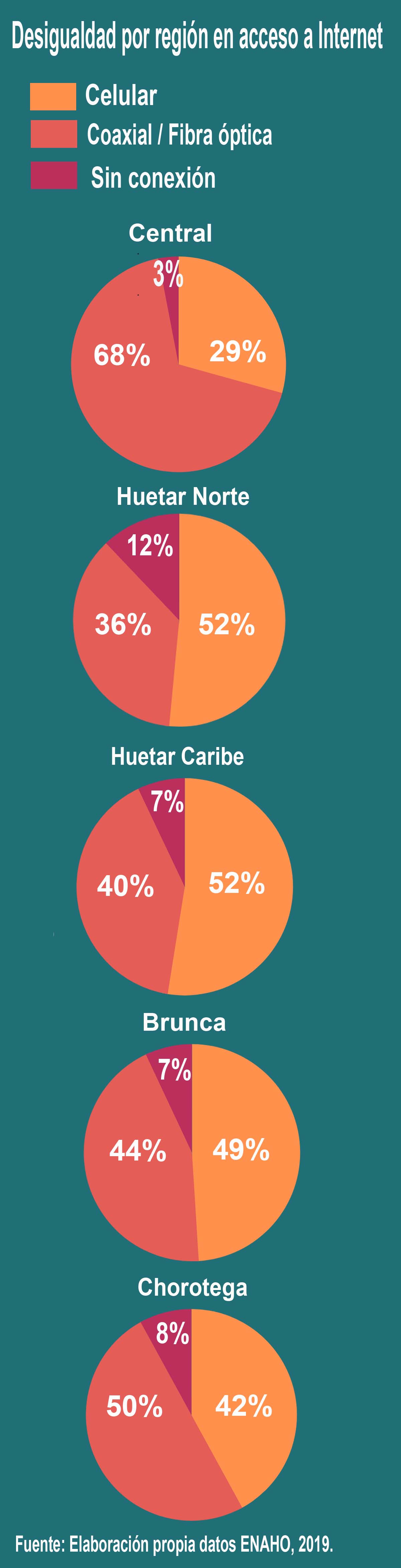
Internet access by region. The gaps in access to technological resources also reflect the country's historical territorial inequalities, associated with the low relative and socio-economic development that has characterized the peripheral regions. In the current context of the pandemic, they deepen the differences in access to education.
While 67% of students in the Central Region have a home Internet connection, 29% only have access via cell phone and 3% have no connection at all. But this situation is even more alarming if we contrast it with peripheral areas that are relatively less developed. There, the connection from home is only 40%; half of them only connected by cell phone and 10% of them have no Internet connection at all. Estado de Situación a comienzos d
Estado de Situación a co
Estado de Situación a comienzos d
1.b. Evolution of infection in Costa Rica
1.b. Evolution of infection in Costa Rica
1.b. Evolution of infection in Costa Rica
1.b. Evolution of infection in Costa Rica
1.b. Evolution of infection in Costa Rica
Connectivity bonus. To solve these gaps in access to distance education, the proposal of the specialists is to develop a connectivity voucher, similar to the "protect" voucher. The proposal is to generate a rapid connectivity package for all poor vulnerable households.
20 Estado de Situación a comienzos d
Estado de Situación a comienzos d
Estado de Situación a comienzos de agosto Estado de Situación a comienzos d
Estado de Situación a comienzos de agosto Estadonzos de agosto Estado de Situación a comienzos de agost
comienzos de agosto 2020
1.b. Evolution of infection in Costa Rica
2.c. Macroeconomic impacts of Covid-19 in Costa Rica
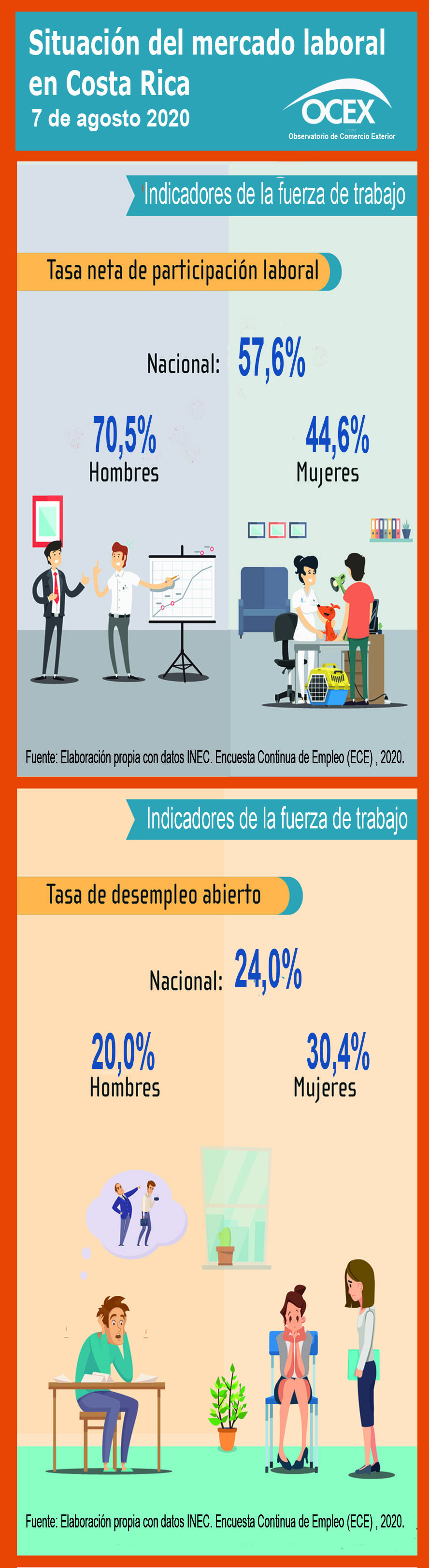
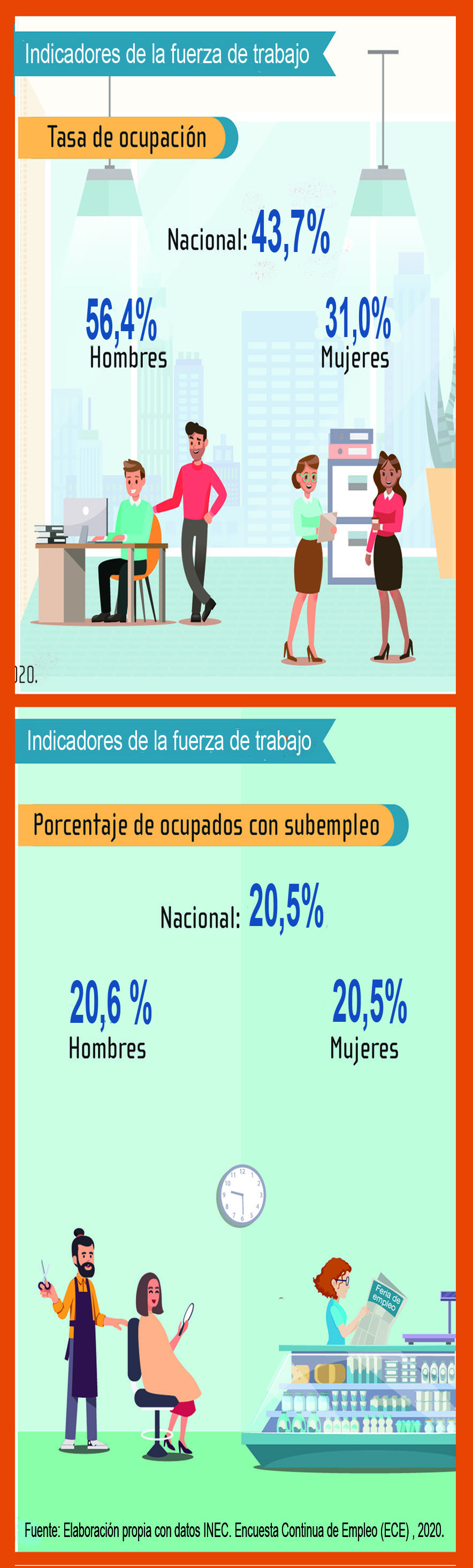
Impacts of the Pandemic on employment and occupation.
The economic impacts of the Covid-19 pandemic are devastating in Costa Rica.
The crisis generated by Covid-19 raised the unemployment rate in Costa Rica to a historic 24% in the second quarter of 2020, 12.1% more than the start of the pandemic, when it was at 11.9%.
In absolute terms, the unemployed population reached 551,000 people, 282,000 men and 269,000 women.
Compared to the situation before the pandemic, this represents an absolute increase in unemployment of 256,000 people, 136,000 men and 120,000 women.
As a result of the pandemic, the working population decreased by 438,000 people, 208,000 men and 230,000 women.
Estado de Situación a comienzos d
gost Estado de Situación a comienzos d
1.b. Evolution of infection in Costa Rica
1.b. Evolution of infection in Costa Rica
1.b. Evolution of infection in Costa Rica
1.b. Evolution of infection in Costa Rica
Aggravation of unemployment. The country adopted rapid and quite radical measures of social distancing, to preserve life and contain contagion at levels that did not overwhelm the installed capacities of hospitalization and Intensive Care Units (ICU). This abruptly disrupted economic activity, raising unemployment to 24%.
Table: Regression in unemployment and underemployment by Covid-19
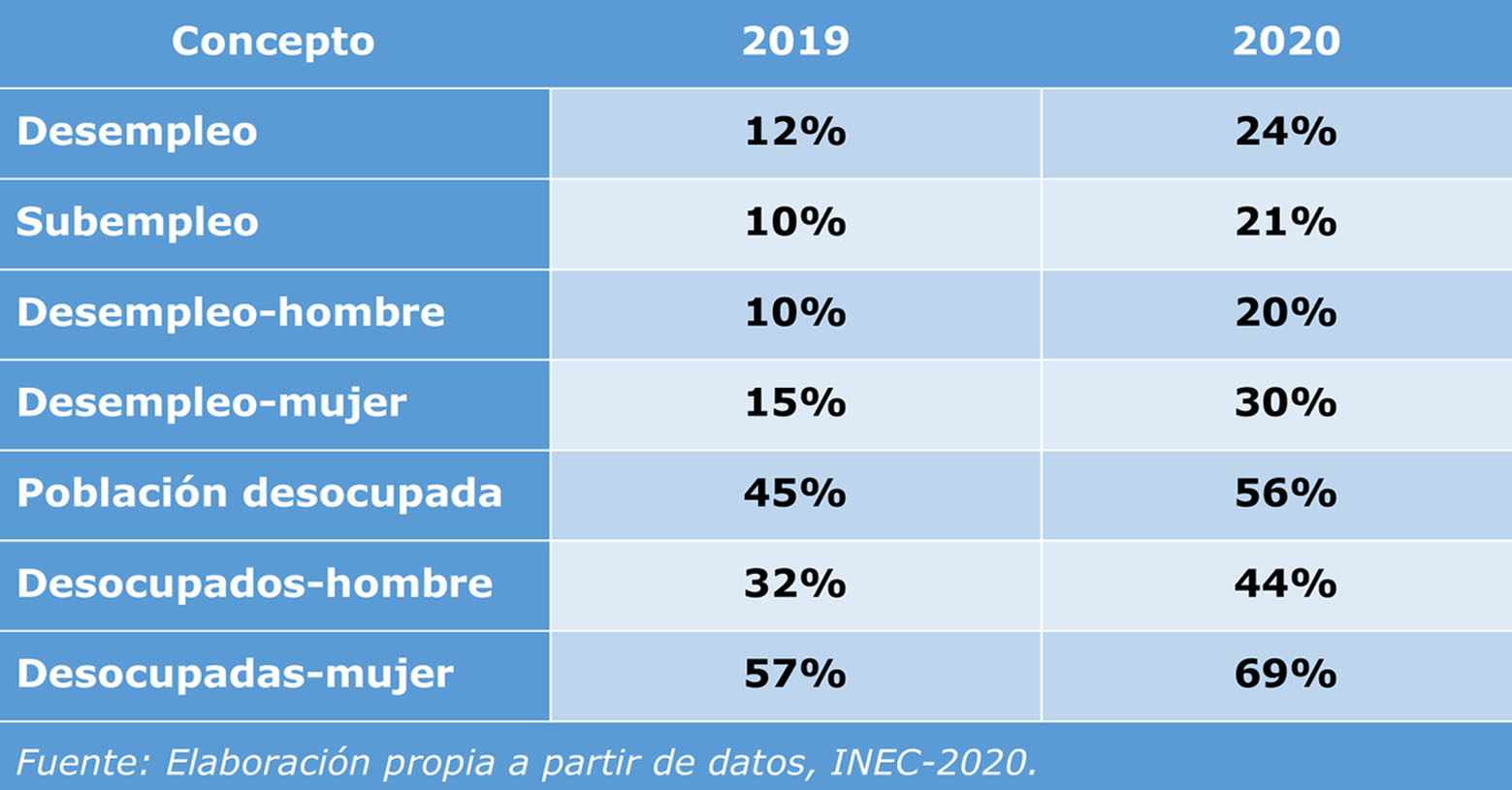
La actividad económica interrumpida y el desempleo incrementado supusieron una fuerte disminución de ingresos para las familias y para las empresas, lo que bajó su contribución tributaria con la consecuente disminución de los ingresos hacendarios.
La actividad económica
interrumpida y el desem Estado de Situación a comienzos d
olution of infection in Costa Ri
1.b. Evolution of infection in Costa Rica
1.b. Evolution of infection in Costa Rica1.b. Evolution of infection in Costa Rica1.b. Evolution of infection in Costa Rica
The interrupted economic activity and the increased unemployment meant a strong decrease in income for families and businesses, which lowered their tax contribution with the consequent decrease in tax revenues.
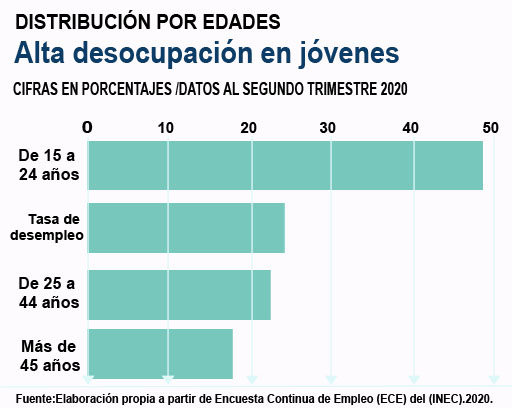
Decrease in employment by age. Young people are the segment of the population most affected by the unemployment resulting from the confrontation with the pandemic.1
.b. Evolution of infection in Costa Rica
Estado de Situación a comienzos dEstado de Situación a comienzos Estado de Situación a co
ómica interrumpida y el desempleo incrementado supusieron una fuerte disminución de ingresos para las familias y para las empres
Para una visión más pormenorizada ver: “Encuesta Continua de Empleo, II Trimestre 2020: Disminuye ocupación y aumentan desempleo y subempleo
1.b. Evolution of infection in Costa Rica
For a more detailed view see: "Continuous Employment Survey, Quarter II 2020: Employment Declines, Unemployment and Underemployment Increase (Aug. 6), at:
https://www.inec.cr/noticia/disminuye-ocupacion-y-aumentan-desempleo-y-subempleo
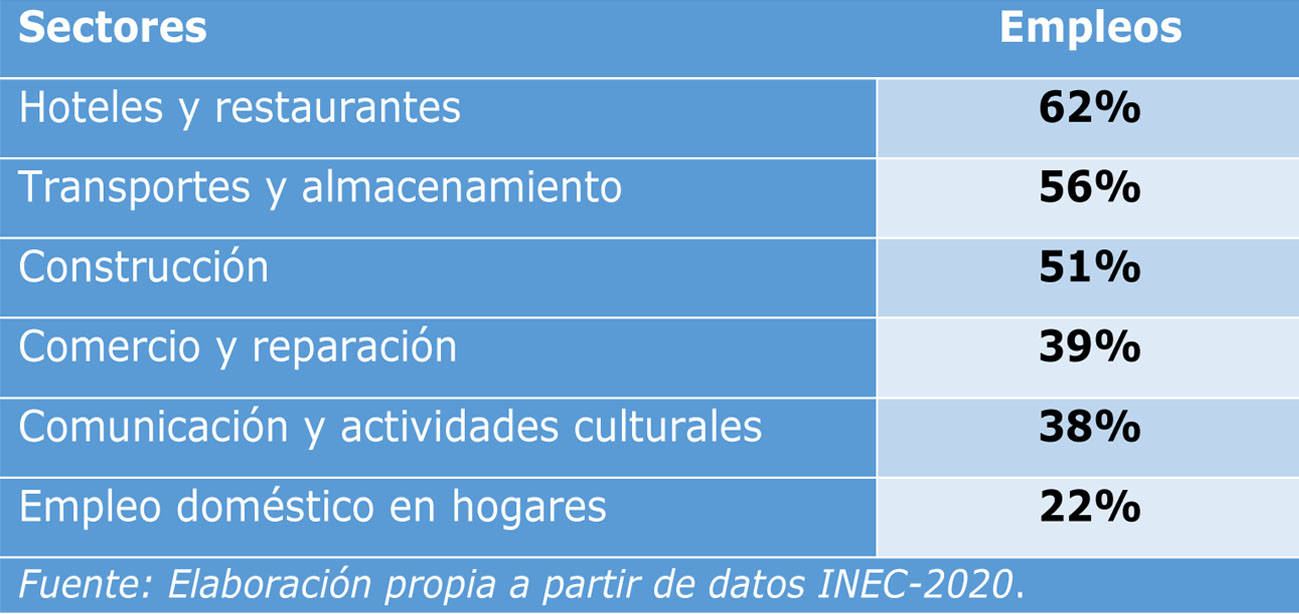
Table: Decrease in employment by sector
nzos d
nzos d
nzos d
Para una visión más pormenorizada ver: “Encuesta Continua de Empleo, II
In the face of the decrease in economic activity and the growth of unemployment, the expenditure on public works has increased:
- The decrease in economic activity produced the greatest contraction in the Gross Domestic Product.
- This resulted in a contraction of tax revenues.
- The government had taken strong compensatory measures which resulted in an unusual increase in spending on different social support programs, which reached about 1% of GDP, in just three months.
- As a direct consequence of lower revenues and higher growth in expenditures, the country had to go further entrenched in debt, with a growing public debt and fewer resources available to address it.
- The sum of all these factors has resulted in the largest fiscal deficit in the country's 40-year history.
Economic contraction. The Central Bank says the GDP will shrink by 5%, which is the largest contraction Costa Rica has had since 1982, when it fell by 7.3%, according to Rodrigo Cubero, president of the Central Bank.
Decrease in tax revenues. The paralysis of businesses and the sharp decline in income of families, SMEs and large companies led to lower taxes. The economic impact of the pandemic and the application of a three-month fiscal moratorium led to an 11.63% decrease in tax revenues, compared to the same period in 2019. This represents a drop in collection of ¢270,000 million colones, almost 1% of GDP. VAT revenue fell by 4.57% and revenue collection by 10.34%.
Increase in public debt. By 2018 Costa Rica was already in a fiscally deplorable situation with low employment and high debt. Costa Rica's debt represents more than five years of total tax revenues. That is, if the country used all tax revenues only to pay the debt, it would take 5 years and four months to cancel the debt.
 ación a comienzos d
Estado de Situación a comienzos de ión a comienzos dEstado de Situación a comienzos de ag
a comienzos dEst
Estado de Situación a comienzos de agosto 2020
1.b. Evolution of infection in Costa Rica
1.b. Evolution of infection in Costa Rica1.b. Evolution of infection in Costa Rica1.b. Evolution of infection in Costa Rica1.b. Evolution of infection in Costa Rica
At the end of 2019, debt service alone in interest payments took 35.8% of the national budget. With great opposition and social confrontations, a strong fiscal adjustment had to be made in order to face this critical level of debt.
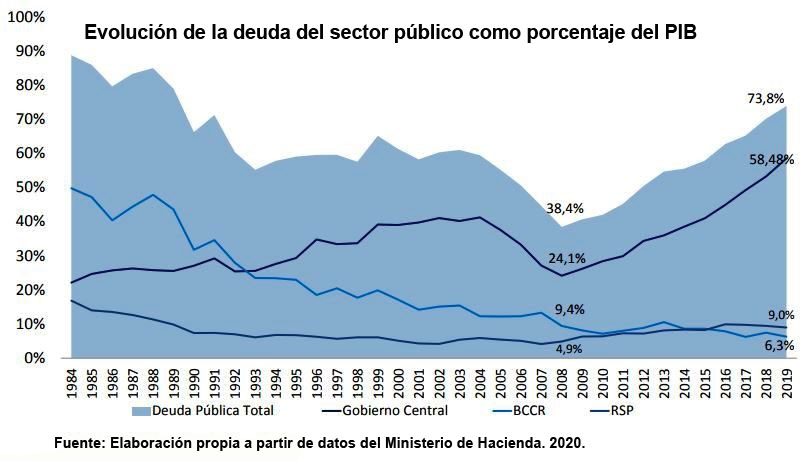
Even so, Costa Rica's central government debt reached 58.48% of GDP in 2019. That means that, despite the adjustments, there was growth of 5.31% compared to the previous year.
Central government: evolution of the debt-GDP ratio (1992-2031)
It should be noted that from 1984 to 2008 the public sector debt as a percentage of GDP, had a downward trend. That year, 2008, it reached its historical minimum of 38.42%. After 2008, both the Central Bank and the rest of the public sector (PSB) maintained the downward trend.
Only the central government had an inflection towards increased indebtedness, going from 24% in 2008 to 58.48% in 2019. Hence, the central government's indebtedness is the component that plays the largest role in the formation of public sector debt. This sector is the one that concentrates the largest expenditures and transfers of the State. Therefore, the change in the trend of public sector debt will only be generated if the trend of central government indebtedness is reversed. This implies very large structural adjustments, in order to reduce the total public debt, which already reaches 73.80% of the GDP, in 2019.
Decrease in household consumption and internal demand. The decline in household income has resulted in a 6% contraction in domestic demand and a 3% contraction in household consumption by 2020. As a result, despite existing monetary liquidity, credit is stagnant, a product of this fall in demand for consumer goods. In a situation of uncertainty, there is a lower propensity to borrow in both consumer goods and durable real estate. This projects a rickety economic growth. In these conditions, the impact of the pandemic on the country's macroeconomic environment is very unflattering and will require extraordinary measures to deal with it.
2.d: Government actions proposed in August
Bonus Protect. At the beginning of the pandemic, the Government of the Republic created the subsidy called "Bono Proteger", a monthly economic aid between ¢62.500 and ¢125.000 destined to people whose income decreased due to the Covid-19 pandemic.
The bond was granted in April and May; however, deposits were suspended in June, as there was no budgetary authorization. Last Tuesday, July 28, Congress approved an item for ¢89,915 million, as part of the extraordinary budget. The funds came from ¢75,000 million from the National Insurance Institute (INS) and ¢14,915 million from the freeze on the price of super and regular gasoline.
August began a legislative period in which the initiative of legislative proposals corresponds to the Executive Branch. On this occasion, the government is working on broader proposals to alleviate the impacts of the crisis. These proposals are condensed into a package of legislative projects that have been agreed upon jointly between various parties in the Legislative.
Agenda of 27 legislative projects. "In view of the serious situation that Costa Rica is facing because of the Covid-19, the faction leaders and the Executive Branch agree upon the following agenda for the extraordinary session to be submitted to the Legislative Assembly for discussion This is in order to reach the necessary decisions for the country to move forward" (Communiqué from the Executive and Legislative branches, August 2020).
These are some of the projects included in the agreed agenda:
|
Complete list of projects included in the agenda. : |
|
Readings consulted:
- Cr.hoy.com. 7 de agosto 2020. 515 personas fueron diagnosticadas con
Covid-19 por nexo: https://www.crhoy.com/nacionales/515-personas-fueron-diagnosticadas-con-covid-19-por-nexo/ - La Nación. 6 de agosto 2020. Gobierno permitirá ingreso de turistas
con pólizas internacionales que tengan la cobertura para Covid-19: https://www.nacion.com/economia/negocios/gobierno-permitira-ingreso-de-turistas-con-polizas/ - ECE. Encuesta Continua de Empleo, trimestre móvil MAM-2020. 5 de
agosto 2020: https://www.inec.cr/noticia/tasa-de-desempleo-se-situa-en-201 - Sitio web inec.cr. 2 de agosto 2020. Encuesta Continua de Empleo (ECE)
del Instituto Nacional de Estadística y Censos (INEC): https://www.inec.cr/encuestas/encuesta-continua-de-empleo - La Nación.30 de julio 2020. Así funcionará el seguro de viajes del INS para
turistas que vengan a Costa Rica en medio de pandemia: https://www.nacion.com/el-pais/servicios/asi-funcionara-el-seguro-de-viajes-del-ins-para/ - Cr.hoy.com. 29 de julio 2020. Europea deja a Costa Rica fuera de lista para
reanudar vuelos: https://www.crhoy.com/nacionales/union-europea-deja-a-costa-rica-fuera-de-lista-para-reanudar-vuelos/ - Sitio web del Ministerio de salud. 29 de julio 2020. Gobierno presenta
plan de medidas para todo el mes de agosto: https://www.ministeriodesalud.go.cr/index.php/centro-de-prensa/noticias/741-noticias-2020/1822-gobierno-presenta-plan-de-medidas-para-todo-el-mes-de-agosto - La republica.net. 30 de julio 2020. Costa Rica recibe certificación como
destino seguro del Consejo Mundial de Viajes y Turismo: https://www.larepublica.net/noticia/costa-rica-recibe-certificacion-como-destino-seguro-del-consejo-mundial-de-viajes-y-turismo - Ameliarueda.com. 30 de julio de 2020. Aprobado de forma definitiva presupuesto extraordinario con recursos para la CCSS y bonos Proteger: https://www.ameliarueda.com/nota/aprobado-definitivo-presupuesto-recursos-para-ccss-y-bonos-proteger
- La Nación. 29 de julio 2020. Carlos Alvarado y seis partidos acuerdan
impulsar 27 proyectos de ley en agosto: https://www.nacion.com/el-pais/politica/carlos-alvarado-y-seis-partidos-acuerdan agenda/ - Delfino.cr. 29 de julio 2020. Gobierno anuncia medidas para agosto:
zonas en alerta naranja se turnarán entre cierre y apertura: https://delfino.cr/2020/07/gobierno-anuncia-medidas-para-agosto-zonas-en-alerta-naranja-se-turnaran-entre-cierre-y-apertura - La Nación. 28 de julio 2020. Pruebas internacionales lo confirman: terapia contra
covid-19 del Instituto Clodomiro Picado sí inhibe acción del virus en el laboratorio: https://www.nacion.com/ciencia/salud/examenes-internacionales-lo-confirman-terapia/ - Ameliarueda.com. 29 de julio 2020.Tratamiento costarricense con plasma de
caballos sí inhibe el nuevo coronavirus, revela estudio: https://www.ameliarueda.com/nota/tratamiento-plasma-de-caballos-desarrollado-en-costa-rica-inhibe-covid1 - Comunicado Casa Presidencial. 29 de julio 2020. Consulte las alertas y
medidas para aplanar la curva de contagio de la COVID-19 en Costa Rica: https://sites.google.com/presidencia.go.cr/alertas - Sitio web del Ministerio de Salud: https://www.ministeriodesalud.go.cr/
- La Republica.net. 28 de julio 2020. Turismo internacional reiniciará en agosto:
todo lo que debe saber: https://www.larepublica.net/noticia/turismo-internacional-reiniciara-en-agosto-todo-lo-que-debe-saber - Time.com. Sitio web coronavirus Map. 11 de agosto 2020. See How COVID-19
Has Spread: https://time.com/5800901/coronavirus-map/ - El Financiero. 23 de julio de 2020. El dilema del turismo: Ingreso de extranjeros resucitaría una actividad que generaba 513.000 empleos en Costa Rica: https://www.elfinancierocr.com/economia-y-politica/el-dilema-del-turismo-ingreso-de-extranjeros/
- SINART Costa Rica Medios. 1 de agosto 2020. Pacientes en UCI por COVID-19
pasaron de 75 a 94 en solo 24 horas:https://costaricamedios.cr/2020/08/01/pacientes-en-uci-por-covid-19-pasaron-de-75-a-94-en-solo-24-horas - La Nación. 28 de julio 2020. Evolución del contagio: https://www.nacion.com/data/evolucion-de-cifras-de-pacientes-recuperados-de/
- La Nación. 2 de agosto de 2020. Caja preocupada por acelerado aumento de pacientes en UCI. https://lanacioncostarica.pressreader.com/la-nacion-costa-rica/20200802/textview
- Delfino.cr. 6 de agosto 2020. Costa Rica-registra-653-nuevos-casos-de-covid-19-los-fallecidos-alcanzan-los-200: https://delfino.cr/2020/08/costa-rica-registra-653-nuevos-casos-de-covid-19-los-fallecidos-alcanzan-los-200
- X Censo Nacional de Población y VI de Vivienda 2011. 2 de julio de 2020.
Población total nacida en el extranjero: https://www.inec.cr/poblacion/migracion - Informa-Tico. 24 de julio 2020. Brecha digital y desigualdades territoriales afectan
acceso de miles de estudiantes a la educación:https://www.informa-tico.com/24-07-2020/brecha-digital-desigualdades-territoriales-afectan-acceso-miles-estudiantes-educacion - La Nación. 24 de mayo de 2020. Ministerio de Salud identifica trío de síntomas del
virus en Costa Rica: https://www.nacion.com/ciencia/salud/ministerio-de-salud-identifica-trio-de-sintomas/YNM7ANWD25BQRBPVXUNSHGGQGY/story/ - Delfino.cr. 24 de julio 2020. Jornada amarga: https://delfino.cr/2020/07/costa-rica-suma-612-nuevos-casos-de-covid-19-y-11-fallecimientos-en-24-horas
- Hablandoclarocr.com.29 de julio 2020. Después de cuatro meses y medio se reabre la entrada a turistas desde Europa: https://www.hablandoclarocr.com/index.php/programas/1279-29-julio-despues-de-cuatro-meses-y-medio-se-reabre-la-entrada-a-turistas-desde-europa-con-gustavo-segura
Más artículos…
Página 21 de 53