


Boletines-Artículos
POR VELIA GOVAERE -
En algún momento pasará la pandemia. Muchos piensan que todo volverá, con esfuerzo, a su curso habitual. Nada es menos cierto.
La covid-19 apenas comienza en imparable curso. Una vacuna cambiaría eso, pero lo más probable es una lenta adaptación inmunológica de la humanidad. Las fake news dicen otra cosa, alimentadas por la necesidad de consuelo. ¡Cuidado! Si eso deseamos oír, eso oiremos.
La covid-19 aumentará el índice de incertidumbre en un 300%. Eso generará grande relocalizaciones de cadenas de suministro.
Es una medida de desglobalización.
Seamos realistas. No hay medicamento a la vista. Está fuera de nuestras manos detener el patógeno, pero podemos frenarlo. Las autoridades se concentran en acoplar los casos graves con la capacidad hospitalaria de enfrentarlos. Higiene y aislamiento social sólo detendrán la velocidad del contagio. Eso no es poco. Es decisivo.
La covid-19 se propaga fácilmente por personas contagiadas, asintomáticas o en incubación, que han propagado la infección a más de 170 países. Es tan alta la probabilidad de contagio que Richard Hatchett, CEO de la Coalición para la Innovación en Preparaciones para la Epidemia (CEPI, por sus siglas en inglés) calcula que entre el 60% y el 70% de la humanidad se infectará.
Aun con una tasa de mortalidad del 1%, la cifra posible de decesos es apocalíptica. En ninguna circunstancia debe haber más pacientes graves que disponibilidad de camas y de atención en cuidados intensivos. Si no, el riesgo de mortalidad masiva es enorme.
Efecto global. Uno de los pacientes que la covid-19 encontró con defensas inmunológicas bajas fue la globalización. La pandemia tiene impactos económicos globales. Lo primero fue un choque de oferta industrial, cuando el cierre de fábricas en China paralizó el 30% de la producción mundial de manufactura. Es el 12% de las exportaciones del planeta, no sólo de bienes finales más baratos, sino de insumos industriales que abastecen casi toda la manufactura mundial.
El paro del Dragón chino fue un choque de oferta para consumidores finales y escasez de suministros para empresas en todo el orbe.
Un poco de historia. Recordar cómo llegamos aquí es útil. El corazón de la globalización aceleró su latido desde que la caída del Muro de Berlín marcó el final de la Guerra Fría. La apertura de China a la inversión, atraída por mano de obra barata, los avances logísticos de transporte y la regulación del comercio bajo OMC estructuraron un andamiaje entretejido de cadenas de producción.
En países desarrollados, las grandes firmas dejaron abandonadas las tradicionales regiones industriales y movieron su inversión en búsqueda de menores costos.
Sin políticas públicas focalizadas en compensar la pérdida de acceso a oportunidades de regiones perdedoras, ese tinglado no era ni social ni políticamente sostenible. Pero esos tiempos de neoliberalismo desatado dejaron todo en manos del mercado y sus “derrames”. Entonces llegó la crisis del 2008 y, aunque nadie se percató, la era de la hiperglobalización había terminado.
Crisis tras crisis. Vino después la crisis del euro y la Unión Europea (UE), en vez de asumir asimetrías, sembró resentimientos y desconfianza. El sufragio castigó a las élites indiferentes. Pero siguieron sin entender. Ocurrió, después, el Brexit y luego Trump. Y siguen sin entender.
Así encontró la covid-19 al planeta, en crisis multiorgánica. Cuando más se necesita cooperación y entendimiento, más cunde el “sálvese quien pueda”. Trump en choque sistémico con China, Gran Bretaña en fase de aislamiento y la OMC sin sistema de solución de controversias. Todo alimenta la ley del más fuerte, al arbitrio del demagogo del instante.
Lo multilateral quedó en fachada. Nadie llama a una reunión de emergencia del G20, como en 2008. El Consejo Europeo se siente paralizado por la pandemia y el tratado de fronteras abiertas de Schengen quedó unilateralmente interrumpido.
Cari italiani, in UE tutti siamo italiani, dijo la presidenta de la Comisión Europea, la alemana Ursula von der Leyen. Dramático mensaje, pero del diente al labio. Cuando Roma recurrió al mecanismo de protección civil de la UE, pidiendo urgente equipo médico, ni un solo país de la UE le respondió. Fue más bien China el primero que acudió a su rescate.
El efecto dominó de la covid-19 no se deja tratar con ligereza como mero choque pasajero de oferta, recuperable si fuera sólo parálisis de producción china. Convertido en pandemia, obliga a los países a un aislamiento por tiempo impredecible. Las fronteras se cierran, los negocios se paralizan y, entonces, llega el choque del consumo. Transporte y turismo son sólo las primeras víctimas. Restaurantes y actividades de recreación les siguen. Los abastecedores dejan de recibir pedidos. Los ingresos de todos se precipitan. El endeudamiento crece, empresas quiebran, el desempleo se dispara.
Caída en picada. Las arcas públicas pueden salir al rescate, pero sólo hasta cierto punto. En algún momento el endeudamiento global asfixiará a todos. En esas condiciones nadie invierte. El valor de las empresas cae y los accionistas venden con una reacción de nerviosismo incontenible.
Es el efecto imponderable del miedo llegando al pánico. Ya Holanda suspendió pedidos de piña a Costa Rica. Esa decisión deprimirá el empleo rural, desatará crisis de empresas agrícolas y afectará al PIB y al fisco. Es apenas un ejemplo nacional del descarrilamiento del tren global.
Dalia Marin, experta en globalización de la Universidad de Múnich, demostró un vínculo entre incertidumbre económica y desglobalización. Las disrupciones recientes, crisis financiera, brexit y guerras comerciales dispararon la inseguridad global. Marin estima que el covid-19 aumentará el índice de incertidumbre en un 300%. Eso provocará grandes relocalizaciones de cadenas de suministro. Es una medida de desglobalización.
En algún momento pasará la pandemia. Muchos piensan que todo volverá, con esfuerzo, a su curso habitual. Nada es menos cierto. Vivimos un momento de inflexión histórica. Ya no es cosa de si la curva de recuperación es uve o u. Va más allá. Es hora de revisar paradigmas, pero con mucha prudencia. Estamos en democracia. Los descontentos alimentan populismos en las urnas. No queremos que a la pandemia se sume una explosión social y política. El covid-19 puso sobre la mesa una nueva vulnerabilidad de la globalización.
La autora es coordinadora del OCEX y catedrática de la UNED.
Artículo publicado en Periódico La Nación, 21 de Marzo 2020
https://www.nacion.com/opinion/columnistas/pagina-quince-una-nueva-vulnerabilidad-de-la/RQ5BF7GU55GO3FWOSBTEGSRILI/story/
POR VELIA GOVAERE -
El trasfondo universal de lo que se juega en las primarias demócratas y la transcendencia del supermartes.
Si sobrepasa nuestras expectativas el avance de ciencia y tecnología, al unísono nos embiste, también, el contraste de realidades políticas estancadas. El futuro tecnológico es ya elemento disruptivo de la cotidianidad. Pero ideas rancias y políticas trasnochadas igualmente asaltan insolentes nuestra vida diaria.
Lo pasmoso no es que pasado y futuro cohabiten en tiempo y espacio. Eso siempre ocurre. Lo peligroso es que ambos extremos sean, simultáneamente, dominantes y no poder anticipar si esas discrepancias se resolverán para bien. Discordancias semejantes acarrearon hecatombe, en un pasado no tan lejano.
De la misma forma, en el plano moral, la cultura humana ha tenido progresos inauditos. Florecen derechos de la mujer y la niñez, la tolerancia ideológica hace bandera, crece el respeto a la diversidad y un ajuste histórico de cuentas con la discriminación toma por asalto, cada día, castillos de fanatismo fariseo y santurrón.
Polos opuestos. Esas universalidades de progresos del espíritu humano, en ciencia, tecnología y cultura ética, se contraponen con aguas amenazantes en el gran escenario político internacional, donde prejuicios e ideologías del pasado parecieran salir de la tumba. Ese es el problema. Avanzada tecnología y principios morales de punta coexisten con contracorrientes de políticas empozadas, contrarias al progreso social. Nada puede asegurar que las sombras de ayer no terminen dominando la luz de mañana.
Ningún ejemplo es más aleccionador y premonitorio que la salud planetaria. La creciente consciencia moral de la responsabilidad humana en los daños ambientales está en pugna con el sistémico fiasco político en aminorar siquiera el cambio climático y detener la desaparición de especies.
A vistas públicas se deshiela el Ártico. Osos polares aparecen en ciudades nórdicas. El 90% de la población de aves desaparece en países desarrollados. Las primaveras son cada vez más silenciosas y nuestros jardines ven menos colibrís. Pareciera que la noche domina al día y el pasado ensombrece el camino hacia el futuro. El calentamiento global avanza como implacable denuncia de nuestro fracaso moral. No es el único.
Angustia por el sufrimiento mundial. El ánimo no puede dejar de resentirse frente a esos embates trágicos que se ciernen en horizontes cercanos. Con síntesis constructivista, el idioma alemán ofrece una palabra de lacerante exactitud que refleja la angustia por los sufrimientos del mundo. Weltschmerz es el concepto que da cuentas del dolor e impotencia (Schmerz) frente a la problemática planetaria (Welt). Esa noción teutona nació en el siglo XIX de la pluma romántica de Jean Paul Richter. Rubén Darío la retomó, “el soñador, imperial meditabundo, sufre con las angustias del corazón del mundo”.
Aquel concepto reflejaba las contradicciones de su época. Con revolución industrial en pleno vuelo, la ciencia se imponía, la Ilustración derrotaba a la superstición y nacían los derechos de la mujer y la niñez.
Pero el triunfo de la máquina y las nuevas conquistas morales, convivían, en lo político, con retornos al autoritarismo. En Europa, la antidemocrática Santa Alianza buscaba recuperar colonias; en Francia, se volvía a coronar un Borbón y, a este lado del Atlántico, nacía la doctrina Monroe de “América para los (norte) americanos”.
Shelley se rebelaba contra los avances tecnológicos sin alma. Sus palabras son casi nuestras: “Hoy poseemos más sabiduría moral, política e histórica de la que somos capaces de poner en práctica; tenemos más conocimientos científicos y económicos de los que pueden ser aplicados a la justa distribución de la riqueza que estos mismos conocimientos multiplican.” (En defensa de la poesía, 1821). Su esposa, Mary, escribió la imagen más grotesca de la quimera moderna: Frankenstein.
Pasado atroz y futuro prometedor. Se replican hoy semejantes condiciones de convivencia política de pasado atroz con futuro prometedor. De ahí nuestra angustia por el mundo. Ya nadie pone en duda que las dos guerras mundiales se incubaron en desacoples de la política internacional del siglo XIX con los progresos de la ciencia y la consciencia moral.
Así llegó el siglo XX, imperialista, colonialista, antidemocrático y preñado de nacionalismos, en contraste con los mayores avances humanistas y científicos.
Ni Hegel ni Kant frenaron el espanto nazi. Ni Goethe ni Heine detuvieron el Holocausto. ¿Qué podrá poner un alto a los populismos, nacionalismos y fanatismos de hoy? La historia nos impone un deber admonitorio. No podemos dar por sentada una victoria de la razón moral.
Los grandes bastiones del orden internacional instaurado después de la II Guerra Mundial, integrados en las Naciones Unidas, buscaron superar desacoples entre política, ciencia y ética. Su síntesis programática es la Declaración Universal de los Derechos Humanos y sus bases económicas partieron de Bretton Woods. La caída del muro de Berlín pareció superar el último escollo del humanismo democrático liberal. ¿De dónde, entonces, nos asalta ahora el pesimismo?
Los Estados Unidos fueron cruciales para la salud del orden internacional. Pero de un tiempo acá, reniegan del multilateralismo, perjuran de sus compromisos ambientales, dan rienda suelta a intereses nacionales, repudian el valor de sus alianzas y parecieran inaugurar, de nuevo, las políticas del siglo XIX. ¿Regreso al pasado o coyuntura apenas de un resfrío moral pasajero?
Esa es la incógnita y el mundo parece un espectador impotente. No podemos inferir de este penoso contexto una inflexión inevitable hacia el desastre. Tampoco, ignorar sus enjeux.
Mucha de la respuesta se juega en las primarias demócratas de los Estados Unidos. Ese partido retoma visiones éticas y políticas consecuentes con nuestros tiempos. Pero cada consigna radical, lejos de unir, divide. La moderación unifica, pero no termina de perfilarse en un liderazgo consecuente, capaz de enmendar entuertos y encauzar las aguas, para terminar esta incongruente navegación hacia el pasado y volver al futuro, con fuerza y esperanza.
La autora es coordinadora del OCEX y catedrática de la UNED.
Artículo publicado en Periódico La Nación, 27 de Febrero 2020
https://www.nacion.com/opinion/columnistas/pagina-quince-volver-al-futuro/6APLAKYXQZHBNEAQM5GRGDRBZQ/story/
MBA. Hellen Ruiz Hidalgo
Strategic Communicator
OCEX-UNED
Level of contagion, health containment measures, state socio-economic support, and financing of the public sector
1. Level of infection
On March 6, 2020, the first two cases of covid-19 were confirmed in Costa Rica. The case was a US tourist, whose partner had contact with a confirmed case in the United States. On 20 March, the woman, as well as her husband, were discharged and allowed to return to their country of origin.
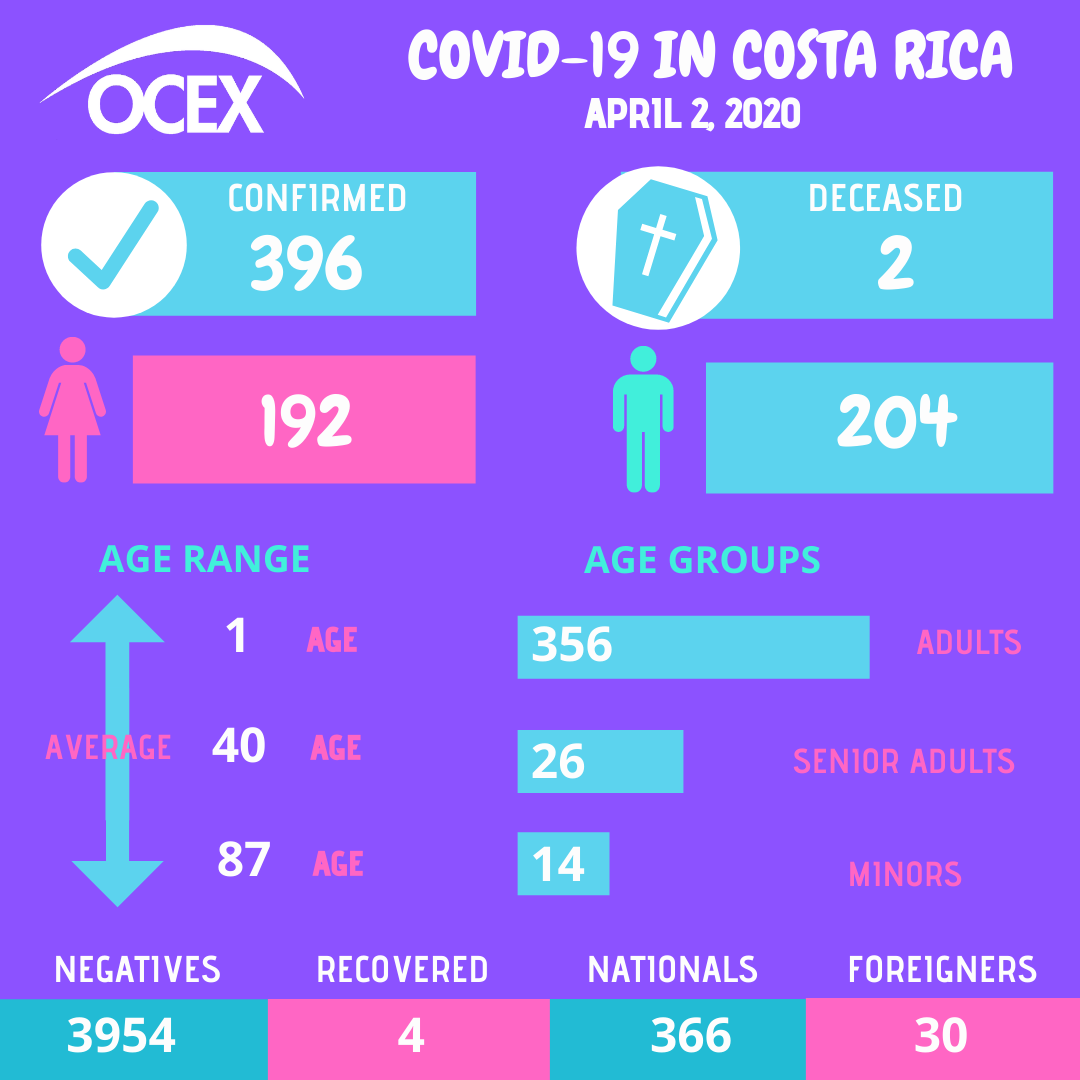
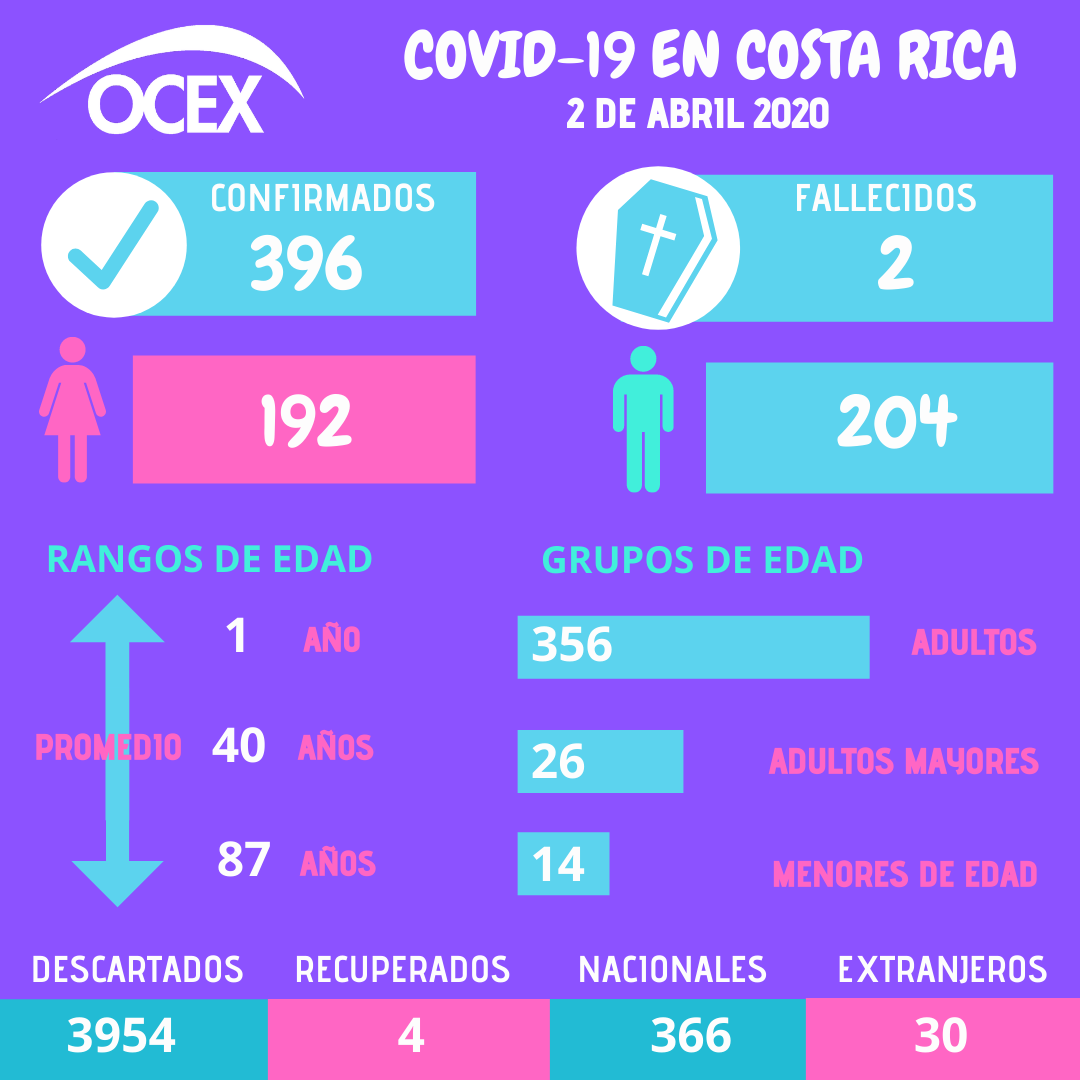
As of April 2nd, 396 cases of the virus had been reported. The statistics include two fatalities, both 87-year-old male patients. The first death occurred on Wednesday, March 18. It was a retired doctor, a resident of Alajuela, who also suffered from hypertension. On the night of Thursday 19 March, the Ministry of Health confirmed the second death. In figures this is our state of affairs as of April 2nd, 2020. See infogram below:
Mortality likelihood by age
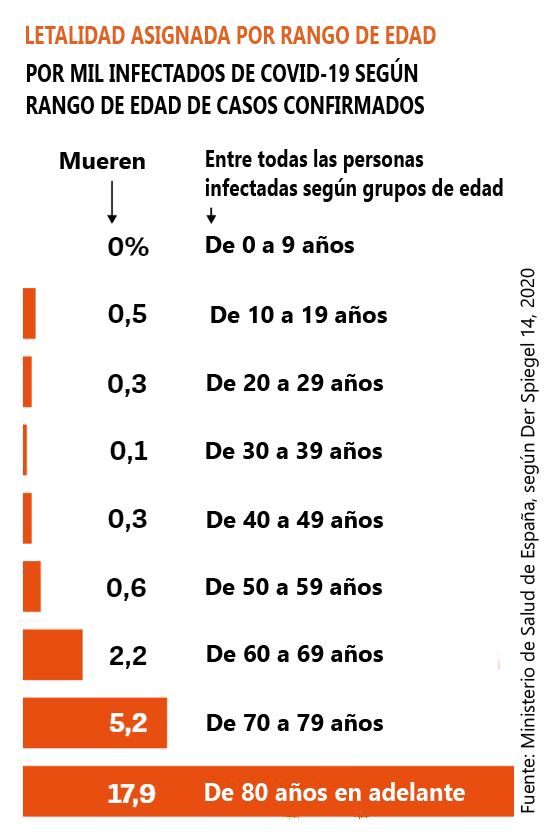
According to official data from the Spanish Ministry of Health, as of March 22, 2020, on the basis of 18959 confirmed cases of infected persons (805 of whom died), the prestigious German magazine Der Spiegel published, on Friday March 27, the following table of mortality by age of the covid-19.
2. Measures in Costa Rica for health containment, state socioeconomic support and financing of the treasury
On 7 March 2020, the Government of Costa Rica took measures to contain the speed of the pandemic's spread. These measures have increasingly focused on social contact restrictions aimed at reducing the rate of growth of infections, especially by reducing the number of serious cases, patients in need of hospital support or intensive care, so as not to compromise the capacity of the health system.
These measures had significant negative consequences on the economy, with a detrimental social impact on both the affected populations and vulnerable social sectors. For that reason, the Government has also proposed and decided on a plan for the socio-economic mitigation of the negative impacts on different economic activities and on the population in general.These measures had significant negative consequences on the economy, with a detrimental social impact on both the affected populations and vulnerable social sectors. For that reason, the Government has also proposed and decided on a plan for the socio-economic mitigation of the negative impacts on different economic activities and on the population in general.
These measures seek to protect employment and free up money for companies and individuals so that they can have "cash flow" in the coming weeks, which will be overwhelmed by the uncertainty caused by the Covid-19.
In this regard, we recommend watching the interview with Ms. Pilar Garrido, Minister of National Planning and Economic Policy, in the program "Enfoques crhoy", on Monday, March 30, 2020. The link below is: (Entrevista a Ministra Pilar Garrido.)
A). Actions to contain the spread of Covid-19
On Monday, March 30, 2020, the Government of the Republic, in view of the rapid expansion of covid-19 and to minimize the impact on the most vulnerable sectors, decreed 56 measures that derive from the Social Protection Roundtable coordinated by the Joint Institute of Social Assistance (IMAS), but which involves institutions such as MCJ, DGME, Vice-Ministry of Dialogue, MIVAH, DESAF, MEP, PANI, REDCUDI, INAMU, MTSS, CCSS, INA, CONAPAM, CONAPDIS, IAFA, JPS, Ministry of Health, Ministry of Human Development and Social Inclusion and the Municipality of San José.
These measures include the social protection of different populations of high-risk groups such as minors, women in vulnerable conditions, people with disabilities, older adults, indigenous people, homeless people and families in poverty. The following link provides details of these measures: (respuestas-en-materia-de-proteccion-social/)
The President of the Republic, Carlos Alvarado, and the Minister of Health, Daniel Salas, presented on Monday, March 30th to the Legislative Assembly the bill to increase the fines against people who violate the health measures adopted by the State.
To set the fine, the monthly base salary of "Oficinista 1" should be used, which for this year 2020, is set at 450,200 colones. A person diagnosed with covid-19 who violates his isolation order will be fined 5 salaries (2.3 million colons).
OCEX is offering you, as of April 2nd 2020, a recount of the new temporary measures instructed by the government as of 8th March, the day the national yellow alert was declared.
8th March
- Ministry of Health recommends postponing trips abroad.
10th March
- Guidelines for the implementation of teleworking for public institutions are instructed.
- The Reverend Francisco Schmitz School in El Porvenir de Desamparados and the Colegio Técnico Profesional Máximo Quesada, Monseñor Rubén Odio, El Nocturno de Desamparados and Blue Valley are closed.
11th March
- Public universities are suspending in-person classes and asking professors to teach them through virtual platforms.
12th March
- Events and activities of mass concentration are cancelled.
- Meeting space is reduced to 50% of its capacity.
- The preventive closure of educational centers where there are educators who test positive for the disease, who have children in other educational centers; and centers that do not have a supply of drinking water and cannot be provided by other means are ordered.
13th March
- Lessons are suspended in 344 schools.
- Line 1322 is activated for consultations.
14th March
- Costa Rica's Post Office and the National Liquor Factory (Fanal) will enable the online platform to distribute antiseptic alcohol throughout the country.
15th March
- Bars, discos and casinos (nightlife) are ordered to be closed.
- They must operate at half capacity or restaurants, sodas, bar-restaurants and food courts will be closed.
16th March
- A state of national emergency is declared and the school year is suspended.
- It is announced that only Costa Ricans may enter from abroad.
17th March
- Protocol for the attention of vessels and persons in Puerto Caldera by INCOP. (Available at https://bit.ly/2WwPDbN).
- The facilities of the National Rehabilitation Center (CENARE) will be used to care for patients infected by covid-19.
- The men's soccer championship is suspended.
- The closure of national parks is announced.
18th March
- Temporary suspension of the vehicle restriction for cargo vehicles. (Valid until April 30th). Directive 2020-000324 MOPT (Available at https://bit.ly/2WymDAz).
- Extended coverage for covid-19 testing.
19th March
- Authorization for companies under the Free Zone Regime to move computer equipment and furniture necessary for their employees to telework. Circular-DGA-006-2020 National Customs Service. (Available at https://bit.ly/2vFwVUp).
- Activation for the emission of digital shipments by the Captaincy of the Port of Limón.
- Restriction for the entrance of foreigners by sea, air and land (not applicable for merchandise transport and other exceptions). (Valid until April 12). (Directive DGA-004-2020).
- Closure of cinemas and theaters during the weekend was ordered.
20th March
- Temporary acceptance of copies for the documental and physical verification at the customs. Valid until the national emergency is maintained. Guideline DGA-004-2020. Directriz DGA-004-2020 (Available at https://bit.ly/2WymXiL).
- The Ministry of Justice ordered the immediate suspension of visits to all prisons in the country until further notice.
- The Ministry of Public Education (MEP) will deliver food packages to school cafeterias.
23th March
- Toll workers are required to wear a mask and gloves, and the Ministry of Health has published a list of measures that commercial networks, supermarkets and suppliers (mini-supermarkets) must comply with.
- UNED, SINART and MEP announced their "Aprendo en Casa" (I learn at home) program to provide guidance, specific guides and support resources to the national educational community.
- The plan brings together actions for teachers, students and families.
- Ministry of Health orders to close business at 8pm on weekends.
24th March
- Vehicles will not be allowed to circulate from Monday to Thursday from 10pm to 5am and from Friday to Sunday from 8pm to 5am, with the exception of home deliveries of medicines and food. Those who do not comply are exposed to a traffic fine of ₡22.187,93 up to ₡107.000 colones.
- CCSS, Correos de Costa Rica and Budget Car Rental form an alliance to make available 40 vehicles for home delivery of medicines.
- Total closure of beaches until further notice.
- Obligatory closing of churches, temples or cults of any denomination.
- All foreign residents in the country and refugees who leave the national territory will lose their immigration status.
30th March
- The Supreme Electoral Tribunal (TSE) will remain closed until 12 April. All other services must be processed through the website.
31th March
- National sports games are postponed to next year 2021.
- The Public Force is accredited to issue traffic fines. Law regulations approved.
B). Socio-economic support actions by the State
This is a list of the Government's socioeconomic support actions for people and sectors affected by the health containment measures of the pandemic:
|
Social Security |
|
|
Ministry of Labor |
|
|
Central Bank, |
|
For further details, we provide you with a summary of the measures announced by each bank, March 21. Download the summary at the following link: (medidas-anunciadas-por-los-bancos-ante covid-19).
|
Logistics Commercial
|
|
|
Taxes and incomeTaxes |
|
|
National |
|
|
Electricity and water |
|
|
Other measures of |
|
C. Accions of support and financing of the treasury
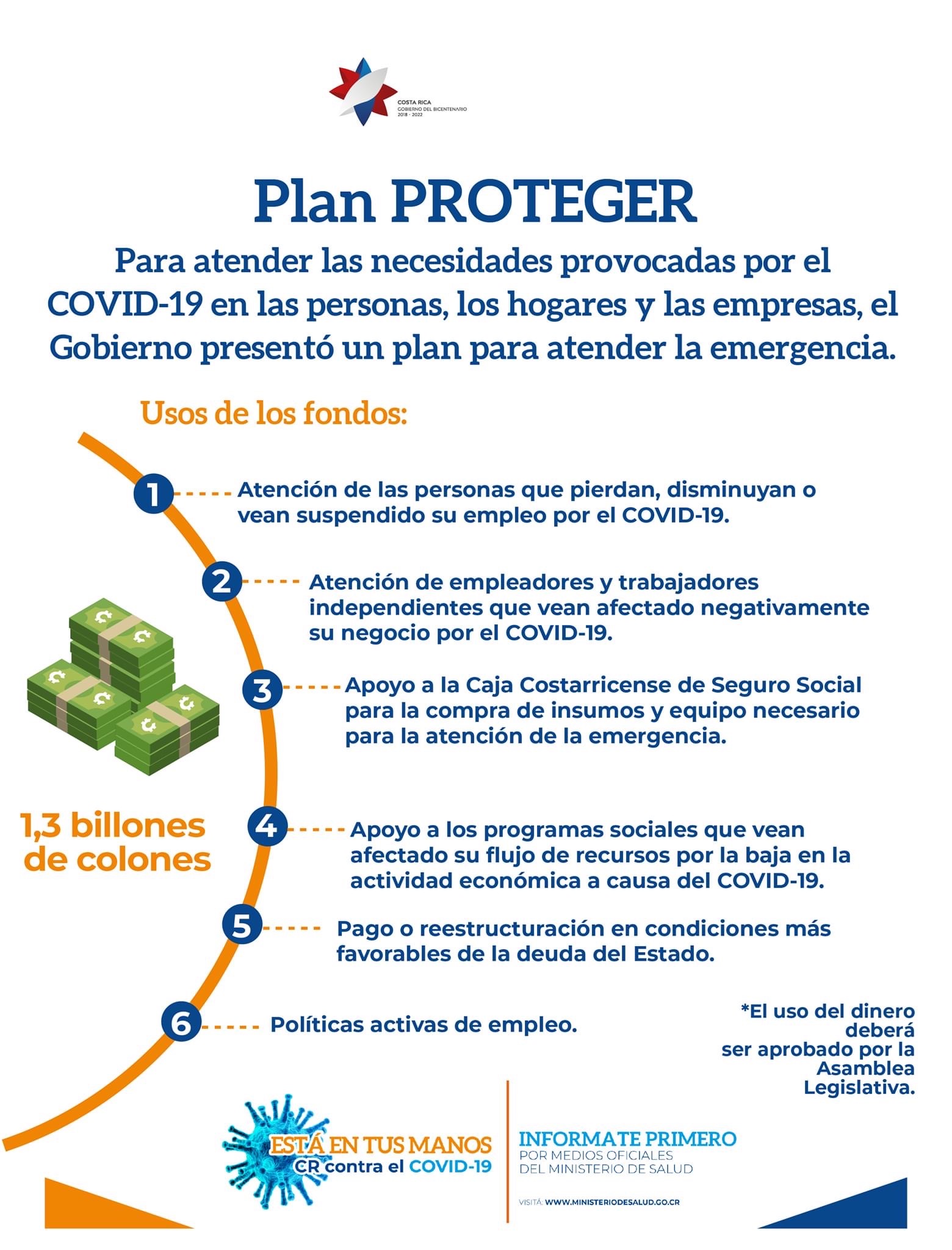
PROTEGER" Plan: With the objective of accumulating liquidity to protect people, jobs and companies, the Government of the Republic created the "PROTEGER" Plan that reaches the amount of ₡1 billion.
These funds will be allocated:
- To people who lose, diminish, or see their employment suspended by covid-19.
- To employers and independent workers who see their businesses affected.
- To the CCSS for the purchase of inputs and equipment (at least ₡33 billion to amortize the reduction of contributions by the CCSS).
- To social programs that affect their flow of resources.
- To the payment or restructuring in more favorable conditions of the State's debt.
- To active employment policies.
In order to have financial access to public funds for financing the State's socioeconomic relief actions, special public financing initiatives have had to be used, such as:
- Reduction of budgeted state expenditures.
- Reallocation of resources from decentralized entities.
- It was announced that, eventually, solidarity support from employees would also be resorted to.
|
|
 |

Other state funding measures include the following:
8th March
- A yellow alert is declared to release funds from the National Emergency Commission, thus activating thematic operational tables, allowing the mobilization of resources on an inter-institutional basis and convening the Emergency Operations Center (COE) twice a day.
9th March
- Foreign travel by public officials is suspended.
24th March
- Government suspends annual salary increase for public employees.
- Approved by the Andean Development Corporation (CAF) Borrowing Congress (₡287 billion or $500 million).
- Solidarity contribution of luxury pensions (₡12 billion), (pending formalization in Congress).
- “Ley Pagar” "Pay Act" (₡226 billion).
- The non-reimbursable cooperation credit from the Central American Bank for Economic Integration (CABEI) of $1 million will be destined exclusively to the National Emergency Fund.
- Loan from the Inter-American Development Bank (IDB)-French Development Agency (AFD) (₡216 billion).
- Securitization or donation of the profits of the National Insurance Institute (INS) (₡288 billion), this amount will go exclusively to the National Emergency Fund.
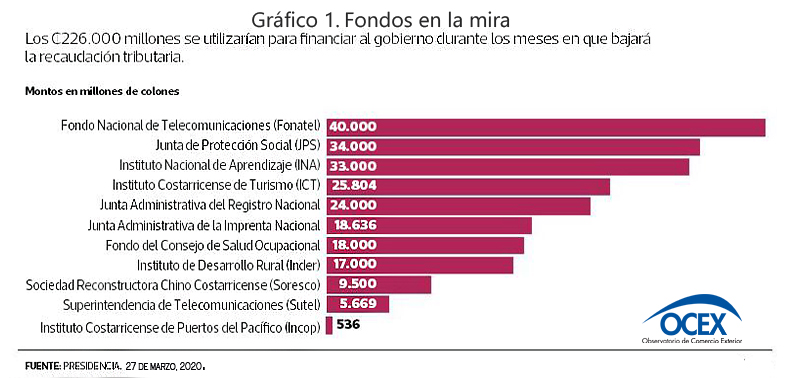
- Assignment of surpluses from eleven public entities (₡266 billion).
The detail of the amount per entity in figure 1 below:
|
|
Final conclusions
The president indicated that the members of the economic team of the government are working on the promotion of a series of projects in the legislative agenda and extended a patriotic thanks to the deputies who have been willing to meet from Friday to Sunday to move forward with the actions.
"We have the liquidity to finance a series of measures that would have the fundamental objective of protecting people, jobs and companies. These resources give us the necessary protection as a country to be able to deal with this social and economic emergency, which is why we are asking the deputies for their support," said the president, while expressing his administration's willingness to work as a team for the country.
Readings consulted:
- La Nación. 25 de marzo 2020. Recuento gráfico de la evolución del covid-19 en Costa Rica:
https://www.nacion.com/gnfactory/especiales/2020/Covid19/index. - COMEX.25 de marzo 2020. Medidas covid-19 al 21-03-2020:
http://www.comex.go.cr/media/8066/medidas-covid-19pdf-1.pdf - El Financiero. 24 de marzo 2020. Estos son los 20 cambios que aplicó el gobierno para ayudar a las empresas y personas frente al coronavirus:
https://www.elfinancierocr.com/economia-y-politica/estos-son-los-20-cambios-que-aplico-el-gobierno/ - Delfino.cr. 22 marzo 2020. Cronología covid-19 al 22 de marzo 2020:
https://delfino.cr/2020/03/covid-19-en-costa-rica - Cápsula OCEX #3-2020. 26 de marzo 2020. Impactos del covid-19 en el comercio nacional y mundial: https://www.uned.ac.cr/ocex/index.php/capsulas/558-capsula-3-2020-impactos-del-covid-19-en-la-economia-costarricense-y-mundial
- El Financiero. 21 -27 de marzo 2020. Superávits financiarían la moratoria tributaria: https://www.elfinancierocr.com/economia-y-politica/superavits-de-once-entidades-ayudarian-a-financiar/
- Delfino.cr. 27 de marzo 2020. JPS lanza subsidio de 200mil colones para vendedores de lotería afectados por covid-19: https://delfino.cr/2020/03/jps-lanza-subsidio-de-200-mil-colones-para-vendedores-de-loteria-afectados-por-covid-19
- La Nación. 24 de marzo de 2020. Plan autorizaría entregar FCL a los trabajadores afectados: https://lanacioncostarica.pressreader.com/la-nacion-costa-rica/
- La Nación. 28 de marzo 2020. Siete aseguradoras privadas activan atención del covid-19 en sus pólizas de salud: https://www.nacion.com/economia/consumo/siete-aseguradoras-privadas-activan-atencion
- La Nación. 24 de marzo 2020. Con 47 votos a favor, diputados aprueban financiar 110.000 pensiones para adultos mayores en pobreza: https://www.nacion.com/el-pais/politica/con-47-votos-a-favor-diputados-aprueban-financiar/
- Comunicado Casa Presidencial. 23 de marzo 2020. MEP lanza estrategia aprendo en casa: https://www.presidencia.go.cr/comunicados/2020/03/mep-lanza-estrategia-aprendo-en-casa/
- Comunicado Casa Presidencial. 23 de marzo 2020. CCSS, Correos de Costa Rica y Budget car rental se unen para entregar medicamentos a domicilio:https://www.presidencia.go.cr/comunicados/2020/03/ccss-correos-de-costa-rica-y-budget-car-rental-se-unen-para-entregar-medicamentos-a-domicilio/
- La Nación. 23 de marzo 2020. 295 contagiados por coronavirus: Salud ordena cerrar negocios a las 8pm los fines de semana: https://www.nacion.com/el-pais/salud/nuevas-medidas-por-coronavirus-ministerio-de/
- Teletica.com. 30 de marzo 2020. Bancos acordaron periodos de tres hasta 12 meses para que clientes no paguen sus cuotas: https://www.teletica.com/253689_bancos-acordaron-periodos-de-tres-y-hasta-12-meses-para-que-clientes-no-paguen-sus-cuotas
- Ameliarueda.com. 30 de marzo 2020. ¡A cuidar la cédula! Servicio del TSE estará cerrado durante las próximas dos semanas: https://www.ameliarueda.com/nota/a-cuidar-la-cedula-servicio-estara-cerrado-durante-las-proximas-dos-semanas
- Comunicado Casa Presidencial. 27 de marzo 2020. Organizaciones sociales que apoya la JPS se preparan ante covid-19: https://www.presidencia.go.cr/comunicados/2020/03/organizaciones-sociales
- Delfino.cr. 21 de marzo 2020. Estas son las medidas anunciadas por los bancos para sus clientes ante la pandemia de COVID-19: https://delfino.cr/2020/03/estas-son-las-medidas-anunciadas-por-los-bancos
- Delfino.cr. 31 de marzo 2020. Ya entró a regir reglamento que permite a Fuerza Pública hacer multas de tránsito: https://delfino.cr/2020/03/ya-entro-a-regir-reglamento-que-permite-a-fuerza-publica-hacer-multas-de-transito
- Delfino.cr. 31 de marzo 2020.Gobierno propone multas de hasta 2.3 millones a quienes violen aislamiento sanitario: https://delfino.cr/2020/03/gobierno-propone-multas-de-hasta-2-3-millones-a-quienes-violen-aislamiento-sanitario
- Comunicado Casa Presidencial. 31 marzo 2020. Aplazan juegos deportivos nacionales 2020 para próximo año: https://www.presidencia.go.cr/comunicados/2020/03/aplazan-juegos-deportivos-nacionales-2020-para-proximo-ano/
- Comunicado Casa Presidencial. 31 marzo 2020. Gobierno presenta medidas de primera respuesta en materia de protección social: https://www.presidencia.go.cr/comunicados/2020/03/gobierno
MBA. Hellen Ruiz Hidalgo
Comunicadora Estratégica, (OCEX-UNED)
Vicerrectoría de Investigación
Nivel del contagio, medidas de contención sanitaria, de apoyo socioeconómico estatal y de financiamiento hacendario
1. Nivel del contagio
El 6 de marzo de 2020 se confirmó los dos primeros casos de covid-19 en Costa Rica. Se trató de una turista estadounidense, cuya pareja tuvo contacto con un caso confirmado en los Estados Unidos. El 20 de marzo, la mujer, así como su esposo, fueron dados de alta y habilitados para regresar a su país de origen.
Al 2 de abril se reportan 396 casos de contagio por este virus. En la estadística se incluyen dos víctimas mortales, ambos pacientes masculinos de 87 años. El miércoles 18 de marzo se dio el primer deceso. Se trató de un médico pensionado, vecino de Alajuela, quien además sufría de hipertensión. La noche del jueves 19 de marzo, el Ministerio de Salud confirmó el segundo deceso. En cifras este es nuestro estado de situación al 2 de abril de 2020. Ver infograma a continuación:
Probabilidad de mortalidad por edad
De acuerdo con datos oficiales del Ministerio de Salud de España, al 22 de marzo de 2020, sobre una base de 18959 casos confirmados de personas infectadas (805 de las cuales murieron), la prestigiosa revista Der Spiegel de Alemania, publicó, el viernes 27 de marzo, la siguiente tabla de letalidad por edades del covid-19.
2. Medidas, en Costa Rica, de contención sanitaria, de apoyo socioeconómico estatal y de financiamiento hacendario
El 7 de marzo 2020, el Gobierno de Costa Rica tomó medidas de contención de la velocidad de contagio de la pandemia. Estas medidas se han concentrado, de forma cada vez más progresiva, en restricciones de contacto social que persiguen reducir el ritmo de crecimiento de contagios, sobre todo aminorando el número de casos graves, pacientes con necesidad de apoyo hospitalario o de cuidados intensivos, para no comprometer la capacidad del sistema de salud.
Dichas medidas tuvieron importantes consecuencias negativas en la economía, con perjudicial impacto social tanto en las poblaciones afectadas como en sectores sociales vulnerables. Por esa razón, el Gobierno también planteó y decidió un plan de mitigación socioeconómica de los embates negativos en diferentes actividades económicas y en la población, en general.
Estas medidas buscan proteger el empleo y liberar dinero para que las empresas y personas tengan “flujo de caja” en las próximas semanas agobiantes por la incertidumbre que provoca el covid-19.
Sobre este particular, recomendamos ver la entrevista realizada a la señora Pilar Garrido, Ministra de Planificación Nacional y Política Económica, en el programa “Enfoques crhoy”, del lunes 30 de marzo de 2020. A continuación el link: (Entrevista a Ministra Pilar Garrido.)
A). Acciones de contención sanitaria del contagio del Covid-19
El lunes 30 de marzo del 2020, el Gobierno de la República ante la rápida expansión del covid-19 y para minimizar el impacto en los sectores más vulnerables decretó 56 medidas que derivan de la mesa de Protección Social coordinada por el Instituto Mixto de Ayuda Social (IMAS), pero en la que participan instituciones como MCJ, DGME, Viceministerio de Dialogo, MIVAH, DESAF, MEP, PANI, REDCUDI, INAMU, MTSS, CCSS, INA, CONAPAM, CONAPDIS, IAFA, JPS, Ministerio de Salud, Ministerio de Desarrollo Humano e Inclusión Social y Municipalidad de San José.
Dichas medidas, incluyen la protección social de distintas poblaciones de grupos de alto riesgo como menores de edad, mujeres en condición vulnerable, personas con discapacidad, adultos mayores, indígenas, indigentes en situación de calle y familias en condición de pobreza. En el siguiente link encontrará el detalle de estas medidas: (respuestas-en-materia-de-proteccion-social/)
El presidente de la República, Carlos Alvarado; y el ministro de Salud, Daniel Salas presentaron el lunes 30 de marzo a la Asamblea Legislativa el proyecto de ley para subir las multas contra personas que violen las medidas sanitarias adoptadas por el Estado.
Para fijar la multa se debe utilizar el salario base mensual del "Oficinista 1", que para este 2020, está fijado en 450.200 colones. A la persona diagnosticada con covid-19 que viole su orden de aislamiento se le impondrá una multa de 5 salarios (2,3 millones de colones).
OCEX les ofrece, al 2 de abril de 2020, un recuento de las nuevas medidas temporales instruidas por el Gobierno a partir del 8 de marzo, día en que se declaró la alerta amarilla nacional.
8 de marzo
- Ministerio de Salud recomienda posponer viajes al exterior.
10 de marzo
- Se instruyen lineamientos para la implementación de teletrabajo para instituciones públicas.
- Se cierra la Escuela Reverendo Francisco Schmitz en el Porvenir de Desamparados y los colegios Técnico Profesional Máximo Quesada, Monseñor Rubén Odio, el Nocturno de Desamparados y Blue Valley.
11 de marzo
- Universidades públicas suspenden clases presenciales y piden a los profesores impartirlas mediante plataformas virtuales.
12 de marzo
- Se cancelan los eventos y actividades de concentración masiva.
- Se reduce al 50% de su capacidad el espacio para reuniones.
- Se ordena el cierre preventivo de centros educativos donde haya educadores que den positivo para la enfermedad, que tengan hijos en otros centros educativos; y centros que no tengan abastecimiento de agua potable y no se les pueda dar por otros medios.
13 de marzo
- Se suspenden lecciones en 344 centros educativos.
- Se activa la línea 1322 para atención de consultas.
14 de marzo
- Correos de Costa Rica y la Fábrica Nacional de Licores (Fanal) habilitarón la plataforma en línea para distribuir alcohol antiséptico en todo el país.
15 de marzo
- Se ordena el cierre de bares, discotecas y casinos (vida nocturna).
- Deben operar a media capacidad o serán cerrados restaurantes, sodas, bar-restaurant y food courts.
16 de marzo
- Se declara estado de emergencia nacional y se suspende el curso lectivo.
- Se anuncia que solo podrán entrar costarricenses desde el extranjero.
17 de marzo
- Protocolo de atención de buques y personas en Puerto Caldera por parte del INCOP. (Disponible en https://bit.ly/2WwPDbN).
- Se utilizarán las instalaciones del Centro Nacional de Rehabilitación (CENARE) para atender pacientes infectados por covid-19.
- Se suspende el campeonato de fútbol masculino.
- Se anuncia el cierre de parques nacionales.
18 de marzo
- Suspensión temporal de la restricción vehicular para los vehículos de carga. (Vigente del hasta el 30 de abril). Directriz 2020-000324-MOPT (Disponible en https://bit.ly/2WymDAz).
- Se amplía cobertura para realizar pruebas de covid-19.
19 de marzo
- Autorización a las empresas del Régimen de Zona Franca para trasladar el equipo de cómputo y mobiliario necesario para que sus empleados puedan teletrabajar. Circular-DGA-006-2020 Servicio Nacional de Aduanas. (Disponible en https://bit.ly/2vFwVUp).
- Activación para la emisión de zarpes de manera digital por parte de la Capitanía de Puerto de Limón.
- Restricción para el ingreso de extranjeros por vía marítima, aérea y terrestre (no aplica para transporte de mercancías y otras excepciones). (Vigente hasta 12 de abril). (Directriz DGA-004-2020).
- Se ordenó el cierre de cines y teatros durante el fin de semana.
20 de marzo
- Aceptación temporal de copias para la verificación documental y física en las aduanas. Vigente hasta se mantenga la emergencia nacional. Directriz DGA-004-2020 (Disponible en https://bit.ly/2WymXiL).
- Ministerio de Justicia ordenó suspender de inmediato y hasta nuevo aviso las visitas en todos los centros penitenciarios del país.
- Ministerio de Educación Pública (MEP) entregará paquetes de alimentos en los comedores escolares.
23 de marzo
- Trabajadores del peaje deben usar mascarilla y guantes, y el Ministerio de Salud publicó la lista de medidas que deberán acatar las cadenas comerciales, supermercados y abastecedores (minisúper).
- La UNED, el SINART y el MEP anunciaron su programa “Aprendo en Casa” con el fin de proveer orientaciones, guías específicas y recursos de apoyo a la comunidad educativa nacional.
- El plan reúne acciones para los docentes, estudiantes y familias.
- Ministerio de Salud ordena cerrar negocios a las 8pm los fines de semana.
24 de marzo
- Vehículos no podrán circular de lunes a jueves de 10pm a 5am y de viernes a domingo a partir de las 8pm a 5am, a excepción de entregas a domicilio de medicamentos y comida. Quienes incumplan se exponen a una multa de tránsito de ₡22.187,93 hasta ₡107.000 colones.
- CCSS, Correos de Costa Rica y Budget Car Rental forman una alianza para poner a disposición 40 vehículos para la entrega a domicilio de medicamentos.
- Cierre total de playas hasta nuevo aviso.
- Cierre obligatorio de iglesias, templos o cultos de cualquier denominación.
- Todo extranjero residente en el país y los refugiados que abandonen el territorio nacional perderán su estatus migratorio.
30 de marzo
- Tribunal Supremo de Elecciones (TSE) permanecerá cerrado hasta el 12 de abril. Los demás servicios deben ser tramitados a través del sitio web.
31 marzo 2020
- Se aplazan juegos deportivos nacionales para el próximo año 2021.
- Se acredita a la Fuerza Pública para realizar multas de tránsito. Aprobado reglamento de ley.
B). Acciones de apoyo socioeconómico a cargo del Estado
Esta es una lista de las acciones de apoyo socioeconómico del Gobierno a las personas y sectores afectados por las medidas de contención sanitaria de la pandemia:
|
Caja Costarricense |
|
|
Ministerio de Trabajo |
|
|
Banco Central,
|
|
Para mayor detalle, ponemos a su disposición un resumen de las medidas anunciadas por cadaentidad bancaria,
21 de marzo. Descargar el resumen en el siguiente link: (medidas-anunciadas-por-los-bancos-ante covid-19).
|
Logística comercial
|
|
|
Impuestos y renta |
|
|
Instituto Nacional de Seguros (INS) y aseguradoras privadas |
|
|
Electricidad
|
|
|
Otras medidas de |
|
C. Acciones de financiamiento hacendario
Plan “PROTEGER”: Con el objetivo de acumular liquidez para resguardar a las personas, los trabajos y las empresas, el Gobierno de la República crea el Plan “PROTEGER” que alcanza el monto de ₡1 billón.
Estos fondos se destinaran:
- A personas que pierdan, disminuyan o vean suspendido su empleo por el covid-19.
- A empleadores y trabajadores independientes que vean afectado sus negocios.
- A la CCSS para la compra de insumos y equipo (al menos ₡33.000 millones para amortizar la reducción de contribuciones de la CCSS).
- A programas sociales que vean afectado su flujo de recursos.
- Al pago o reestructuración en condiciones más favorables de la deuda del Estado.
- A políticas activas de empleo.
Para tener posibilidad financiera de acceso a fondos públicos destinados al financiamiento de las acciones de alivio socioeconómico del Estado se ha tenido que recurrir a iniciativas especiales de financiamiento público, tales como:
- Disminución de gastos estatales presupuestados.
- Reasignación de recursos de entidades descentralizadas.
- Se anuncia que, eventualmente, se recurriría también al apoyo solidario de los asalariados.
|
|
|
Entre otras medidas de financiamiento estatal se encuentran las siguientes:
8 de marzo
- Se declara alerta amarilla para liberar fondos de la Comisión Nacional de Emergencia, con lo que se activan mesas operativas temáticas, se permiten movilizar recursos de manera interinstitucional y se convoca al Centro de Operaciones de Emergencias (COE) dos veces al día.
9 de marzo
- Se suspenden los viajes al exterior de funcionarios públicos.
24 de marzo
- Gobierno suspende aumento salarial anual a los empleados públicos.
- Aprobado por el Congreso Empréstito de la Corporación Andina de Fomento (CAF) (₡287 mil millones o $500 millones).
- Contribución solidaria de pensiones de lujo (₡12 mil millones), (pendiente de formalizar en el Congreso).
- “Ley Pagar” (₡226 mil millones).
- Se destinará exclusivamente al Fondo Nacional de Emergencias el crédito de cooperación no reembolsable del Banco Centroamericano de Integración Económica (BCIE) por $1 millón.
- Empréstito del Banco Interamericano de Desarrollo (BID)-Agencia Francesa de Desarrollo (AFD) (₡216 mil millones).
- Titularización o donación de las utilidades del Instituto Nacional de Seguros (INS) (₡288 mil millones), este monto se destinará exclusivamente al Fondo Nacional de Emergencias.
- Cesión de superávits de once entidades públicas (₡266.000 millones).
El detalle del monto por entidad en el gráfico 1 a continuación:
|
|
A modo de conclusión
El presidente indicó que los jerarcas integrantes del equipo económico de Gobierno trabajan en el impulso de una serie de proyectos en la agenda legislativa y extendió un agradecimiento patriótico a los diputados y diputadas quienes han dispuesto a sesionar de viernes a domingo para sacar adelante las acciones.
“Contamos con la liquidez para financiar una serie de medidas que tendrían como objetivo fundamental proteger a las personas, los trabajos y las empresas. Estos recursos nos dan el resguardo necesario como país para poder atender ante esta emergencia en lo social y económico, por eso le solicitamos a los diputados y diputadas su apoyo”, dijo el mandatario al tiempo que expresó la disposición de su administración para profundizar en equipo por el país.
Lecturas consultadas:
- La Nación. 25 de marzo 2020. Recuento gráfico de la evolución del covid-19 en Costa Rica: https://www.nacion.com/gnfactory/especiales/2020/Covid19/index.
- COMEX.25 de marzo 2020. Medidas covid-19 al 21-03-2020:
http://www.comex.go.cr/media/8066/medidas-covid-19pdf-1.pdf - El Financiero. 24 de marzo 2020. Estos son los 20 cambios que aplicó el gobierno para ayudar a las empresas y personas frente al coronavirus:
https://www.elfinancierocr.com/economia-y-politica/estos-son-los-20-cambios-que-aplico-el-gobierno/ - Delfino.cr. 22 marzo 2020. Cronología covid-19 al 22 de marzo 2020:https://delfino.cr/2020/03/covid-19-en-costa-rica
- Cápsula OCEX #3-2020. 26 de marzo 2020. Impactos del covid-19 en el comercio nacional y mundial: https://www.uned.ac.cr/ocex/index.php/capsulas/558-capsula-3-2020-impactos-del-covid-19-en-la-economia-costarricense-y-mundial
- El Financiero. 21 -27 de marzo 2020. Superávits financiarían la moratoria tributaria: https://www.elfinancierocr.com/economia-y-politica/superavits-de-once-entidades-ayudarian-a-financiar/
- Delfino.cr. 27 de marzo 2020. JPS lanza subsidio de 200mil colones para vendedores de lotería afectados por covid-19: https://delfino.cr/2020/03/jps-lanza-subsidio-de-200-mil-colones-para-vendedores-de-loteria
- La Nación. 24 de marzo de 2020. Plan autorizaría entregar FCL a los trabajadores afectados: https://lanacioncostarica.pressreader.com/la-nacion-costa-rica/
- La Nación. 28 de marzo 2020. Siete aseguradoras privadas activan atención del covid-19 en sus pólizas de salud: https://www.nacion.com/economia/consumo/siete-aseguradoras-privadas-activan-atencion
- La Nación. 24 de marzo 2020. Con 47 votos a favor, diputados aprueban financiar 110.000 pensiones para adultos mayores en pobreza: https://www.nacion.com/el-pais/politica/con-47-votos-a-favor-diputados-aprueban-financiar/
- Comunicado Casa Presidencial. 23 de marzo 2020. MEP lanza estrategia aprendo en casa: https://www.presidencia.go.cr/comunicados/2020/03/mep-lanza-estrategia-aprendo-en-casa/
- Comunicado Casa Presidencial. 23 de marzo 2020. CCSS, Correos de Costa Rica y Budget car rental se unen para entregar medicamentos a domicilio:https://www.presidencia.go.cr/comunicados/2020/03/ccss-correos-de-costa-rica-y-budget-car-rental-se-unen-para-entregar-medicamentos-a-domicilio/
- La Nación. 23 de marzo 2020. 295 contagiados por coronavirus: Salud ordena cerrar negocios a las 8pm los fines de semana: https://www.nacion.com/el-pais/salud/nuevas-medidas-por-coronavirus-ministerio-de/
- Teletica.com. 30 de marzo 2020. Bancos acordaron periodos de tres hasta 12 meses para que clientes no paguen sus cuotas: https://www.teletica.com/253689_bancos-acordaron-periodos-de-tres-y-hasta-12-meses-para-que-clientes-no-paguen-sus-cuotas
- Ameliarueda.com. 30 de marzo 2020. ¡A cuidar la cédula! Servicio del TSE estará cerrado durante las próximas dos semanas:
https://www.ameliarueda.com/nota/a-cuidar-la-cedula-servicio-estara-cerrado-durante-las-proximas - Comunicado Casa Presidencial. 27 de marzo 2020. Organizaciones sociales que apoya la JPS se preparan ante covid-19:
https://www.presidencia.go.cr/comunicados/2020/03/organizaciones-sociales- - Delfino.cr. 21 de marzo 2020. Estas son las medidas anunciadas por los bancos para sus clientes ante la pandemia de COVID-19:
https://delfino.cr/2020/03/estas-son-las-medidas-anunciadas-por-los-bancos-para-sus-clientes - Delfino.cr. 31 de marzo 2020. Ya entró a regir reglamento que permite a Fuerza Pública hacer multas de tránsito: https://delfino.cr/2020/03/ya-entro-a-regir-reglamento
- Delfino.cr. 31 de marzo 2020.Gobierno propone multas de hasta 2.3 millones a quienes violen aislamiento sanitario: https://delfino.cr/2020/03/gobierno-propone-multas-de-hasta-2-3-millones
- Comunicado Casa Presidencial. 31 marzo 2020. Aplazan juegos deportivos nacionales 2020 para próximo año: https://www.presidencia.go.cr/comunicados/2020/03/aplazan
- Comunicado Casa Presidencial. 31 marzo 2020. Gobierno presenta medidas de primera respuesta en materia de protección social: https://www.presidencia.go.cr/comunicados/2020/03/gobierno-
MBA. Hellen Ruiz Hidalgo
Strategic Communicator - OCEX-UNED
- Chronology of the Covid-19 pandemic: outbreaks, detection and responses
Covid-19 activated health alerts worldwide. The new strain of the virus had an epicenter in Wuhan City, China and has spread to more than 176 countries worldwide, with more than 13.000 deaths among 310.000 diagnosed cases (rtve, 5:00 pm, March 22, 2020).
On Dec. 8, 2019, the beginning of a new infection was detected for the first time, according to the WHO. The new infection had already become epidemic on December 12, 2019, four days later. By January 20, 2020, it had caused 198 laboratory-confirmed infections with three fatal cases.
Between December 22 and 24, just eight days after the detection of the epidemic, the new virus had been genetically sequenced and the first clinical studies of its evolution were published. It was named 2019-nCov, then SARS-CoV-2. Internationally it is now better known as covid-19, (acronym for Corona virus disease 2019). On December 31, WHO received the first alert.
The importance of presenting these dates is to provide an opportunity to assess the different rates of transmission and also of response by countries.
It was only until January 23, 2020, that is, 46 days after the first case was detected, that it was decided to close the city. Trains and planes from Wuhan were not allowed to leave the town and the highways were blocked. The metropolis of Wuhan, with 11 million people, was thus isolated from the world in the hope of stopping the epidemic.
South Korea: On January 22, the first infections were announced in South Korea. Their reaction was immediate. With the massive launch of infection detection and isolation measures for all those detected, it seemed at first that the infection was contained, with 30 cases detected. But almost a month after the first outbreaks, on February 29, the positive cases skyrocketed to an alarming 3150. Patient 31 went undetected and was a super spreader who passed it on to thousands of people. Since the virus spreads before people show symptoms, by the time authorities realized the problem, the virus was already out there. Now they're paying the price for that one case. Even so, the epidemic is already contained.
Iran: February 19 closed its borders after the first cases were confirmed.
Italy: On February 1st, the first registrations occurred. Only one month later, it decreed quarantine in part of the north of the country for coronavirus.
According to an analysis of the 72,342 cases diagnosed in China as of February 11, the disease is mild for 81% of patients, 14% show more severe symptoms, and 4-5% enter critical condition. Worldwide, in 160 affected countries, at the time of writing, out of 218,827 confirmed cases, 84,121 have recovered and there have been 8,811 deaths. This confirms the publicized proportion (80-15-5): 80% of those infected have very mild symptoms or are not even aware of being infected, 15% need hospital support, 4% are serious cases. Between 1% and 3% are fatal.
Costa Rica: The Global Health Security Index 2019 (GHS Index) is the first comprehensive assessment of the global health security capacities in 195 countries, evaluated in 2019 (Link from GHS Index: https://www.ghsindex.org/; link from the Health Security Profile of Costa Rica 2019 is: https://www.ghsindex.org/country/costa-rica/)
In the Global Health Security Index, the average country score is 40.2 out of 10. Developed countries score 5.9 on average. Costa Rica has a rating of 4.5. It ranks 62nd out of 195 countries.
On 6 March, the first infection was detected in Costa Rica. On 13 March, seven days later and with 23 confirmed cases, the health authorities took the first steps in a very hesitant manner. "I know that there are countries that are taking very, very extreme measures because of the coronavirus, and that there are people who expect us to do the same in Costa Rica," said Health Minister Daniel Salas Peraza. And he added: "Based on the criteria of qualified experts at the national level and recommendations of the World Health Organization (WHO), we are taking measures that do not turn off the activity of the country as a whole”.
However, events in other countries led the country to take extreme measures very quickly. On March 16, decrees of social isolation were issued. The imminent economic impact created an atmosphere of national unity among all the currents that supported economic relief measures.
- Overall economic impact of covid-19
China's National Bureau of Statistics reported a record drop in industrial production (which measures manufacturing, mining and public service activity), which fell 13.5% year-on-year, the first contraction since January 1990. Retailing is a key indicator of the state of consumption in the world's second largest economy and fell by 20.5% year-on-year, the largest collapse on record. While investment in fixed assets-which reflects spending on items including infrastructure, property, machinery and equipment-went down 24.5% year-on-year, another record low.
These data also add to the poor figures for the manufacturing industry in February, which was at its lowest level since 2005, as released earlier this month.
The drop is largely the result of measures taken by China to contain the spread of the virus in the territory, including the closure of factories or shops across the country for weeks after the Lunar New Year holiday, which is already a severe setback. From the beginning of this crisis, one thing has been clear to economists: that covid-19 affects both extremes of the economy, both the supply chain and demand.
The supply of goods and services is affected because factories and offices close and production falls as a result. And at the same time, demand is also affected because consumers stay home and stop spending.
According to the National Business Index of the research firm Trivium, as of March 16th the Chinese economy was operating at 69.5% of normal production. "The restrictions on industrial activity have mostly been solved. The major concern now for companies is weak demand," said the firm.
Despite the government's efforts to redirect the country towards a more domestic demand-based model, the world's second largest economy remains heavily dependent on foreign demand, and is thus greatly affected by the situation in other countries.
"While conditions at home should gradually improve in the coming months”, warned Evans-Pritchard of the British consulting firm Capital Economics, "the increasing global disruption from the coronavirus will slow the pace of recovery”.
Estimates from different agencies have been adjusted as the virus progressed and the latest forecasts from banks such as ING put China's GDP growth for 2020 at 4.8%, which would be the biggest slump in three decades. And, in a hyper-connected world, where China today has great weight -representing a third of the world's manufacturing and the largest exporter of goods in the world-, whatever happens in the Chinese country will have a global impact.
The virus, according to the Organization for Economic Cooperation and Development (OECD), represents the "greatest threat to the global economy since the financial crisis of 2008" and estimates that there could be the lowest growth rate since 2009 due to the outbreak.
In early March, the United Nations Conference on Trade and Development (UNCTAD) predicted that the coronavirus could cost the global economy up to US$2 trillion this year. Globalization is causing economic estimates of the impact of the pandemic to vary as more countries adopt new and different measures to contain the virus, greatly affecting the world economy.
The closures in Spain and Italy are an example of the drastic actions that some governments have taken in an attempt to curb contagion.
On the supply side, the decline in activity at the so-called "world factory" has already had consequences: restrictions have affected the value chains of large companies such as the car manufacturer Nissan or Jaguar, Land Rover, for example. The latter pointed out that it had had to move car parts in baggage because some factories had run out of supplies. On the demand side, sectors such as tourism are being tremendously affected following restrictions on the transport of people and the cancellation of major events.
The consulting firm McKinsey differentiates between two scenarios: (1) a rapid recovery, in which the virus is found to be seasonal and by autumn governments have the tools to stop it; (2) a global slowdown, in which the virus is not seasonal and countries must maintain infection prevention measures even if they control the epidemic, as in the case of China.
In the case of Latin America, for example, the consulting firm McKinsey estimates that in the first scenario growth estimates would fall by only 0.5%, while in the second scenario growth forecasts would be reduced by 38%.
Countries that depend on the sale of raw materials, as is the case for Latin America, are in a precarious situation, UNCTAD warned.
"Heavily indebted developing countries, particularly commodity exporters, face an exceptional threat" due to lower export returns linked to a stronger dollar, warned Richard Kozul-Wright, director of UNCTAD's Division on Globalization and Development Strategies.
Encouraging awareness of the economic impact of this crisis is one of the reasons that may have led China to publish its bad numbers this month, according to experts like Alicia García Herrero, chief economist for Asia-Pacific at NATIXIS.
"One important reason China may have published such bad numbers, beyond helping (to achieve) the V curve, was to warn the world of how bad the situation may get for them and to encourage the Fed and others to react to the fading global demand," she said on Twitter. "Let's call it 'coordination by threat'”.
- Impacts of covid-19 on foreign trade and services in Costa Rica
Covid - 19 cools down the country's exports and imports The Costa Rican companies indicate logistical problems, both in exports and imports. Let's look at different scenarios of their impact.
The impact generated in the export sector. Costa Rican foreign trade companies report the slow progress of shipments and landings at Asian ports, delays in the return of containers and the "cooling" of purchases in the countries to where Costa Rica exports, as a result of the impact on markets and logistics of the coronavirus covid-19.
 Laura Bonilla, president of Cadexco, indicated that there are delays in the arrival of raw material, mainly from Asia, and that it is also possible that shortages of equipment will be generated. She received reports from companies about logistical problems, both in exports and imports. In addition, there have been seven cancellations of international fairs in where Tico exporters had planned to participate.
The president of the National Chamber of Producers and Exporters of Pineapple (Canapep), Abel Chaves, explained that the problem is focused on the congestion of the docks in China. This makes the cargo take longer to reach the market. Chaves revealed that in this situation, shipping companies are charging additional fees.
There are delays and minor sales from keeping fruit and other products on the Chinese docks. He said this extra charge is between $1,000 and $1,500 per container. The major dilemma faced by the companies has to do with the flow of goods, due to the delay in the return of containers (mainly refrigerated ones) due to the slow landings and shipments in the ports, especially in Asia. In this regard, one of the export sectors that has been hit hardest is beef. Livestock farmers had made significant progress in placing the product in China, but since January container unloading has been delayed because of the drop in activity in Chinese ports.
For pig farmers the reality is different. Romulo Chaves, president of the National Chamber of Pig Farmers, said that even none of the scheduled shipments have been delayed, but recalled that this sector just started exports in early February and therefore does not require much space on ships so far.
Bonilla noted her concern that the longer a product is delayed on the ship, the higher the cost and the impact on its shelf life, especially for perishable products, which translates into both economic losses and damage or loss of the product.
Specific impact on pineapple exports. The Dutch market has already reduced purchase orders for pineapple. The Costa Rican private sector warned this Tuesday March 17 about a collapse in businesses and employment as a result of the measures taken to address the emergency by the new coronavirus.
For its part, the president of Cadexco, Laura Bonilla, revealed that since last week shipments of products such as roots and root vegetables to Italy were suspended, while the National Chamber of Producers and Exporters of Pineapple (Canapep) reported that in the Netherlands suppliers of schools, bars and restaurants stopped buying Costa Rican pineapple.
In the service sector, the impact on domestic tourism is noteworthy. Hotels report more than 10,000 cancelled nights. Costa Rican hotels report more than 10,000 cancelled nights and expect a drop of between 80% and 90% in future bookings, following the measures announced by the government on Monday, March 16, to curb the spread of the new coronavirus.
 The government decreed a state of national emergency and prohibited the entry of foreign and non-resident tourists by air, sea and land. The restriction came into effect on Wednesday, March 18, at 11:59 p.m. and will remain in effect until the same time on April 12.
"Anyone who violates the measures imposed by law or by the competent authorities to prevent the introduction or spread of an epidemic will be punished with a prison term of one to three years, or a fine of fifty to two hundred days”. Criminal Code Article 277.
Javier Pacheco, president of the Costa Rican Chamber of Hotels (CCH), explained to La Nación that the latest data from the sector, before the government's announcement on Monday, already showed significant cancellations in the number of hotel nights. "Now, the biggest concern is not the cancellations we have had, but all those that are coming in the future after the government's decision. The measures being taken in the world and in Costa Rica bring devastating economic consequences for the tourism sector", said Pacheco.
The latest data collected by the CCH, before this Monday, reported falls of 30% and 40% in future reserves. However, with the restrictions imposed, the projection changed to a range of between 80% and 90%. According to Pacheco, the sector understands the importance of taking actions to stop the spread of the disease and, therefore, will respect them and apply them in the 170 hotels affiliated to the Chamber.
Urgent requests and claims from the private sector. Faced with the current emergency situation, Bonilla (Cadexco) requested that the transit of air, sea and land cargo transport be guaranteed; a permanent articulation and communication between regional customs to guarantee common criteria that allow the transit of goods through the Central American Isthmus, and that instructions be issued to entities to facilitate the passage of products.
The complaint was submitted by the Costa Rican Union of Chambers and Associations of the Private Business Sector (Uccaep), the Costa Rican Chamber of Exporters (Cadexco), the National Chamber of Tourism (Canatur) and the Costa Rican Chamber of Restaurants (Cacore).
Álvaro Sáenz, president of Uccaep, said that hard-hit sectors, such as tourism, could begin to lay off staff if urgent measures are not taken to avoid such a collapse. That is why, he added, Uccaep is urging a series of measures in credit, taxes, labour and other fields.
He called for the readjustment of debts and mortgages, as well as credit arrears; to lower value added tax from 13% to 6% while the yellow alert lasts and, thus, to stimulate consumption; that the municipal regime, in solidarity, temporarily annul, during the emergency, all collection of municipal rates and taxes, and to make monetary policy instruments, such as legal reserves, more flexible, in order to lower the financial cost and provide the necessary liquidity.
In addition, the Uccaep representative requested a reduction in electricity tariffs during the emergency, as well as several measures in the labor area. Among them, he mentioned the need to approve the bill that makes the working hours more flexible; also, to pay the labor charges on the work actually done, and the possibility to partially or totally suspend the work contract and, therefore, the payment of social charges. According to Uccaep, if no measures are taken, unemployment will grow rapidly.
|
Impacts of covid-19 in Costa Rica (as of March 10, 2020) |
|
|
Exports |
Imports |
|
No container rotation. |
Delayed arrival of raw materials. |
|
Decrease in the volume exported as the shipping lines are not leaving with the usual frequency. |
Closure of the factories in China forces the purchase of more expensive products from other countries. |
|
Customers are stopping buying and there are fewer air traffic operations. |
The decrease in the volume of goods means that shipping companies are not leaving as often as usual. |
|
Drop in consumption of products in the countries most affected by covid-19. |
|
|
Uncertainty in the behavior of strategic international markets such as Europe, the United States, Mexico and the Southern Cone. |
|
|
Cancellation of 7 international fairs due to security measures (five to be defined). |
|
|
High costs due to queuing at the ports and re-routing to other ports, distancing the products from the original points of arrival. |
|
|
Source: Elaboration of the author from Cadexco and La Nación. |
|
José Manuel Quirce, president of the Chamber of Foreign Trade and Representatives of Foreign Houses (Crecex), said that some businessmen are already expressing their difficulties in restocking with imported products. He added that these businessmen are even asking for written notes from their international suppliers, to present them in Costa Rica in case they are probed by the reduction in supply. If the problem continues, there will be a shortage of products or other materials.
Analysis of general impacts in Costa Rica. Tourism, mass entertainment, chains to provide raw materials, education and industry dependent on a single supplier in the world, are among the sectors that, by their nature, are most affected by the emergence of covid-19, says specialist Alberto Trejos, of the Incae Business School.
In the webinar "Coronavirus: economic, social and political impact in Latin America", held on March 12, Trejos said that, on the other hand, companies in the area of telecommunications, suppliers of items for teleworking and those offering elements linked to automation can increase their sales in this situation. The also former Minister of Foreign Trade (Comex) of Costa Rica considered that the situation will accelerate changes in the way companies see different areas, including the incorporation of technology (autonomous trucks would have a great use at this time), management and volume of inventories, teleworking, working hours and production with data management.
The companies will face, he said, on the one hand, a lower demand and, on the other, a possible reduction in production, because they do not obtain raw materials. In addition, he continued, there will be a drop in the price of raw materials, which has different consequences among Latin Americans, depending on their role in the market. Thus, for example, the reduction in the value of oil is good news for Central Americans, but negative for South Americans.
From a political point of view, Trejos pointed out that there are governments that close borders with a high component of xenophobia, as well as the rebirth, under these circumstances, of a populist current. However, from the perspective of the countries, there are also differences: some have excellent health systems, not for this emergency but for all times, and there are those that handle information with transparency and data to adequately prepare the population to face the situation, said the specialist.
- Economic actions to mitigate the impact of the covid-19
On Saturday, March 7, the Costa Rican government announced a plan of measures to mitigate the negative impacts on the economy, resulted from measures to stop the spread of the covid-19 pandemic.
The provisions seek relief in social charges, in the cost of credit, in tax obligations and subsidies for insurance and special coverage for tourists. Measures are proposed to make credit cheaper, make debt adjustment more flexible, establish temporary tax arrears and improve insurance options.
It also provides for a three-month moratorium on the payment of value added tax, corporate income tax and customs duties, a significant reduction in the monetary policy rate to make credit cheaper, and insurance to enable the tourism sector to deal with the Coronavirus quarantine. These are the first financial measures announced to deal with the effects of covid-19.
Proposals
- Employment protection measures. The President of the Republic, Mr. Carlos Alvarado, urged the Executive President and the Board of Directors of the CCSS to implement the temporary and necessary measures to mitigate the economic and employment effect of the covid-19. To this end, on Monday, March 16, the President of the Republic convened the Board of the CCSS so that, within the framework of its autonomy, it would promptly specify and implement the relevant measures. This means that the social charges would be made proportional to the actually worked time. In addition, it will ask to consider the deferred payment of social charges. Both measures would be envisioned for those companies that maintain their payroll, in such a way that employment is protected.
- Relief in the cost of credit. Actions are being taken to improve credit conditions for Costa Rican households and businesses. In particular:
- The Board of Directors of the Central Bank will assess the possibility of an additional monetary stimulus to further push down interest rates.
- CONASSIF will consider temporary adjustments to prudential regulations in order to expand the space for credit readjustment, so that banks can reduce credit service fees for their debtors.
- CONASSIF will also evaluate the temporary reduction of countercyclical provisions, to allow for a greater expansion of credit in this situation.
- The President of the Republic will instruct the commercial banks of the state to readjust the credits of debtors, including a possible moratorium in the payment of the principal and/or the interests for three months, extendable, in particular for the most affected sectors.
- Relief from tax obligations. In regard to tax burdens, it is being proposed the postponement in the payment of income taxes, VAT and customs duties of companies and SMEs for a period of three months from the entry into force of the law. The amounts of the taxes corresponding to that period will have to be paid by the taxpayers before December 31, without interest or fines.
- The measures include a 3-month moratorium on the payment of Value Added Tax (VAT), Income Tax and Customs duties for companies, extendable to a fourth month; and the regulation of prices for alcohol gels, liquid disinfectants, spray disinfectants and bar or liquid soaps, disinfectant towels; goods that are indispensable during the emergency. Depending on the impact of the pandemic on the economy, the law would authorize the President of the
Republic to extend the moratorium only once for a month. The measure does not exempt taxpayers from any other tax obligation. - In the case of the tax moratorium, it is proposed that for three months companies can postpone the payment of three taxes, so that they can cancel them on a deferred basis by December 31, without interest or fines.
- Relief in the payment of insurance and special coverage for tourists. The Executive President and the Board of Directors of the National Insurance Institute (INS) will propose to the Superintendent of Insurance:
- A preferential rate for insurance of occupational risks for companies with less than 30 workers. The amount to be paid, as a proportion of the full premium, would be applied as follows 40% in year 1, 60% in year 2 and 75% as from year 3
- A new definition so that the occupational hazard claims that may arise from covid-19 are not attributed to individual companies but to the entire line.
- A new insurance product to help the tourism sector cope with the contingencies caused by covid-19. It is a quarantine insurance for tourists coming to the country.
5. “Protect" Plan: financial support for government actions to address covid-19
The Government of the Republic activates the "Plan PROTEGER" that reaches the amount of ₡1 billion with the objective of attending the consequences of the covid-19, by means of which it is sought to protect the people, the works and the companies, informed the President of the Republic, Carlos Alvarado Quesada.
- The plan aims to accumulate liquidity. To react responsibly to the needs and according to the evolution of the emergency.
- The amount is equivalent to 3% of the Gross Domestic Product (GDP) and seeks to protect people, jobs and companies.
- The plan targets to accumulate liquidity to react responsibly to the needs and according to the evolution of the emergency.
- The resources come from the project PAGAR, CAF, social contribution of luxury pensions, project of securitization of profits of the INS and IDB-AFD loan.
These resources represent 3% of the Domestic Product (GDP) and come from the project "Pagar Law" (₡226 billion), the Latin American Development Bank (CAF) (₡287 billion), solidarity contribution of luxury pensions (₡12 billion), the loan of the Inter-American Development Bank (IDB)-French Development Agency (AFD) (₡216 billion) and the project of securitization of profits of the National Insurance Institute (INS) (₡288 billion).
The president indicated that the members of the economic team of the government are working on the promotion of a series of projects in the legislative agenda and extended a patriotic thanks to the deputies who have been willing to meet from Friday to Sunday to carry out the actions. "We have the liquidity to finance a series of measures that would have the fundamental objective of protecting people, jobs and companies. These resources give us the necessary protection as a country to be able to deal with this social and economic emergency, which is why we are asking the deputies for their support", said the president, while expressing his administration's willingness to work as a team for the country.
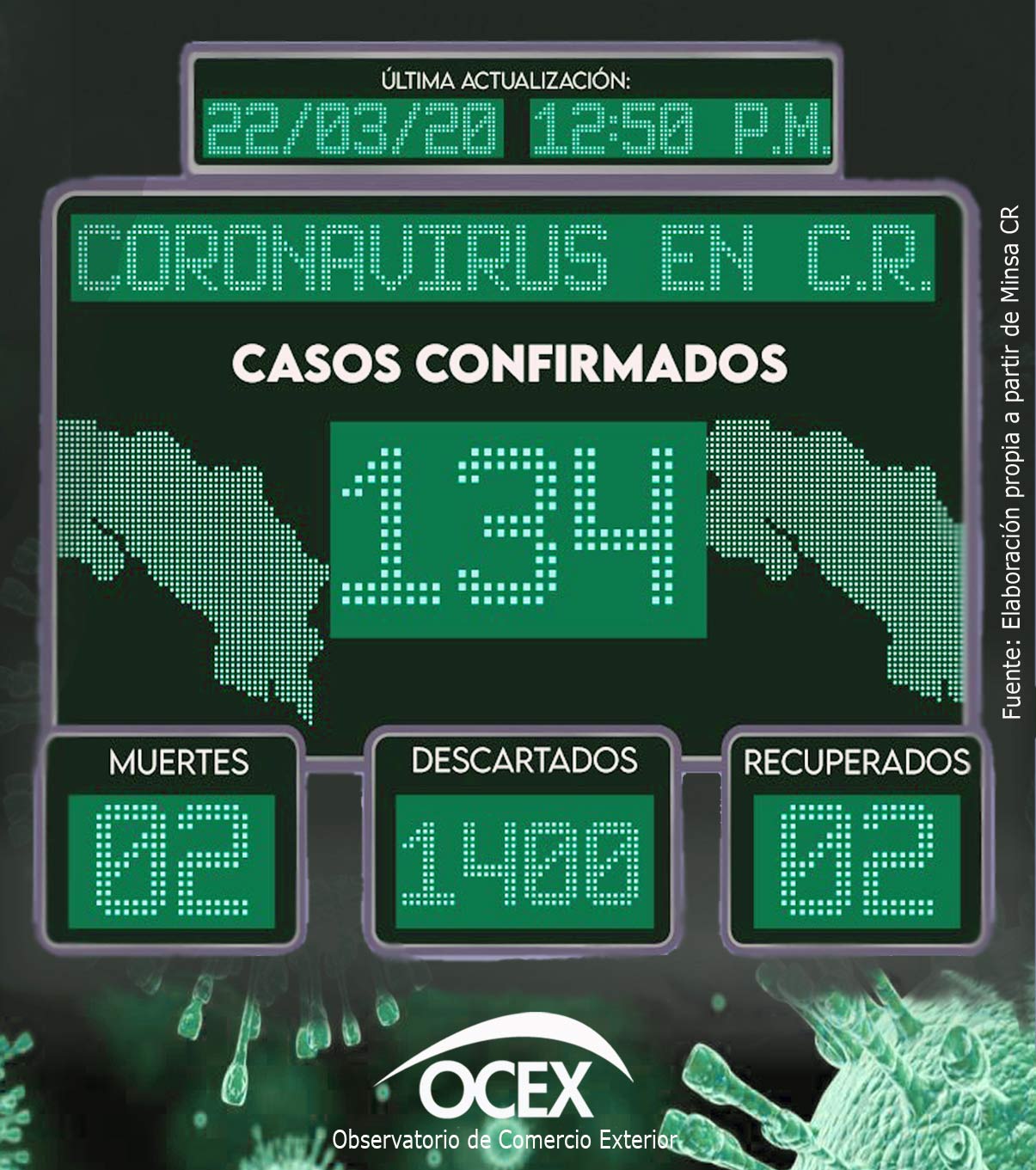
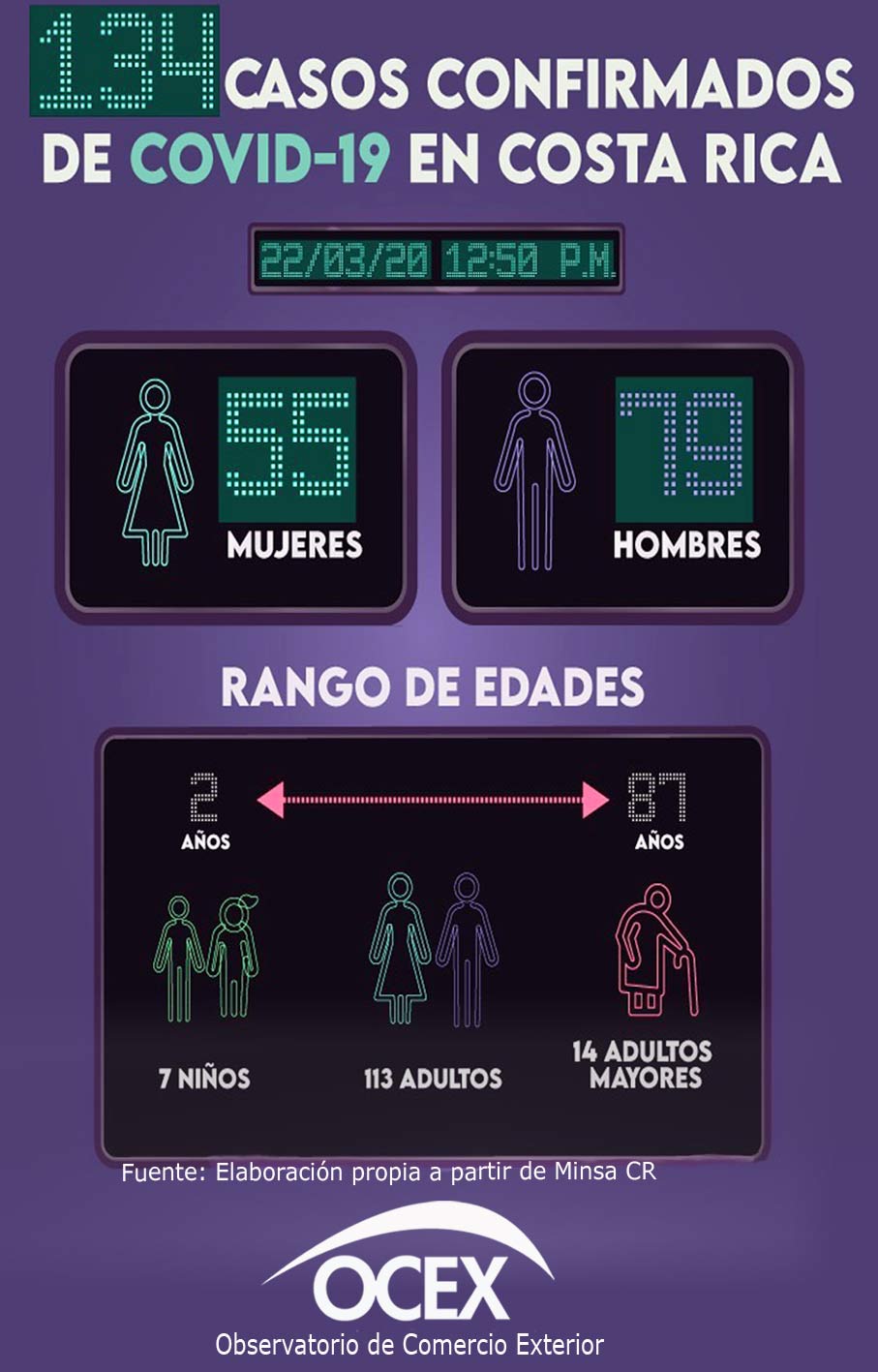
Today, March 22, 2020, there are 134 reported cases of covid-19 infection in Costa Rica. The statistics include two fatalities, both 87-year-old male patients. The first to die, on Wednesday, March 18, was a retired doctor, who also suffered from hypertension and was a resident of Alajuela. On the night of Thursday, March 19, the Ministry of Health confirmed the second death.
Readings consulted:
- BBC News World - March 17, 2020. Coronavirus: the collapse of the Chinese economy by the coronavirus (and why it is a "great threat" to the world): https://www.bbc.com/mundo/noticias-internacional
- Medium.com. 10 de marzo 2020. Tomas Pueyo. Coronavirus: Why you must act now: medium.com/@tomaspueyo/coronavirus-act-today-or-people-will-die-f4d3d9cd99ca
- The Nation. March 13, 2020. Alberto Trejos. Economist: Main Impacts of COVID -19 will be felt in tourism, entertainment, raw materials and education: https://www.nacion.com/economia/politica-economica/alberto-trejos-economista-principales impacts/BOCMOH7ZNVA6RMZAQBAHTX7NCM/story/
- The Nation. March 18, 2020. Chambers fear collapse due to lower consumption and export closure: https://www.nacion.com/economia/negocios/sector-privado-teme-colapso-en-empresas-por-menor/MMEC2YJM5NHRXJDBYPSBQKKRBA/story/
- The Nation. March 10, 2020. Virus cools down the country's exports and imports:https://lanacioncostarica.pressreader.com/la-nacion-costa-rica/20200310/textview
- The Nation. March 17, 2020. Hotels report more than 10,000 cancelled nights: https://lanacioncostarica.pressreader.com/la-nacion-costa-rica/20200317/textview
- The Nation. March 18, 2020. Approved postponement of payment of four taxes: https://lanacioncostarica.pressreader.com/la-nacion-costa-rica/20200318/textview
- Presidential House. Communiqués. March 14, 2020. Government presents measures to protect workers and companies from the economic effects of covid-19: https://www.presidencia.go.cr/comunicados/2020/03/gobierno-presenta-medidas-para-proteger-trabajadores-y-empresas-ante-los-efectos-economicos-del-covid-19/
- The Nation. March 15th, 2020. EDITORIAL, PAGE 16. The global impact of covid-19: https://lanacioncostarica.pressreader.com/la-nacion-costa-rica/20200315
- Delfino.cr. 14 March 2020.Government announces 5 economic counter measures 19: tax moratorium and price regulation: https://delfino.cr/2020/03/gobierno-anuncia-5-medidas-economicas-contra-covid-19-moratoria-de-impuestos-y-regulacion-de-previos
- Communiqué Presidential House. March 19, 2020. Government launches 1 billion colones Plan Proteger to address consequences of covid-19: https://www.presidencia.go.cr/comunicados/2020/03/gobierno-acciona-plan-proteger-de-1-billon-de-colones-para-atender-consecuencias-del-covid-19/
- The Nation. March 20, 2020. Last night: Covid-19 kills another 87-year-old man: https://lanacioncostarica.pressreader.com/la-nacion-costa-rica/20200320/textview
- Crhoy.com. 20 March 2020. Health confirms 113 cases of COVID-19: https://www.crhoy.com/nacionales/salud-confirma-113-casos-de-covid-19/?utm_source=webPushNotification&utm_medium=ultimaHora&utm_campaign=ultimaHora
Más artículos…
Página 23 de 53