


Boletines-Artículos
La hora de Macron

POR VELIA GOVAERE VICARIOLI
El impulso al armamento europeo, provocado por la agresión rusa contra Ucrania, señala una novedosa tendencia comunitaria a asumir protagonismo propio como bloque autónomo.
Todavía no llegamos a eso, ni será sencillo. Habrá que superar muchos escollos. Estados Unidos no es la menor de esas barreras, ya que da por descontada una Europa dependiente.
En la hora de los hornos, cuando la guerra en Ucrania amenaza un aborto prematuro de la globalización, la Unión Europea reclama un liderazgo capaz de rescatarla en este fatídico trance.
En ausencia de Merkel, Emmanuel Macron ocupa un espacio decisivo en su conducción. Nadie como él ha señalado a Europa un derrotero propio y propuesto la unidad política, económica y defensa autónoma.
Accese el artículo completo en: https://www.nacion.com/opinion/columnistas/la-hora-de-macron/54UPXC5CYVAJPFERIRGPI6E6FA/story/
Artículo publicado en Periódico La Nación, 15 de marzo 2022.
La autora es coordinadora de OCEX y catedrática de la UNED
The question of the day in Ukraine
Free translation
By VELIA GOVAERE - Professor UNED
On February 24, 2022, Russia invaded Ukraine. That unjustified aggression awakened the universal conscience to the fragility of the geopolitical equilibrium we live in. Since the fall of the Berlin Wall, peace has been taken for granted. Sheltered by it, we have quietly plunged into a life bordering on the inconsequential.
Rampant consumption, globalized trade and technological advances have brought us into a comfortable but misleading comfort zone. The fray reveals the brittle foundations of our expectations of promising futures. The universal civilization we proudly built shows feet of clay, in Ukraine. But the outrageous proximity of this fateful aggression threatens to obscure its greater historical significance.
Much is at stake in Ukraine. It is up to our generation to save the underlying rationality of the civilizational arena, with its plethora of international policies upholding peace. Assaulted by unprecedented realities, we find ourselves blinded by terrifying scenarios. The danger of a nuclear cataclysm cannot be ruled out. Millions of refugees bring to Europe realities that until recently were far away. It is no longer as easy to close borders to a Ukrainian refugee as it is to those still escaping from Afghanistan and Syria. The outrage over the shelling of Mariupol barely conceals the indifference to the destruction of Aleppo.
But beyond xenophobic differences, Russia's aggression unleashed a morally justified global outrage. Its assault on Ukraine deserves universal condemnation based on elementary political and human principles.
Popular anger has turned, however, into a triple wave of pressure on governments and multinationals. They are being urged to give humanitarian aid to Ukraine, asylum to its refugees and funds for its reconstruction at the end of the crisis. It is also demanding military aid to Ukraine and greater military investment, in a European armament race, unseen even in the Cold War. There are calls for punishment of the aggressor, on a scale never seen before. All these demands are understandable and natural, some of them responding to moral criteria and others to reactive defensive and security policies.
Demands for humanitarian relief should be unconditionally supported. Further consideration requires easy accommodation of punitive populism. We are a global village of spectacle. Bombings horrify us, in real time, with painful images. Zelensky accesses live US, EU and UK legislators. His exhortations to greater war commitment are applauded in those scenarios and there they unleash demands for greater armed involvement in the conflict.
From the Ukrainian president's dramatic appeal, it is difficult to deduce guidelines that respond to the deeper and long-term problems of the conflict. Supposed to solve them, emotionally reactive policies tend to complicate the strategic problems. Each sanction raises the stakes, incites retaliation, and they call for further pressure. A perverse cycle. In democracy, this spectacle of suffering becomes an electoral factor, with undue pressure on governments at the point of the ballot box, as in France in April and the United States in November.
More than 20 countries continue to weaponize Ukraine. Thousands of thousands of foreign weapons flood battlefields. Country after country adds to more than 4 thousand sanctions on Russian individuals and companies. Seven Russian banks are excluded from SWIFT. The central bank's foreign reserves are frozen and airspace is closed to its civil aviation. Everything is in crescendo. It seems to be the only way to intervene without direct confrontation. It has its logic, but history has revealed its low effectiveness and risky cost.
Apart from rational sanctions, a cultural escalation was also unleashed, a kind of indiscriminate Russophobia. Orchestra conductors, artists, sportsmen, the Bolshoi and even dead writers pay for being born Russian. It is an inhuman collective behavior, generating a toxic social context.
We are in a vortex. It is difficult to elucidate a way out of this spiral of excessive danger. Insufficient punishment leads to new punishment and the substitution of physical confrontation risks crossing the thin red line of the common sense of national survival. And since no one can calculate the incalculable, one minute later there will be no time for regrets.
The clash of two opposing logics in foreign policy is Max Weber's dilemma. Two opposing rationalities. One, that of deserved punishment, the other, that of desired consequences. In Michael J. Mazarr's Leap of Faith, it is shown that the wars in Iraq and Afghanistan were reactive policies to the public outrage over the 9/11 attack. But punishing Saddam and the Taliban was costly.
Beyond moral questions, linked to the fairness of punishments and sanctions, the governments of the leading powers of the United States, China, the European Union and Russia know that they are playing with fire. It is difficult to recognize that there have been errors of judgment and policy. That no longer matters so much. We are beyond blame. But one thing is clear: international politics must be taken out of the public spectacle. It is time for sobriety, prudence and discretion in actions, words and policies.
Rebuilding a sense of international trust with a shared security system, facilitating understandings, addressing grievances, and reaching a bad settlement to get out of a worse fight, will not be a "fair" outcome. But reversing what has been walked and stopping the escalation of mutual maximalism is desirable and necessary to extinguish the lit fuse that could end in collective tragedy.
The question of the day, perhaps of the century or even of human history, examines the profound logic of the moment. It is about deciphering the axes of thought that should guide the minds that are deciding how to get out of this unusual crisis.
La pregunta del día en Ucrania
Versión en inglés
POR VELIA GOVAERE VICARIOLI
El 24 de febrero del 2022 Rusia invadió Ucrania. Esa injustificada agresión despertó en la conciencia universal la fragilidad del equilibrio geopolítico que vivimos.
Desde la caída del muro de Berlín, la paz se ha dado por sentada. Cobijados por ella, nos hemos sumido tranquilos en una vida rayana en lo intrascendente.
Consumo desbocado, comercio globalizado y avances tecnológicos nos han llevado a una cómoda pero equívoca zona de confort. La refriega revela las quebradizas bases de nuestras expectativas de futuros promisorios.
Accese el artículo completo en: https://www.nacion.com/opinion/columnistas/la-pregunta-del-dia-en-ucrania/DHCY5C3S7ZD4FOK2XRTNEZDNKU/story/
Artículo publicado en Periódico La Nación, 26 de marzo 2022.
La autora es coordinadora de OCEX y catedrática de la UNED
Ponemos a su disposición el siguiente contenido adicional relacionado:
- Perspectivas del 28 de febrero ("Vientos de Guerra"): https://www.nacion.com/opinion/columnistas/vientos-de-guerra/DGKIGSQVTJB7PFL34Y2RB7YVFY/story/)/
- Perspectivas del 7 de marzo ("Hay que parar esta guerra"): https://www.nacion.com/opinion/columnistas/hay-que-parar-esta-guerra/AHI2W2HJJZCVRAMEKESYAQISW4/story/)
American University en Washington DC
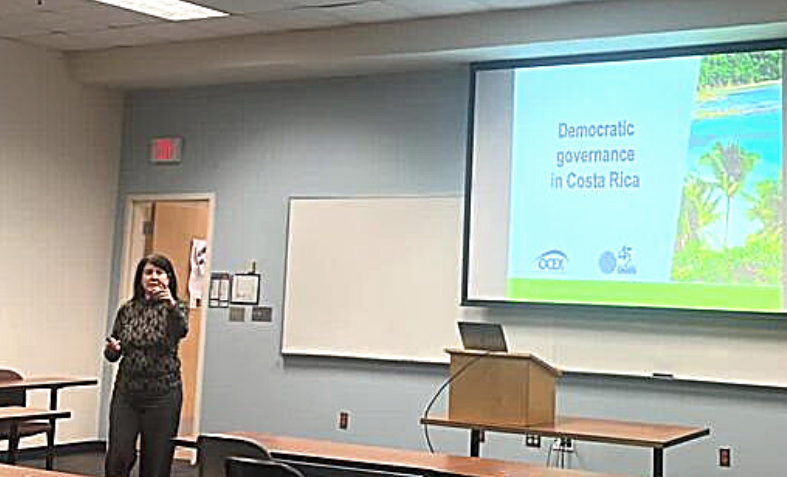 El 12 de abril del 2022, Govaere fue invitada a participar en una sesión del curso sobre “Comparative Policies”, a cargo del Profesor Haskologlu. Isa Haskologlu es profesor asociado del programa de SUSI de la Universidad de Delaware y profesor de la American University ubicada en Washington DC.
En este conversatorio, Govaere compartió con sus estudiantes algunas ideas sobre la gobernanza en Costa Rica, incluyendo su sistema de pesos y contrapesos, hitos relevantes de la Constitución Política de 1949, elementos fundacionales del Poder Ejecutivo, Legislativo y Judicial y desafíos actuales de nuestra gobernanza. Para finalizar su ponencia, Govaere expuso brevemente algunos elementos del sistema electoral costarricense finalizando su ponencia con una breve comparación con el sistema norteamericano.
Ponemos a disposición de nuestros usuarios la PP del conversatorio.

Más artículos…
Página 34 de 131

