


Boletines-Artículos
The stubborn democratic recession
Free translation
By VELIA GOVAERE - Professor UNED
At the dawn of a new year, humanity is torn between hardships with no sign of solutions. In the third year of the pandemic, 37 after the first climate change conference and 33 after the fall of the Berlin Wall with the beginning of globalization, each progress came with unattended challenges. From one crisis we move on to the next without having solved the previous one, in search of political answers. But they are not forthcoming.
We are at a crucial moment, where every false step brings us closer to the abyss. In the midst of a redundancy of dissonant noises, we remain deaf. One more day seems enough. It is not. We need a foreseeable future, which we do not have. Amidst so much uncertainty: the generalized political crisis summarizes the civilizational anguish.
The predicament we are going through is not the dilemma of a political current, but a crisis of the system. In both developed and emerging countries, populist threats contaminate all environments and political systems are on the defensive. This democratic recession is the cracked cornerstone of the foundations of our civilization.
But the political crisis of greatest consequence is in the United States. Specialists have been warning of a civilizational decline there for years. Trump has been a nefarious catalyst of the negativities of this system.
Trump's impact is reflected in national self-esteem. Within four months of his inauguration, the Pew Research Center showed that 58% rated their democracy as working "well" or "very well." It was the country's usual narrative. Trump was just beginning his rampage.
A current NPR/Ipsos poll reveals a drastically different perception, where 64% think their system of government is in crisis. And 70% feel the country is about to crack.
That's the impact of four years of Trump. Democrats fear a quiet coup d'état and a Trump comeback propitiated by restrictions on suffrage and new powers to nullify votes. In the Republican imagination, the crisis is the product of an electoral "fraud" in 2020. It has been established that when electoral results are lost, they are not valid. This is Trump's legacy.
More important than opinions are the alarm call Biden has made. On the anniversary of the assault on the Capitol he said Trump had a "knife at the throat of democracy." He repeated the sense of urgency in Georgia when he charged that 19 states with Republican legislatures enacted 34 anti-voting rights laws. He added: "The issue is no longer who gets to vote, but making it harder to vote. It is who counts the vote and whether that vote counts. It's not hyperbole; it's fact."
Biden is referring to the Republicans' legislative offensive in states where they have a legislative majority. This anti-democratic move focuses on the so-called swing states where elections are close, such as Florida, Georgia, Arizona, Texas, Pennsylvania, Wisconsin, Michigan. To restrictive laws are added changes in the electoral bodies. Democratic members of the Electoral Boards were replaced by Republicans, in systematic purges. These boards manage the electoral procedure and certify decisive results, reviews, and recounts. Therein lies what is now called a silent coup d'état.
In this scenario, the mid-term elections are coming up in November, in which Biden will probably lose his legislative margin. Even without the new Republican restrictions and gimmicks, it is usual for presidents to suffer mid-term losses. In 2010, Obama lost 63 seats and Trump, 35, in 2018. This time, the Republicans with only 5 seats would have a majority in the House of Representatives and the possibility of vetoing all Biden's legislation. If Biden were more popular he might face that threat. But he is not.
Faced with that Republican offensive and even anticipating it, with Trump still president, Democrats prepared countervailing federal legislation. With Biden's victory, the House passed that legislation and passed it to the Senate. There, the Republicans apply a filibuster that requires a 60% majority to pass laws they oppose. With this mechanism, they refuse to even discuss Democratic proposals.
Eliminating the filibuster requires a simple majority, but two Democratic senators refuse to support Biden in that attempt. That is the background of his speech in Georgia. He had been warned early in his term of the roadblock the filibuster would put in the way of fulfilling campaign promises. But he had resisted overcoming it.
Biden had not come to grips with the profound damage Trump had inflicted on the political dialogue. He finally understood. "Today I'm going to make it clear: To protect our democracy, I support changing the rules of the Senate in whatever way is necessary to prevent a minority of senators from blocking the passage of legislation that protects voting rights."
Great speech, but it's not enough. It is too little too late. Will he convince the senators of his own party to suppress the filibuster, at least for the voting rights laws? Will that save him from the catastrophe that awaits him in November? Probably not. But, in addition, the filibuster is preventing him from carrying out other essential parts of his mandate: reforming immigration law, strengthening unionism and combating police brutality. More worrisome, he has only until November to salvage the essentials of his proposed investment in technology, infrastructure, environment and education, which are at the heart of redeeming national cohesion.
Returning to the issue of the civilizational crisis we are experiencing, Joe Biden's presidency does not seem to be able to be a turning point. But its failure would open the way to a fateful return of Trump. In that case, which is not remote, the stubborn democratic recession will know a worse hour.
La porfiada recesión democrática

POR VELIA GOVAERE VICARIOLI
En los albores de un nuevo año, la humanidad se debate entre miserias sin visos de soluciones. En el tercer año de pandemia, 37 después de la primera conferencia sobre cambio climático y 33 de la caída del muro de Berlín con comienzo de la globalización, cada progreso llegó con desafíos desatendidos. De una crisis pasamos a la siguiente sin haber resuelto la anterior, en busca de respuestas políticas. Pero no llegan.
Estamos en un momento crucial, cuando cada paso en falso nos acerca al abismo. En medio de redundancia de ruidos disonantes, seguimos sordos. Un día más nos parece suficiente. No lo es. Necesitamos futuro previsible, que no tenemos. Entre tanta incertidumbre, la crisis política generalizada resume la angustia civilizatoria.
Accese el artículo completo en: https://www.nacion.com/opinion/columnistas/la-porfiada-recesion-democratica/42FFWUIJVNEZHHW454SCO2VV7A/story/
Artículo publicado en Periódico La Nación, 15 de enero 2022.
La autora es coordinadora de OCEX y catedrática de la UNED.
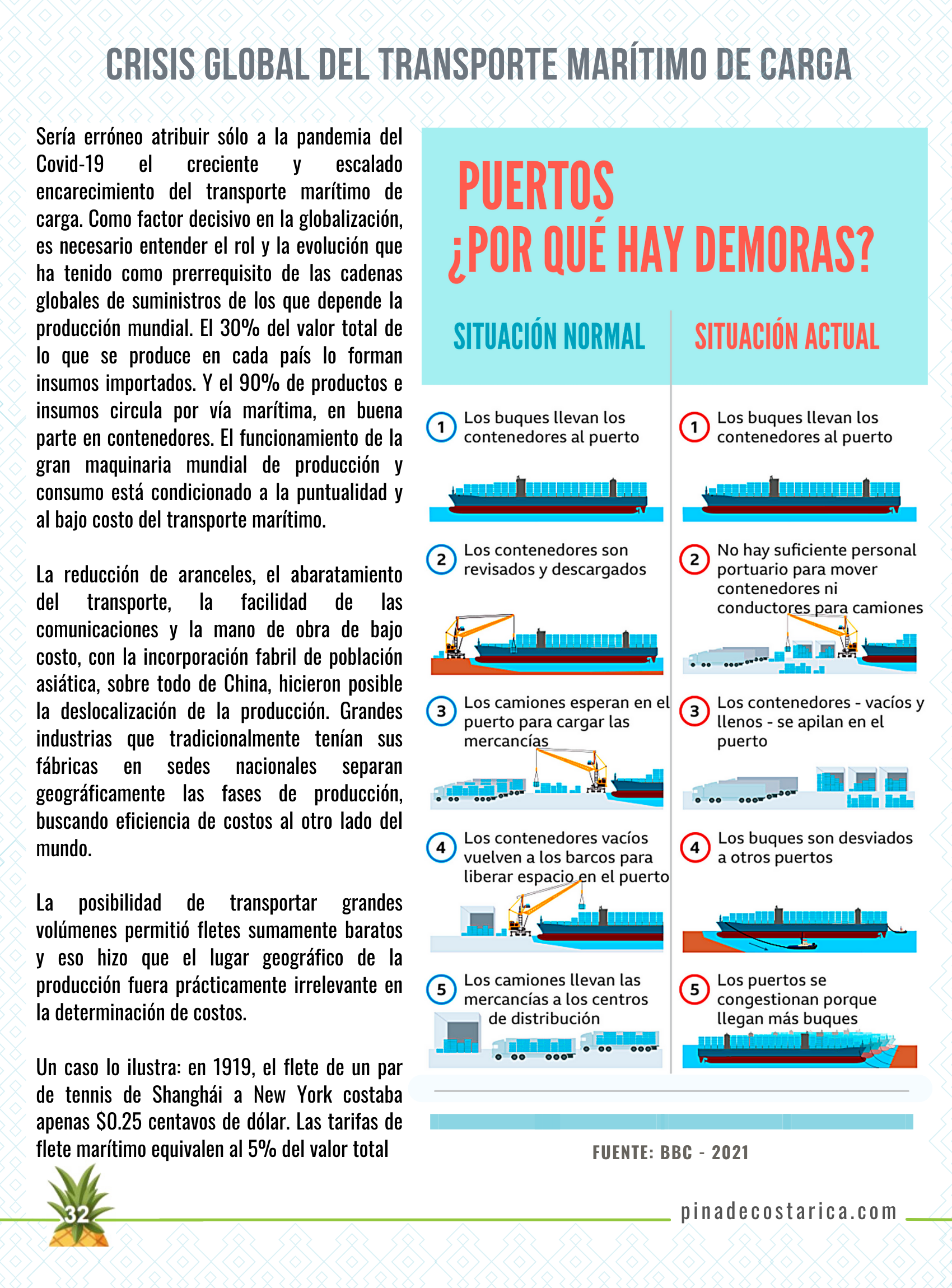
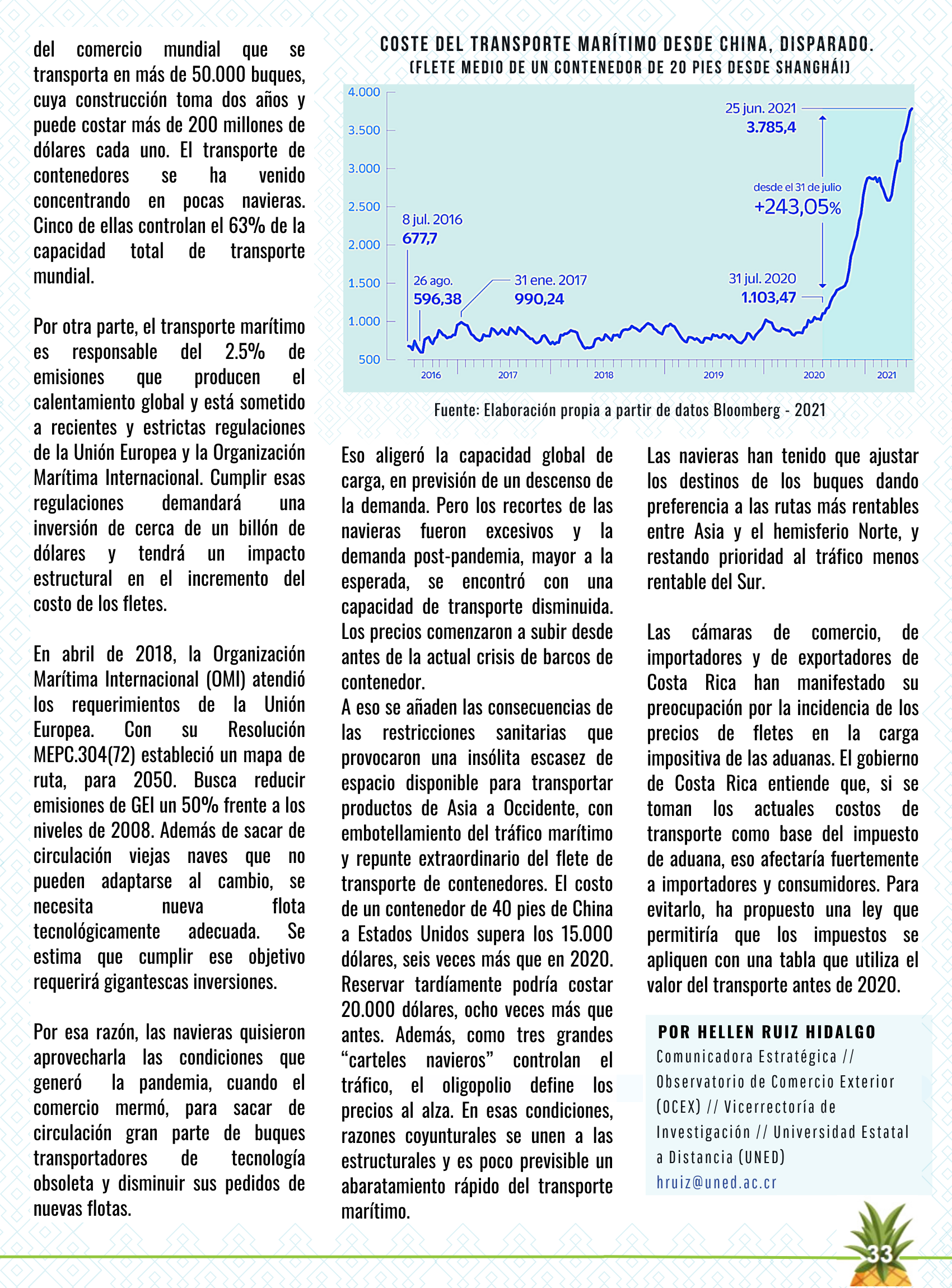
Crisis global del transporte marítimo
OCEX se complace en compartir con sus suscriptores un análisis de la importancia y el estado de situación del comercio marítimo en la globalización, así como de las repercusiones de la pandemia del Covid-19 en la crisis del transporte y logística de barcos de contenedores. Esta es una contribución de Hellen Ruiz Hidalgo, Comunicadora Estratégica de OCEX, a solicitud del Sector Productivo Nacional Piñero, para su Revista Piña de Costa Rica.
Ponemos a su disposición este análisis publicado en las páginas 32 y 33 de la Revista Piña de Costa Rica (Edición 41. Año 2021).
Accesar la revista completa, en: https://pinadecostarica.com/2021/12/revista-pina-de-costa-rica-edicion-41
Seguidamente, encontrarán el texto de ésta publicación:
Valoración de impactos TLC con China
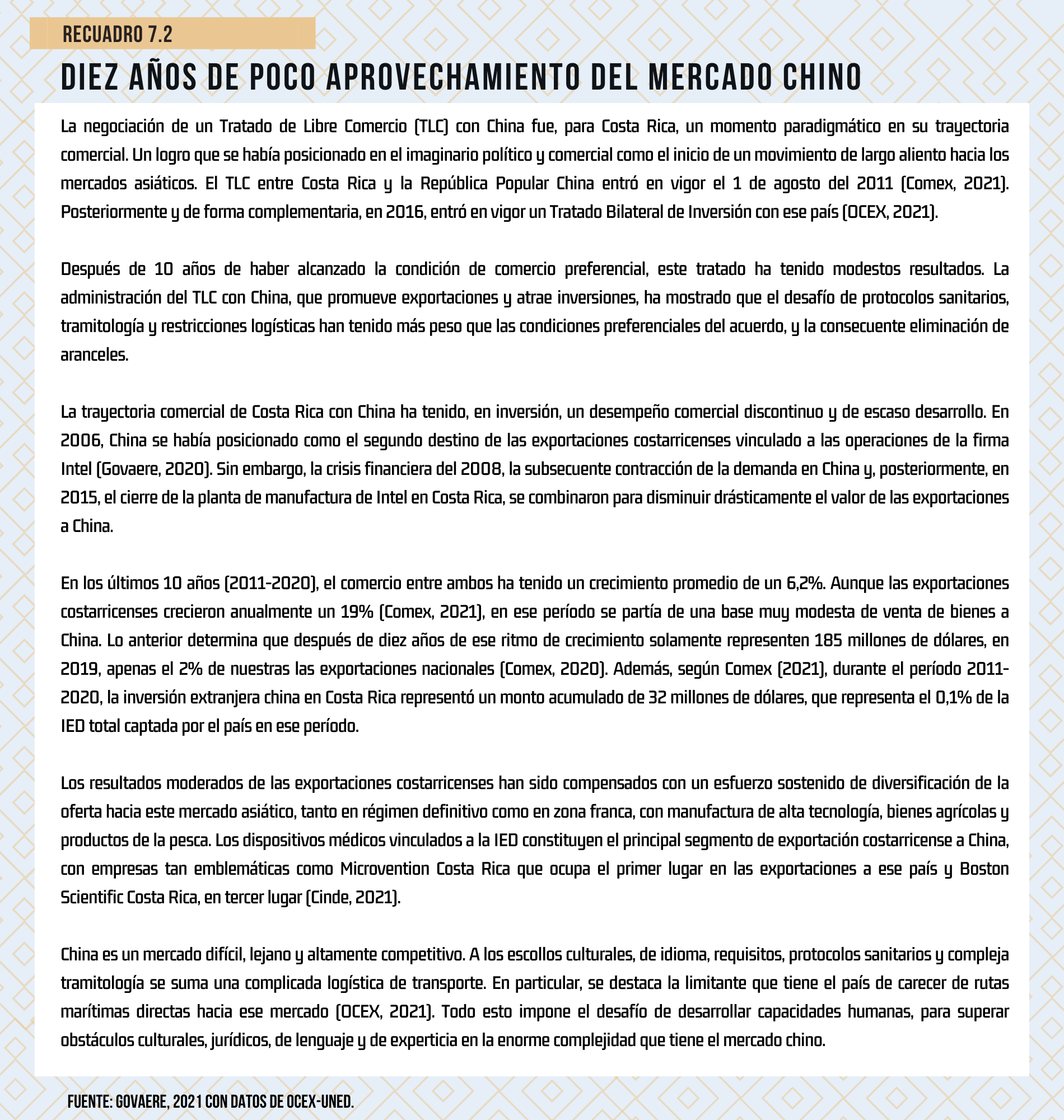
OCEX se complace en compartir con sus usuarios una valoración del desempeño que ha tenido el TLC entre nuestro país y la República Popular China, a diez años de su puesta en vigencia. Esta es una contribución al Estado de la Nación de parte de la coordinadora de OCEX, Velia Govaere, que también integra, desde hace años ya, su Consejo Consultivo. En el recuadro 7.2 de la página 311 del Informe del Estado de la Nación del 2021 se encuentra plasmada una somera pero crítica evaluación de los retos y desafíos que ha presentado para nuestro sector productivo diversificar su oferta exportable a este importante socio comercial. Abajo encontrarán el texto del Informe del año 2021 con este aporte.
 .
.
Más artículos…
Página 37 de 131

