


Boletines-Artículos
BRICS+ Undervalued Geopolitical Protagonism
MBA. Hellen Ruiz Hidalgo
Strategic Communicator
Foreign Trade Observatory (OCEX)
Vice-Rectory for Research - Distance Learning State University (UNED)
Introduction. In this capsule, which is OCEX's second installment on the subject of the BRICS+ countries, we will explain in greater depth the development of the BRICS, their evolution since their summits, the current situation and the prospects that lie ahead. This capsule seeks to provide an overview of the BRICS+ countries in the context of a changing era marked, among other things, by changes in the relative weight of the countries that govern global geopolitical governance. That regency has been dominated, since 1975, by the G7 countries, under US leadership. The BRICS+ are manifesting themselves as a challenge to the G7's control of the multilateral organizations that govern the world economy. We share with you in the following link the first installment of OCEX, on this topic, entitled: Capsule #1-2024|BRICS: an alternative geopolitical and economic bloc.
BRICS+ catalyst for a new international order. The acronym BRICS+ refers to the countries that make up a coalition that coordinate their economic and diplomatic efforts around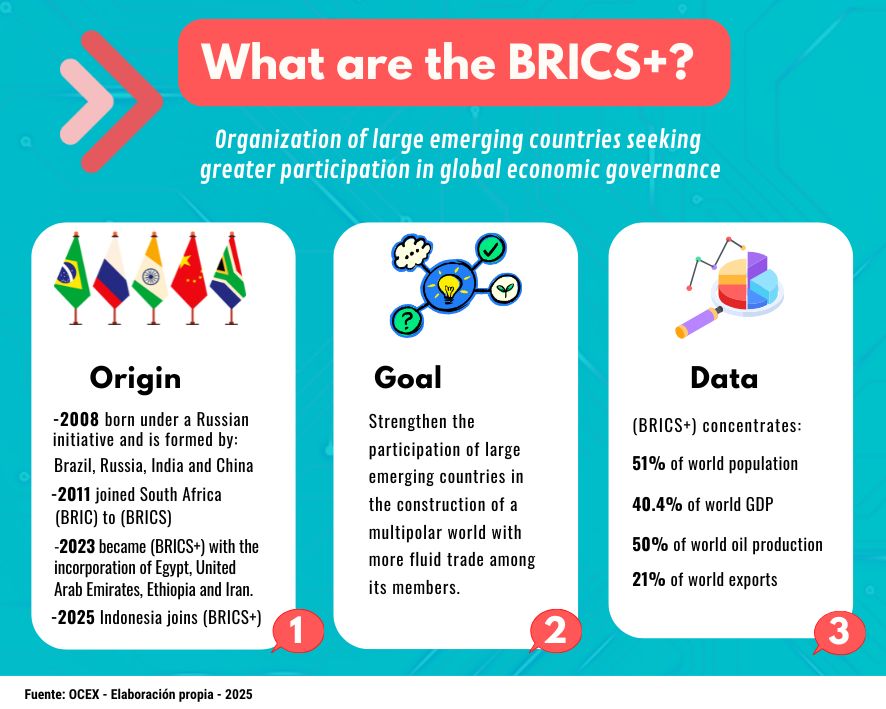 common objectives. They function as a loose bloc. Basically, they are an informal grouping of emerging economies that associate to achieve geopolitical influence in accordance withtheir growing economic weight and enormous demographic size.
Its original name was “BRIC” and originates from the initial letters of its founding countries: Brazil, Russia, India and China. South Africa was added to them, changing its name to BRICS. After the summit in South Africa, five new members were added, making its more accepted designation BRICS+.
BRICS+ base of scoop. The term BRIC was originally coined by Goldman Sachs economist Jim O'Neill in 2001, in which he outlined the growth of Brazil, Russia, India and China (“BRIC”) and made a warning and recommendation. He warned that these countries were on the verge of overtaking almost all of the dominant rich economies of the G7, except for the United States which would continue to compete closely with China. He recommended that they be taken on with their weight in global financial decision-making bodies. His warning was heeded. His recommendation was not heeded and this resulted in these countries opting to group together so that their weight would be considered in global economic governance.
Discrimination in global governance. Discrimination in global governance. At first glance, it was not clear that the awareness of discrimination in world governance would lead to a movement of countries with the most dynamic productive, commercial and demographic evolution and less taken into consideration. Nor was there, in this realization of organic handicap in multilateral organizations, the weight that the punitive use of the dollar could have to mobilize against countries that were against the United States.
Context of the origin of the BRICS+. The origin of the BRICS+ is therefore due to a complex combination of geopolitical discontent, national senses of monetary defense and old claims linked to the colonial and neocolonial past after the Second World War. The functional separation of the developed world from the emerging world evoked that past-present and conjured up the need for concerted action.
It was not the first time that the international concertation of less developed countries was invoked to seek ways to build a community of nations with similar problems, as well as to undertake actions aimed at alleviating their economic dependence, fundamentally based on the negative evolution of the terms of trade, for the dependent countries: increasing value of manufacturing exchanged for decreasing value of primary goods.
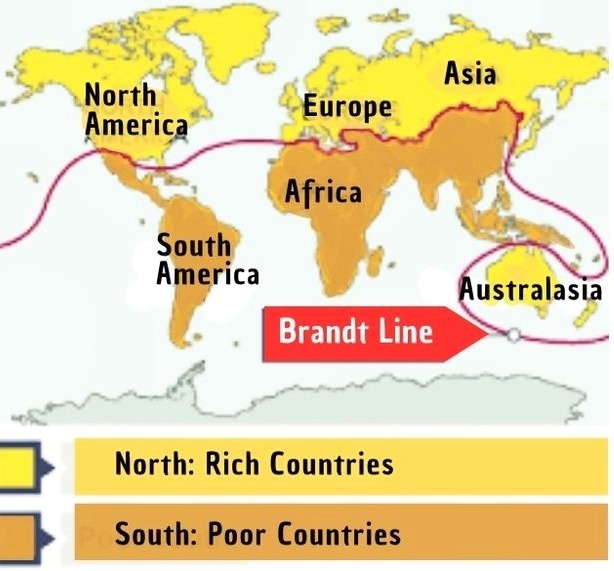 “The Brandt Line”. An attempt at geographical precision between development and underdevelopment was made in the Report of the Brandt Commission, chaired by German Chancellor Willy Brandt at the end of the 1970s, which presented a so-called “Brandt Line” as an expression of the division of the world into North and South, as a georeferenced expression of the gaps between the differentiated development of the world's regions. The “Brandt Line” divided the world in terms of economic development into North and South.
From the point of view of geopolitical mobilization, the first major attempt was the construction of the Non-Aligned Movement, founded at the Bandung Conference in 1955, under the leadership of India, Egypt and Indonesia.
There were also national and regional strategies to overcome the terms of trade disadvantage, such as the attempts at Import Substitution Industrialization (ISI) that took place in Latin America and in Asian countries such as Korea. But the fundamentals changed when the Cold War ended and the absence of ideological rivalries between countries allowed the free movement of capital.
With the ability to invest where there were better returns, the search for economic efficiency pushed companies from the developed world to move their factories to the underdeveloped world in search of lower labor costs. The effect of this was the double process of manufacturing industrialization in the dependent countries, on the one hand, and industrial manufacturing relocation from the United States and Europe, on the other. This has changed the pieces of the international commercial geopolitical chessboard. Consider, for example, that China currently has a manufacturing output three times greater than that of the United States and already accounts for 35% of the world's gross manufacturing output.
To these processes should be added two decisive components that would push the larger emerging countries to defend themselves. One was NATO's decision to expand, threateningly encircling Russia. The other was the increasingly widespread use of the US dollar as a sanctioning weapon against countries that went against its guidelines in any way.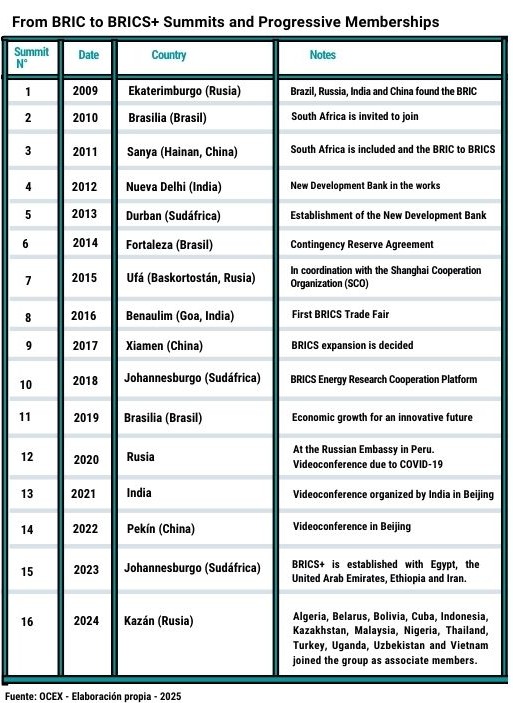
Birth of BRICS+ as a defensive movement. Russia was the first to convene a meeting of the four founding countries, in 2009. Its President Vladimir Putin had been confronted with NATO's decision to expand into Ukraine. He had warned that it would pose an existential threat to Russia. Russia warned that it would not tolerate NATO expansion into Ukraine. At the same time the Russian establishment understood that the West would not stop its enveloping move against Russia. It also understood that it would not be enough to oppose this movement with military force, but that it would also be threatened with economic isolation due to the dominance of the dollar in the hands of the United States, which would be used as a financial weapon in a possible war.
BRICS+ Russian precautionary initiative. Thus, it was that, in an extraordinarily proactive manner, Russia called for the organization of several countries that could also fear economic aggression by the U.S. dominance of the dollar. Thus, the BRICS+ were the product of a precautionary Russian initiative, which has allowed it to overcome all the sanctions it has been subjected to in its confrontation with NATO in Ukraine. Just as the United States tried to economically break Russia in 6 months, excluding it from all international transactions in dollars, Russia, for its part, had already spent 14 years building its international support network: the BRICS+.
BRICS+ towards a multilateralism without hegemonies. In 2009, Russia hosted and hosted, in Yekaterinburg, the first official summit. South Africa joined a year later at China's invitation, forming the five-country grouping that would persist until 2023, when the 15th BRICS Summit was held in Johannesburg, South Africa, where its expansion was decided.
By the time of the Johannesburg Summit, the BRICS+ countries had already had 15 years of excellent consensual functioning without hegemonism of any kind. Their initiatives and proposals were very attractive to many other emerging countries with regional influence. That is why several countries had applied to join.
Johannesburg Summit in 2023. The first major wave of expansion was decided. Six new applicant countries were invited to join: Argentina, Egypt, Ethiopia, Iran, Saudi Arabia and the United Arab Emirates (UAE). All accepted. Although months later Argentina declined to participate, when its new president, Javier Milei, opted for a pro-Western orientation of extreme neoliberalism.
Kazan Summit in Russia. In January 2024, the XVI Kazan Summit was held in Russia, where Iran, Egypt, Ethiopia and the United Arab Emirates joined as scheduled. Delegations from thirty-six nations and six international organizations, including the United Nations, gathered in Kazan.
Thirteen other countries were invited to join the organization in the new category created in Kazan of “Associate Members”. They were: Algeria, Belarus, Bolivia, Cuba, Kazakhstan, Indonesia, Malaysia, Nigeria, Thailand, Turkey, Vietnam, Uganda and Uzbekistan.
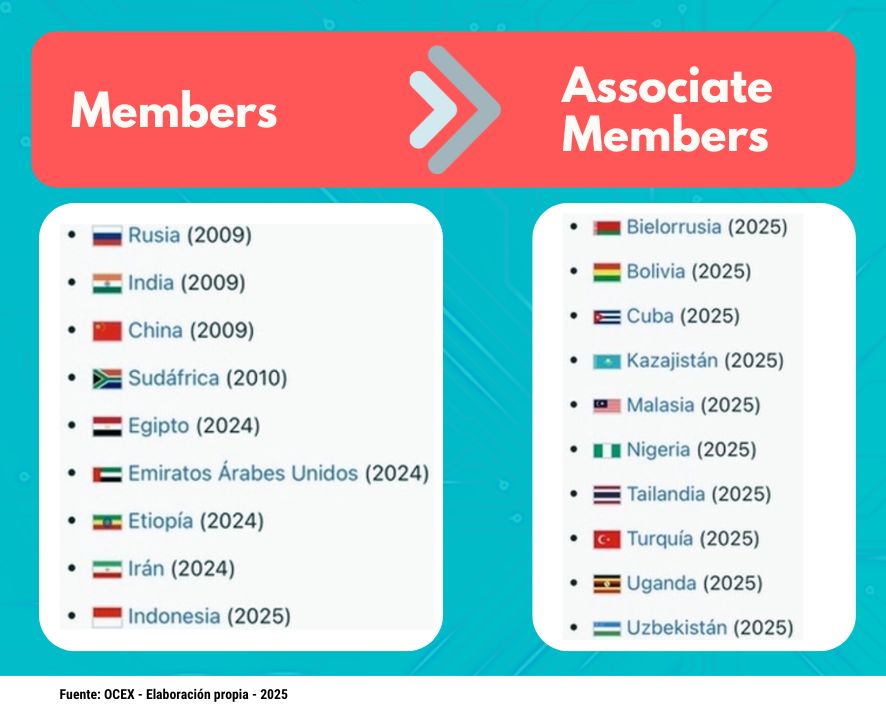 High point of the BRICS+ evolution. On January 1, 2025, eight of them accepted the invitation received in Kazan and formally joined the new category. Indonesia was the first of them to become an official member, on January 6.
Despite the enormous expansion and increased weight of the BRICS+, there is an elephant in the room: Saudi Arabia, a country invited to join and with which there are excellent relations with all BRICS+ member countries, has not yet responded to an invitation to join the BRICS that was extended to it during the Johannesburg summit in 2023. Ankara, for its part, had expressed its desire to become a BRICS member. But Turkey, which received an invitation in Kazan in 2024, is still silent on this offer of membership status.
Indonesia's entry is significant as it is the largest economy in Southeast Asia and occupies a strategic position in the Indo-Pacific. In addition, there is a whole aspect of enormous geopolitical symbolism. Indonesia presided over the birth of the Non-Aligned Movement in its capital, Bandung, and was subsequently the victim of a CIA-sponsored massacre of hundreds of thousands of communist militants. With its accession to the BRICS+, Indonesia takes up its vocation against neocolonialism and inserts itself in the modern movement of countries of the Global South that claims its space for international recognition.
The significance of Saudi Arabia and Turkey in the world is of great transcendence. Saudi Arabia is the largest oil exporter and a key player in the Middle East. Turkey, for its part, would be the first NATO member to join the BRICS+.
Each of these three countries has managed its relations with BRICS+ differently. The comparison between Indonesia's accession, Saudi Arabia's ambiguity and Turkey's aspirations offers valuable insight into the evolving role of BRICS+ in the international system and how emerging powers assert their interests, amid geopolitical uncertainty. It thus gains growing credibility, increases its attractiveness and creates a growing lineup of economies eager for viable alternatives to Western-led institutions. But the addition of more countries may dilute the group's ability to act in unison. The accessions of Turkey and Saudi Arabia would represent a qualitative step toward broader changes in the world order. It would also be an illustration of BRICS+ dynamics enhancing strategic autonomy and complicating Western geopolitical leadership in global economic governance.
In Kazan, the BRICS continued the collective, cross-cultural effort they have been promoting since their founding. Beyond the vision of their economic objectives, which are important but not exclusive, Kazan emphasized the potential of this new informal grouping of countries to design multifunctional and multifaceted spaces with its member countries.
BRICS+ as an international support network. From there, international relations are being formed based on a multipolarity that redeems the metaphysical universe prior to the industrial revolution and the colonization of the world by the Western industrial powers. It is a rescue of the cultural contents of the ancient “state-civilizations” (Persian, Ottoman, Muslim, Russian, Chinese, Amerindian, etc.).
The BRICS+ emerged from Kazan with ten countries joined by Indonesia and together they have a combined population of more than 3.5 billion inhabitants, 51% of the world's population. The aggregate economies of its members add up to a collective GDP of more than $28.5 trillion, 40.4% of the world economy. From an energy point of view, the BRICS+ countries produce almost 50% of the world's oil production and account for about 35% of total oil consumption. This is because, from the production point of view, the BRICS+ countries include Iran, Saudi Arabia and the United Arab Emirates as members or strong supporters, in addition to Russia. From the point of view of energy consumption, China represents their largest demand.
Qualitative regional geopolitical weight. In addition to quantitative factors, the BRICS+ have a strong qualitative regional geopolitical weight, as they are made up of major world-regional powers, such as China, Russia, Iran, South Africa and Brazil, countries of great influence in their respective regions.
BRICS members and partners represent the most important countries in the world in the production of crucial raw materials, such as grains, meat, crude oil, natural gas and strategic minerals such as iron, copper and nickel, as well as lithium and rare earths.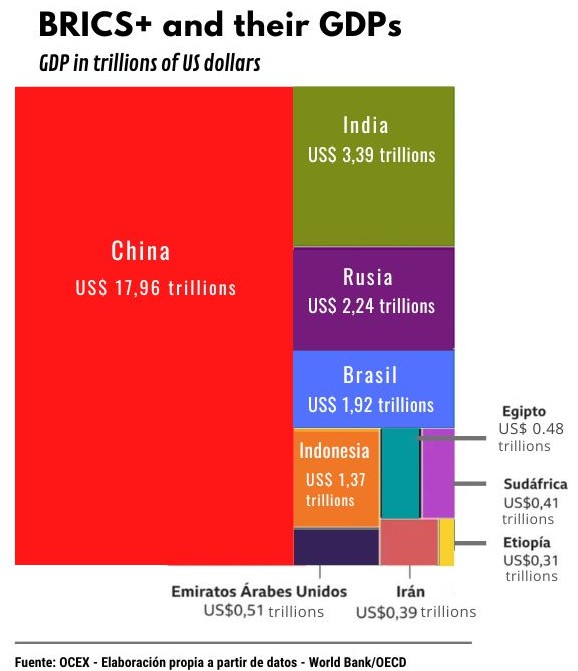
The BRICS+ manifest themselves as a challenge to the control of the G7. To understand the geopolitical vectors of the evolution of the different groups of countries, BRICS+ vs. G7, it is important to compare the evolution of these various groupings of nations: the G7 countries now account for only 29.08% of world GDP (PPP), showing a decisive decline from 1990, when they accounted for 52%.
Functioning as a flexible bloc. The bloc is based on consensus decision-making and is largely informal: it has no defined statutes, secretariat or common funds. Each country holds the presidency for one year and is responsible for priorities and for organizing a summit of heads of state that meets annually. The bloc has sought to coordinate the economic and diplomatic policies of its members, establish new financial institutions and manage their economies and trade by seeking to counteract, at least relatively, dependence on the U.S. dollar, especially by promoting direct trade among its members in national currencies. The BRICS+ countries are not seeking to build an alternative to the main multilateral groupings, such as the World Bank, the Group of Seven (G7) and the UN Security Council, but rather to find ways to increase their influence in what they consider is still the unrestricted dominance of the Western, primarily U.S., viewpoint in these bodies.
BRICS+ and their collective financial management. The BRICS+ countries created the New Development Bank (NBD) to finance the drive for infrastructure development and connectivity in their regions. This quickly became a reality and by 2022, it had already succeeded in granting loans to emerging countries for more than US$32 billion, for new roads, bridges, railroads and water supply projects. Some thematic areas underline its priorities:
- Increased representation in global organizations. BRICS aims to establish a united front of emerging economy perspectives in multilateral institutions. The group aims both to push for reform of existing institutions, such as the expansion of the UN Security Council, and to form negotiating blocs within those institutions. For example, many BRICS countries opposed UN condemnation of Russia's war in Ukraine and have sought common positions on Iran's nuclear program and the conflicts in Afghanistan, Gaza, Libya and Syria.
- Coordinate economic policy. The 2008 global recession hit the BRICS countries hard, leading the group to emphasize economic coordination on issues such as tariff policy, export restrictions on critical resources and investment. The bloc's annual foreign direct investment (FDI) flows more than quadrupled between 2001 and 2021, although they have slowed in recent years.
- Create an alternative financial system. The group's New Development Bank (NDB) and Contingent Reserve Arrangement (CRA) aim to mimic the World Bank and the International Monetary Fund (IMF), respectively. BRICS members hope that alternative lending institutions can invigorate South-South cooperation and reduce dependence on traditional sources of financing.
- Reduce dependence on the U.S. dollar. Increasingly unhappy with the dollar's dominance in global transactions, which exposes them to Western sanctions, BRICS leaders have long advocated de-dollarization in favor of greater trade in local currencies or even a possible common BRICS currency.
Bibliography consulted:
- BRICS catalyst. Crisis Watch. 24 August, 2023. “BRICS expansion is the “main catalyst” for the new world order marked by the “end of the petrodollar.” https://observatoriocrisis.com/2023/08/24/la-expansion-de-los-brics-es-el-principal-catalizador-del-nuevo-orden-mundial-marcado-por-el-fin-del-petrodolar/
- BRICS+ base scoop. Haibin, Niu. 2012. BRICS in global governance : a progressive force ? - Friedriech Ebert Stiftung (FES). New York. At: https://library.fes.de/pdf-files/iez/09592.pdf
- BRICS+ towards a multilateralism without hegemonies. Maihold, Günther and Villamar, Zirahuén. 2016. The G20 and emerging countries. International Forum. Vol.56 no.1 Mexico City. Mexico. At: https://www.scielo.org.mx/scielo.php?script=sci_arttext&pid=S0185-013X2016000100165
- Discrimination in global governance. Rebelión. Homar Garcés. 01 November 2024. “The BRICS and the validity of the capitalist order.” https://rebelion.org/los-brics-y-la-vigencia-del-orden-capitalista/
- Context of the origin of the BRICS+.O’Neil, Jim. 2001. Building Better Global Economic BRICs. Global Economics Paper No: 66. Golden Sachs. New York. At:https://www.goldmansachs.com/intelligence/archive/building-better.html
- The “Brandt Line. Brand, W. 1980. North South: a programme for survival; report of the Independent Commission on International Development Issues. https://idl-bnc-idrc.dspacedirect.org/items/5de304fb-519d-4675-9ad5-8ac896cb6de4
- Nicholas Lees. November 2020. The Brandt Line after forty years: The more North–South relations change, the more they stay the same? Review of International Studies 47(1):1-22. https://www.researchgate.net/publication/346915835_The_Brandt_Line_after_forty_years_The_more_NorthSouth_relations_change_the_more_they_stay_the_same.
- Birth of the BRICS+ as a defensive movement. Deutsche Welle. 10/23/2024October 23, 2024 BRICS summit: how Russia wants to expand its power. https://www.dw.com/es/cumbre-de-los-brics-c%C3%B3mo-rusia-quiere-expandir-su-poder/a-70581038
- High point of the BRICS+ evolution. XXIII International Congress of Accounting, Management and Informatics. October 2018. BRICS evolution, achievements and challenges for its projection. https://investigacion.fca.unam.mx/docs/memorias/2018/15.01.pdf
- BRICS+ as an international support network. Oliveira, T. et al. 2014-2018. Networks of international cooperation of the BRICS bloc: evaluation of strategic areas and potential partnerships in Science, Technology and Innovation. https://osf.io/765tn/download
- BRICS+ and their collective financial management. Stewart Patrick. October 9, 2024. BRICS Expansion, the G20, and the Future of World Order. Carnegie Endowment for International Peace.https://carnegieendowment.org/research/2024/10/brics-summit-emerging-middle-powers-g7-g20?lang=en
- BRICS+ manifest themselves as a challenge to G7 control. Maximilian G. Mooradian. September 20, 2020. The BRICS Challenge to the G7 Established International Order. Foreign Policy Research Institute. https://www.fpri.org/article/2024/09/the-brics-challenge-to-the-g7-established-international-order/
- Operationalization as a flexible bloc. Kamin, Katrin; Langhammer, Rolf J. (2024). BRICS+: A Wake-Up Call for the G7? ICE Economic Notebooks. Kiel Institute for the World Economy - Leibniz Center for Research on Global Economic Challenges. https://www.econstor.eu/bitstream/10419/306420/1/107.6_BRICS_FINAL.pdf
- Creating an Alternative Financial System. Udaibir Das. 5 November 2024, Brics' daringly autonomous model for financial sovereignty. Official Monetary and Financial Institutions Forum Think tank (OMFIF).
https://www.omfif.org/2024/11/brics-daringly-autonomous-model-for-financial sovereignty/#:~:text=The%20Brics%20declaration%20envisions%20a,payment%20systems%2C%20such%20as%20Swift. - Niall Duggan et. al. 2021. The BRICS, Global Governance, and Challenges for South-South Cooperation in a Post-Western World. International Political Science Review. https://www.researchgate.net/publication/357155480_Symposium_'The_BRICS_Global_Governance_and_Challenges_for_South-South_Cooperation_in_a_Post-Western_World'
BRICS+ Protagonismo Geopolítico Subvalorado
MBA. Hellen Ruiz Hidalgo
Comunicadora Estratégica
Observatorio de Comercio Exterior (OCEX)
Vicerrectoría de Investigación - Universidad Estatal a Distancia (UNED)
Introducción. En esta cápsula, que es la segunda entrega que realiza OCEX sobre el tema de los países BRICS+, se explicará más a profundidad el desarrollo de los BRICS, su evolución a partir de sus cumbres, la situación actual y perspectivas que se plantean. Esta cápsula busca ofrecer información panorámica de los BRICS+, dentro del contexto de un cambio de época marcada, entre otras cosas, por cambios en el peso relativo de los países que rigen la gobernanza geopolítica mundial. Esa regencia ha sido dominada, desde 1975, por los países del G7, bajo liderazgo estadounidense. Los BRICS+ se manifiestan como un desafío al control del G7 de los organismos multilaterales que rigen la economía mundial.
Les compartimos en el siguiente link la primera entrega de OCEX, sobre este tema, titulada: Cápsula #1-2024|BRICS: un bloque geopolítico y económico alternativo
BRICS+ catalizador de un nuevo orden internacional. Con las siglas BRICS+ se comprenden los países que conforman una coalición que coordinan sus esfuerzos económicos y diplomáticos en torno a objetivos comunes. Funcionan como bloque flexible. Básicamente son una agrupación informal de economías emergentes que se asocian para lograr que su influencia geopolítica tenga concordancia con su creciente peso económico y su enorme dimensión demográfica.
Su nombre original fue “BRIC” y se origina en las letras iniciales de sus países fundadores: Brasil, Rusia, India y China. A ellos se agregó Sudáfrica, cambiando su nombre a BRICS. Después de la cumbre de Sudáfrica se añadieron cinco nuevos miembros, con lo que su designación más aceptada quedó como BRICS+.
Primicia base de los BRICS+. El término BRIC fue acuñado originalmente por el economista Jim O'Neill, de Goldman Sachs en 2001, en el que exponía el crecimiento de Brasil, Rusia, India y China («BRIC») y hacía una advertencia y una recomendación. Advertía que esos países estaban a punto de sobrepasar casi todas las economías ricas dominantes del G7, menos Estados Unidos que seguiría compitiendo muy de cerca con China. Recomendaba que se les asumiera con su peso en los organismos de decisión financiera mundial. Su advertencia se cumplió. Su recomendación no fue atendida y eso dio lugar a que esos países optaran por agruparse para que su peso fuera tenido en cuenta en la gobernanza económica mundial.
Discriminación en la gobernanza mundial. A primera vista, no era claro que la consciencia de discriminación en la gobernanza mundial induciría a un movimiento de países que tenían la evolución productiva, comercial y demográfica más dinámica y menos tomada en consideración. Tampoco existía en esa constatación de minusvalía orgánica en los organismos multilaterales, el peso que podría tener para movilizarse el uso punitivo del dólar contra países que contrariaran a los Estados Unidos.
Contexto del origen de los BRICS+. Por eso el origen de los BRICS+ obedece a una combinación compleja de descontentos geopolíticos, sentidos nacionales de defensa monetaria y viejas reivindicaciones vinculadas con el pasado colonial y neocolonial posterior a la segunda guerra mundial. La separación funcional del mundo desarrollado frente al mundo emergente evocaba ese pasado-presente y conjuraba la necesidad de acciones concertadas.
No era la primera vez que se invocaba la concertación internacional de países de menor desarrollo para buscar formas de construir una comunidad de naciones con problemas semejantes, así como emprender acciones con el objetivo de aliviar su dependencia económica, fundamentalmente basada en la evolución negativa de los términos de intercambio, para los países dependientes: valor creciente de la manufactura intercambiada por cada vez menor valor de los bienes primarios.
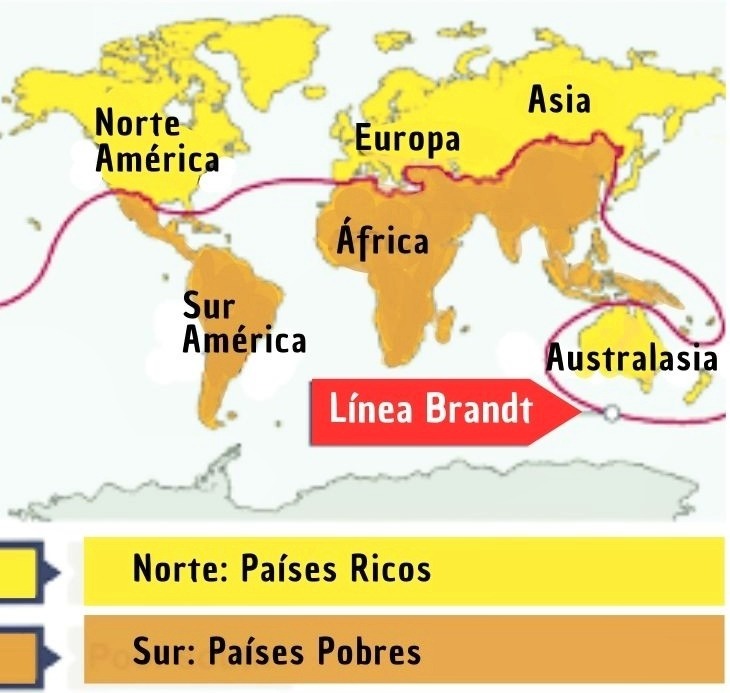 La “Línea Brandt”. Un intento de precisión geográfica entre el desarrollo y el subdesarrollo lo constituyó el Informe de la Comisión Brandt, presidida por el canciller alemán Willy Brandt a finales de los años 70 que presentó una, así llamada, “Línea de Brandt”, como expresión de la división del mundo en norte y sur, como expresión georreferenciada de las brechas entre el desarrollo diferenciado de las regiones del mundo. La “Línea Brandt” dividía el mundo en términos de desarrollo económico entre el Norte y el Sur.
Desde el punto de vista de movilización geopolítica, el primer gran intento lo constituyó la construcción del Movimiento de Países no Alineados, fundado en la Conferencia de Bandung, en 1955, bajo el liderazgo de India, Egipto e Indonesia.
También hubo estrategias nacionales y regionales para superar la desventaja de los términos de intercambio, como los intentos de industrialización por sustitución de importaciones que tuvieron lugar en América Latina y en países asiáticos como Corea. Pero los fundamentos de base cambiaron cuando terminó la guerra fría y la ausencia de rivalidades ideológicas entre los países permitió el movimiento libre de capitales.
Con la capacidad de invertir dónde hubiera mejores rendimientos, la búsqueda de eficiencia económica empujó a las empresas del mundo desarrollado a trasladar sus fábricas al mundo subdesarrollado, en busca de menores costos laborales. Eso tuvo como efecto el doble proceso de industrialización manufacturera en los países dependientes, por una parte, y la deslocalización industrial manufacturera de Estados Unidos y Europa, por otra.
Eso cambió fuertemente las piezas del tablero geopolítico comercial internacional. Tómese en consideración, por ejemplo, que China tiene actualmente una producción manufacturera tres veces mayor que Estados Unidos y responde ya del 35% de la producción manufacturera bruta mundial.
A esos procesos habría que añadir dos componentes decisivos que empujarían a defenderse a los países emergentes más grandes. Uno fue la decisión de la OTAN de expandirse cercando amenazadoramente a Rusia. El otro fue la cada vez más generalizada utilización del dólar estadounidense como arma sancionatoria de los países que contrariaran de alguna manera sus orientaciones. 
Nacimiento de los BRICS+ como movimiento defensivo. Rusia fue la primera en convocar una reunión de los cuatro países fundadores, en 2009. Su presidente Vladimir Putin se había visto confrontado con la decisión de la OTAN de expandirse hasta Ucrania. Él había advertido que eso representaría una amenaza existencial para Rusia. Rusia advirtió que notoleraría la expansión de la OTAN a Ucrania. Al mismo tiempo la clase dirigente rusa comprendió que occidente no detendría su movimiento envolvente contra Rusia. También entendió que no le bastaría oponerse a ese movimiento con la fuerza militar, sino que se vería también amenazada de ser aislada económicamente por el dominio del dólar en manos de Estados Unidos, que sería utilizado como arma financiera en una posible guerra.
BRICS+ iniciativa precautoria rusa. Fue así que, de una forma extraordinariamente anticipatoria, Rusia convocó a organizarse entre varios países que también podrían temer ser objetode agresión económica por el dominio estadounidense del dólar. Así fue como los BRICS+ fueron producto de una iniciativa precautoria rusa, que le ha permitido sobreponerse de todas las sanciones de las que ha sido objeto en su enfrentamiento con la OTAN, en Ucrania. Así como, Estados Unidos pretendió doblegar económicamente a Rusia en 6 meses, excluyéndola de toda transacción internacional en dólares, Rusia, por su parte, había tenido ya 14 años construyendo lo que fue su red internacional de apoyo: los BRICS+.
BRICS+ hacia un multilateralismo sin hegemonías. En 2009, Rusia fue sede y acogió, en Ekaterimburgo, la primera cumbre oficial. Sudáfrica se unió un año después por invitación de China, formando la agrupación de cinco países que persistiría hasta 2023, cuando se celebró la XV Cumbre de los BRICS, en Johannesburgo, Sudáfrica, donde se decidió su expansión.
Cuando llegó la Cumbre de Johannesburgo, los países BRICS+ habían tenido ya 15 años de excelente funcionamiento consensual sin hegemonismos de ningún tipo. Sus iniciativas y propuestas resultaban muy atractivos a muchos otros países emergentes con influencia regional. Por eso varios países habían solicitado adherirse.
Cumbre de Johannesburgo de 2023. Se decidió la primera gran oleada de expansión. Seis nuevos países solicitantes fueron invitados a sumarse: Argentina, Egipto, Etiopía, Irán, Arabia Saudí y Emiratos Árabes Unidos (EAU). Todos aceptaron. Aunque meses más tarde Argentina declinó de participar, cuando su nuevo presidente, Javier Milei, optó por una orientación pro-occidental de neoliberalismo extremo.
Cumbre de Kazán en Rusia. En enero de 2024, fue la XVI Cumbre de Kazán en Rusia, ahí se unieron, como programado, Irán, Egipto, Etiopía y Emiratos Árabes Unidos. En Kazán se reunieron delegaciones de treinta y seis naciones y seis organizaciones internacionales, incluidas las Naciones Unidas.
Otros trece países fueron invitados a unirse a la organización en la nueva categoría creada en Kazán de “Miembros Asociados”. Ellos fueron: Argelia, Bielorrusia, Bolivia, Cuba, Kazajistán, Indonesia, Malasia, Nigeria, Tailandia, Turquía, Vietnam, Uganda y Uzbekistán.
 Punto culminante de la evolución de los BRICS+. El 1 de enero de 2025, ocho de ellos aceptaron la invitación recibida en Kazán y se unieron formalmente a la nueva categoría. Indonesia fue el primero de ellos que se convirtió en miembro oficial, el 6 de enero.
A pesar de la enorme expansión y el acrecentado peso de los BRICS+, existe un elefante en la habitación: Arabia Saudita, país invitado a sumarse y con quien existen excelentes relaciones con todos los países miembros de los BRICS+, aún no ha respondido a una invitación de adhesión al BRICS+ que se le giró durante la cumbre de Johannesburgo, de 2023. Ankara, por su parte, había manifestado su deseo de convertirse en miembro de los BRICS+. Pero Turquía, que recibió una invitación en Kazán, en 2024, aún guarda silencio sobre esa oferta de obtener el estatus de socio.
El ingreso de Indonesia es significativo ya que es la mayor economía del sudeste asiático y ocupa una posición estratégica en el Indo-Pacífico. Adicionalmente existe todo un aspecto de enorme simbolismo geopolítico. Indonesia presidió en su capital, Bandung, el nacimiento del Movimiento de los Países no Alineados y posteriormente fue víctima de una masacre promovida por la CIA, de centenares de miles de militantes comunistas. Con su adhesión a los BRICS+, Indonesia retoma su vocación contra el neocolonialismo y insertándose en el moderno movimiento de países del Sur Global que reclama su espacio de reconocimiento internacional.
El significado en el mundo Arabia Saudita y Turquía es de gran trascendencia. Arabia Saudita es el mayor exportador de petróleo y un actor clave en Oriente Medio. Turquía, por su parte, sería el primer miembro de la OTAN en incorporarse a los BRICS+.
Cada uno de estos tres países ha gestionado sus relaciones con los BRICS+ de forma diferente. La comparación entre la adhesión de Indonesia, la ambigüedad de Arabia Saudita y las aspiraciones de Turquía ofrece una valiosa perspectiva sobre la evolución del papel de los BRICS+ en el sistema internacional y sobre cómo las potencias emergentes afirman sus intereses, en medio de la incertidumbre geopolítica. Gana así creciente credibilidad, aumenta su atractivo y crea una alineación cada vez mayor de economías deseosas de alternativas viables a las instituciones lideradas por Occidente. Pero la incorporación de más países puede diluir la capacidad del grupo para actuar al unísono. Los ingresos de Turquía y Arabia Saudita representarían un paso cualitativo para cambios más amplios en el orden mundial. Sería también una ilustración que mostraría la dinámica de los BRICS+ mejorando la autonomía estratégica y complicando el liderazgo geopolítico occidental en la gobernanza económica mundial.
En Kazán, los BRICS continuaron el esfuerzo colectivo e intercultural que han venido promoviendo desde su fundación. Más allá de la visión de sus objetivos económicos, importantes, pero no exclusivos, Kazán acentuó el potencial que tiene esa nueva agrupación informal de países de diseñar espacios multifuncionales y multifacéticos con los países que la forman.
BRICS+ como red internacional de apoyo. A partir de ahí, se van formando relaciones internacionales fundadas en una multipolaridad que redime el universo metafísico anterior a la revolución industrial y a la colonización del mundo por las potencias industriales occidentales. Se trata de un rescate de los contenidos culturales de las antiguas “civilizaciones-estado” (persa, otomano, musulmán, ruso, chino, amerindio, etc.).
De Kazán surgieron los BRICS+ con diez países a los que se sumó Indonesia y juntos tienen una población combinada de más de 3.500 millones de habitantes, el 51% de la población mundial.
Las economías agregadas de sus miembros suman un PIB colectivo de más de 28,5 billones de dólares, el 40.4% de la economía mundial. Desde el punto de vista energético los países BRICS+ producen casi el 50% de la producción mundial de petróleo y aseguran cerca del 35% del consumo total de petróleo.
Esto es así porque, desde el punto de vista de la producción, en los países BRICS+ están Irán, Arabia Saudí y Emiratos Árabes Unidos como miembros o fuertemente simpatizantes, además de Rusia. Desde el punto de vista del consumo energético, China representa su mayor demanda.
Peso geopolítico regional cualitativo. Además de los factores cuantitativos, los BRICS+ tienen un fuerte peso geopolítico regional cualitativo, ya que los conforman grandes potencias mundiales-regionales, como China, Rusia, Irán, Sudáfrica y Brasil, países de gran influencia en sus respectivas regiones.
Los miembros y socios de los BRICS representan el conjunto de países más importantes del mundo en la producción de materias primas cruciales, como cereales, carne, petróleo crudo, gas natural y minerales estratégicos como el hierro, el cobre y el níquel, así como litio y tierras raras.
Los BRICS+ se manifiestan como un desafío al control del G7. Para comprender los vectores geopolíticos de la evolución de los diferentes grupos de países, BRICS+ vs. G7, es importante comparar la evolución de esas diversas agrupaciones de naciones: los países del G7 representan ya sólo el 29,08% del PIB mundial (PPA), lo que muestra un descenso decisivo con respecto a 1990, cuando representaban el 52%.
Operatividad como bloque flexible. El bloque se basa en la toma de decisiones por consenso y es en gran medida informal: carece de estatutos definidos, secretaría o fondoscomunes. Cada país asume la presidencia durante un año y es responsable de prioridades y de organizar una cumbre de jefes de Estado que se reúnen anualmente. El bloque ha tratado de coordinar las políticas económicas y diplomáticas de sus miembros, fundar nuevas instituciones financieras y manejar sus economías y su comercio buscando contrarrestar, al menos relativamente, la dependencia del dólar estadounidense, sobre todo promoviendo el comercio directo entre sus miembros en monedas nacionales. Los países del BRICS+ no buscan construir una alternativa a las principales agrupaciones multilaterales, como el Banco Mundial, el Grupo de los Siete (G7) y el Consejo de Seguridad de la ONU, sino encontrar vías para aumentar su influencia en lo que consideran es aún dominio irrestricto del punto de vista occidental, fundamentalmente estadounidense, en esos organismos.
BRICS+ y su manejo financiero colectivo. Los países BRICS+ crearon el Nuevo Banco de Desarrollo (NBD) para financiar el impulso del desarrollo de las infraestructuras y la conectividad de sus regiones. Esto se convirtió rápidamente en una realidad y ya en 2022, había logrado otorgar créditos a países emergentes por más de 32 mil millones de dólares, para nuevas carreteras, puentes, ferrocarriles y proyectos de abastecimiento de agua. Algunas áreas temáticas subrayan sus prioridades:
- Mayor representación en las organizaciones mundiales. El BRICS pretende establecer un frente unido de perspectivas de economías emergentes en las instituciones multilaterales. El grupo aspira tanto a impulsar la reforma de las instituciones existentes, como la ampliación del Consejo de Seguridad de la ONU y formar bloques de negociación dentro de esas instituciones. Por ejemplo, muchos países BRICS se opusieron a la condena por la ONU de la guerra de Rusia en Ucrania y han buscado posiciones comunes sobre el programa nuclear iraní y los conflictos en Afganistán, Gaza, Libia y Siria.
- Coordinar la política económica. La recesión mundial de 2008 golpeó duramente a los países BRICS, lo que llevó al grupo a hacer hincapié en la coordinación económica en cuestiones como la política arancelaria, las restricciones a la exportación de recursos críticos y la inversión. Los flujos anuales de inversión extranjera directa (IED) del bloque se cuadruplicaron con creces entre 2001 y 2021, aunque se han ralentizado en los últimos años.
- Crear un sistema financiero alternativo. El Nuevo Banco de Desarrollo (NDB) y el Acuerdo de Reservas Contingentes (CRA) del grupo pretenden imitar al Banco Mundial y al Fondo Monetario Internacional (FMI), respectivamente. Los miembros del BRICS esperan que las instituciones de préstamo alternativas puedan vigorizar la cooperación Sur-Sur y reducir la dependencia de las fuentes de financiación tradicionales.
- Reducir la dependencia del dólar estadounidense. Cada vez más descontentos por el dominio del dólar en las transacciones mundiales, que les expone a sanciones occidentales, los líderes de los BRICS abogan desde hace tiempo por la desdolarización en favor de un mayor comercio en monedas locales o incluso una posible moneda común de los BRICS.
Bibliografía consultada:
- Brics catalizador. Observatorio de la crisis. 24 agosto, 2023. “La expansión de los BRICS es el «principal catalizador» del nuevo orden mundial marcado por el «fin del petrodólar”. https://observatoriocrisis.com/2023/08/24/la-expansion-de-los-brics-es-el-principal-catalizador-del-nuevo-orden-mundial-marcado-por-el-fin-del-petrodolar/
- Primicia base de los BRICS+. Haibin, Niu. 2012. Los BRICS en la gobernanza global: ¿una fuerza progresista?- Friedriech Ebert Stiftung (FES). New York. En:https://library.fes.de/pdf-files/iez/09592.pdf
- BRICS+ hacia un multilateralismo sin hegemonías. Maihold, Günther y Villamar, Zirahuén. 2016. El G20 y los países emergentes. Foro internacional. Vol.56 no.1 Ciudad de México. México. En:https://www.scielo.org.mx/scielo.php?script=sci_arttext&pid=S0185-013X2016000100165
- Discriminación en la gobernanza mundial. Rebelión. Homar Garcés. 01 noviembre 2024. “Los BRICS y la vigencia del orden capitalista”. https://rebelion.org/los-brics-y-la-vigencia-del-orden-capitalista/
- Contexto del origen de los BRICS+. O’Neil, Jim. 2001. Building Better Global Economic BRICs. Global Economics Paper No: 66. Golden Sachs. New York. En:https://www.goldmansachs.com/intelligence/archive/building-better.html
- La “Línea Brandt”. Brand, W. 1980. North South: a programme for survival; report of the Independent Commission on International Development Issues. https://idl-bnc-idrc.dspacedirect.org/items/5de304fb-519d-4675-9ad5-8ac896cb6de4
- Nicholas Lees. November 2020. The Brandt Line after forty years: The more North–South relations change, the more they stay the same? Review of International Studies 47(1):1-22. https://www.researchgate.net/publication/346915835_The_Brandt_Line_after_forty_years_The_more_NorthSouth_relations_change_the_more_they_stay_the_same.
- Nacimiento de los BRICS+ como movimiento defensivo. Deutsche Welle. 23/10/202423 de octubre de 2024 Cumbre de los BRICS: cómo Rusia quiere expandir su poder. https://www.dw.com/es/cumbre-de-los-brics-c%C3%B3mo-rusia-quiere-expandir-su-poder/a-70581038
- Punto culminante de la evolución de los BRICS+. XXIII Congreso Internacional de Contaduría, Administración e Informática. Octubre 2018. BRICS evolución, logros y retos para su proyección. https://investigacion.fca.unam.mx/docs/memorias/2018/15.01.pdf
- BRICS+ como red internacional de apoyo. Oliveira, T. et al. 2014-2018. Networks of international cooperation of the BRICS bloc: evaluation of strategic areas and potential partnerships in Science, Technology and Innovation. https://osf.io/765tn/download
- BRICS+ y su manejo financiero colectivo. Stewart Patrick. October 9, 2024. BRICS Expansion, the G20, and the Future of World Order. Carnegie Endowment for International Peace.https://carnegieendowment.org/research/2024/10/brics-summit-emerging-middle-powers-g7-g20?lang=en
- Los BRICS+ se manifiestan como un desafío al control del G7. Maximilian G. Mooradian. 20 de septiembre de 2020. The BRICS Challenge to the G7 Established International Order. Foreign Policy Research Institute. https://www.fpri.org/article/2024/09/the-brics-challenge-to-the-g7-established-international-order/
- Operatividad como bloque flexible. Kamin, Katrin; Langhammer, Rolf J. (2024). BRICS+: A Wake-Up Call for the G7? Cuadernos Económicos de ICE. Kiel Institute for the World Economy – Leibniz Center for Research on Global Economic Challenges. https://www.econstor.eu/bitstream/10419/306420/1/107.6_BRICS_FINAL.pdf
- Crear un sistema financiero alternativo. Udaibir Das. 5 November 2024, Brics’ daringly autonomous model for financial sovereignty. Official Monetary and Financial Institutions Forum Think tank (OMFIF).
https://www.omfif.org/2024/11/brics-daringly-autonomous-model-for-financial sovereignty/#:~:text=The%20Brics%20declaration%20envisions%20a,payment%20systems%2C%20such%20as%20Swift. - Niall Duggan et. al. 2021. The BRICS, Global Governance, and Challenges for South-South Cooperation in a Post-Western World. International Political Science Review. https://www.researchgate.net/publication/357155480_Symposium_'The_BRICS_Global_Governance_and_Challenges_for_South-South_Cooperation_in_a_Post-Western_World'
Aumento en costos de importación desde EE.UU. podría afectar a consumidor costarricense, señala catedrática de la UNED
12 de febrero de 2025
- Experta detalló que los nuevos aranceles sobre acero y aluminio podría elevar precios principalmente bienes como por ejemplo electrodomésticos y latas de bebidas y alimentos.
- Advirtió que consumidores costarricenses podrían enfrentarse a la decisión de comprar productos a precios más altos o buscar alternativas económicas, lo que podría propiciar un cambio en patrones de consumo.
- Medida podría generar cambios en la competitividad de los mercados internacionales, obligando a consumidores costarricenses a considerar productos de otros proveedores fuera de EE.UU.
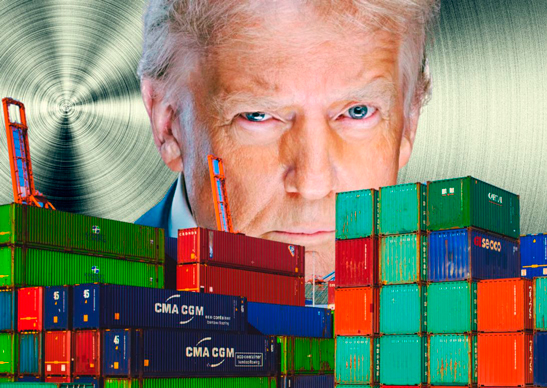 San José. El reciente aumento del 25% en los aranceles sobre las importaciones de acero y aluminio desde los Estados Unidos, implementado por la administración del presidente Donald Trump, tiene el potencial de generar efectos indirectos en el mercado costarricense.
Aunque Costa Rica no produce estos materiales, la catedrática de la Universidad Estatal a Distancia (UNED), Velia Govaere Vicarioli, advirtió que el incremento en los costos de importación de productos finales que utilizan acero y aluminio como insumos podría reflejarse en los precios de diversos productos que llegan al país desde EE.UU.
Productos como por ejemplo para el consumo diario, electrodomésticos, latas de bebidas y alimentos, y otros bienes manufacturados que dependen del acero y aluminio, podrían experimentar un aumento en sus precios debido a los nuevos aranceles.
“Esto afectaría a los consumidores costarricenses, quienes enfrentarán mayores costos en productos importados”, señaló Govaere al tiempo que indicó que la medida tiene un impacto inmediato en los precios de estos productos en el mercado estadounidense, lo que repercute en las importaciones hacia Costa Rica.
La experta señaló que esto podría resultar en un aumento de los precios de estos bienes en el mercado costarricense, lo que afectaría directamente a los consumidores. “Este fenómeno también podría fomentar el cambio en patrones de consumo, ya que los consumidores, motivados por el aumento de precios, podrían recurrir a productos sustituto”, dijo.
“A largo plazo, los consumidores podrían preferir alternativas fabricadas localmente o provenientes de otros mercados que ofrezcan precios más competitivos”, indicó Govaere.
Estadísticas clave:
- En 2024, EE.UU. importó 28.858.000 toneladas netas de acero, de las cuales Canadá, Brasil, México y Corea del Sur fueron los principales proveedores.
- Los productos que dependen del acero y aluminio, electrodomésticos y envases, son comunes en el mercado costarricense y podrían enfrentar aumentos de precios significativos.
Además de los efectos inmediatos sobre el consumidor, la catedrática de la UNED, Velia Govaere, indicó que esta medida también tiene implicaciones a largo plazo para el mercado de importaciones en Costa Rica, “el aumento en los costos podría ralentizar el consumo de ciertos bienes, lo que podría afectar a las empresas locales que dependen de estos productos para satisfacer la demanda interna”, concluyó.
Fuente: Ver nota | Fabián Marrero Soto | Comunicador Social - Mercadeo y Comunicación | Medio: Acontecer de la UNED
A continuación, les compartimos más de las declaracionnes, de la experta Velia Govaere, publicadas en diversos medios de comunicación, que brindaron cobertura:
- Aumento en costos de importación desde EE.UU. podría afectar a consumidor costarricense
Fecha: 12 de febrero, 2025
Medio: Revista Summa
Vocera: Velia Govaere Vicarioli
Ver nota - ¿Impactará el alza en aranceles en EEUU a los consumidores costarricenses?
Fecha: 12 de febrero, 2025
Medio: Monumental
Vocera: Velia Govaere Vicarioli
Ver nota - Alza en aranceles en EE.UU. encarecería electrodomésticos y alimentos
Fecha: 12 de febrero, 2025
Medio: SINART Digital
Vocera: Velia Govaere Vicarioli
Ver nota - Aranceles en EE UU tendrán repercusiones en Costa Rica
Fecha: 12 de febrero, 2025
Medio: Noticias Monumental, Meridiana
Duración: 00:03:05
Vocera: Velia Govaere Vicarioli
Ver nota - Aumento en aranceles de EEUU podría afectar precios en Costa Rica
Fecha: 12 de febrero, 2025
Medio: El Mundo CR
Vocera: Velia Govaere Vicarioli
Ver nota - Aumento en costos de importación desde EE.UU. afectaría al consumidor costarricense, según UNED
Fecha: 12 de febrero, 2025
Medio: CRC 89.1
Vocera: Velia Govaere Vicarioli
Ver nota - Aranceles de EE.UU. para México y Canadá implicarían una oportunidad comercial para exportadores ticos
Fecha: 18/02/2025
Medio: La República
Vocera: Velia Govaere Vicarioli
Ver nota - Donald Trump aplicará aranceles del 25% a semiconductores y golpearía incipiente industria en Costa Rica
Fecha: 19/02/2025
Medio: La República
Vocera: Velia Govaere Vicarioli
Ver nota
Discover. Explore. Expand.
Arlington Tech Launchpad is a program designed to support founders of international and domestic tech companies in discovering Arlington as a possible business location. Connect you with key stakeholders, and access the unique resources that Arlington has to offer through exclusive virtual business engagements and tailored immersion programs. This initiative is designed to offer tech founders resources and opportunities, including:
- Exclusive insights into Arlington’s vibrant tech ecosystem
- Strategic connections with local leaders and innovators
- Opportunities for growth and collaboration
Two upcoming flagship opportunities for tech businesses are the following:
- Virtual Business Engagement – February 26
This session is open to everyone and aims to attract tech companies and those supporting the tech ecosystem. It’s a great opportunity to learn more about Arlington’s dynamic business environment and what it offers to tech innovators.
Registration open - 3-Day Immersion Program – May 14-16
This exclusive program will welcome up to 12 selected tech companies from around the world. Participants will enjoy 3 nights of hotel accommodations, meals, and local transportation during their participation. The program aligns with the SelectUSA Investment Summit (May 11–14) for companies planning to attend. Companies not attending SelectUSA are also invited and encouraged to apply – no SelectUSA registration is required.
Application open
The agenda will be as follows:- A welcome dinner on May 14.
- Two full days of business programming and visits on May 15–16, featuring engagements with companies like Amazon, universities, accelerators, and other members of our business community.
- Virtual Business Engagement – February 26
For reference, here are some key links and details:
- Website:
https://bit.ly/TechLaunchpad - LinkedIn Showcase Page:
Follow us! - Launch Announcement Posts:
Tech Launchpad Account
Post >> - Marketing Email Subscription:
https://arlingtonva.jotform.com/243443893509970 - WhatsApp Channel:
For real-time updates and relevant information
https://whatsapp.com/channel/0029Vb3LYw30wajtSj6k8V0q
Arlington is more than a business destination — it is a launchpad for growth and collaboration for global tech innovators. Strategically located next to Washington, D.C.,
Amazon, Nestlé, Microsoft, Accenture, Boeing and Deloitte have chosen Arlington to fuel their innovations.
Will you be next?
Más artículos…
Página 8 de 131

