


Boletines-Artículos
Congreso Sinología de CR
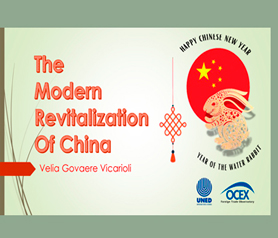 El Congreso del Instituto Confucio del 26 al 28 de setiembre reunió una serie de especialistas sobre China de América Latina, Estados Unidos, Europa y Asia. En este foro se cubrieron diversos aspectos de las políticas públicas en comercio, inversión, política productiva o el área digital de la China Contemporánea, como temas más amplios concernientes a la civilización china como religión, filosofía confuciana y literatura. Este foro se enmarcó en la celebración del 15 aniversario del Instituto Confucio como parte de la Universidad de Costa Rica.
El 27 de setiembre del 2023, doña Velia fue invitada a participar en una sesión del II Congreso Internacional de Estudios sobre China con una ponencia que se centró en los impactos de la apertura y la reforma china, la política actual de “circulación dual y la cobertura y exitosos resultados de sus políticas de alivio a la pobreza. Para Velia Govaere, en su doble calidad de investigadora de OCEX y directora de la DIC de la UNED fue un orgullo participar con un selecto grupo de distinguidos expertos tanto extranjeros como nacionales.
La ponencia se tituló “La revitalización moderna de China” y fue impartida en idioma inglés dentro del grupo de sesiones sobre China Contemporánea. OCEX le comparte a sus lectores el PP utilizado para esa ocasión. (Compartimos la presentación brindada).
Diario del pueblo: (IRF)
Con ocasión del décimo aniversario de la emblemática iniciativa de la Franja y la Ruta, OCEX se complace en compartir el artículo de opinión publicado por Velia Govaere en el período chino El Diario del Pueblo, en el setiembre del 2023.
Con un tiraje impreso de más de 3 millones de ejemplares, el Diario del Pueblo es uno de los periódicos más prestigioso de la República Popular China. El artículo fue publicado en idioma chino el 23 de setiembre del 2023 y posteriormente difundido por la Cancillería de la RPC a todas sus embajadas en el mundo.
 A continuación compartimos con nuestros lectores la versión en inglés de este ampliamente divulgado artículo de opinión.
“Since the beginning of this century, trade with China has provided an important impetus to economic development in Latin America. Latin American countries generally believe that strengthening economic and trade ties with China will help promote their own economic development.
China is one of the most dynamic economies in the world. When the international financial crisis swept the world in 2008, China played an active role in the economic recovery of Latin American countries. The goods produced in China are rich in variety, reliable in quality and reasonable in price, which greatly meet the needs of Latin American companies and consumers. At present, China has become the largest trading partner of many Latin American countries.
Under the framework of the joint construction of the "Belt and Road", China has made full use of its capital, technology and management advantages to continuously strengthen international cooperation. From Argentina to Uruguay and Chile, from Peru to Venezuela and Ecuador, and from Panama to Dominica and Costa Rica, the joint construction of the "Belt and Road" will effectively promote the development of Latin America.
Costa Rica is located in Central America, which connects North and South America, with the Atlantic Ocean to the east and the Pacific Ocean to the west. Its geographical location is very advantageous. Costa Rica urgently needs to strengthen infrastructure construction such as roads, railways, and communications, and improve logistics and communications networks. Costa Rica signed a free trade agreement with China in 2010, and signed a memorandum of understanding with China on jointly building the "Belt and Road" in 2018. The joint construction of the "Belt and Road" can promote the infrastructure construction of Costa Rica and other Central American countries, and help the region give full play to the geographical advantages of connecting two continents and two oceans. People from all walks of life in Costa Rica generally believe that the joint construction of the "Belt and Road" has provided Costa Rica with new development opportunities.
At present, the recovery of the world economy is still in a difficult stage. Both developed and developing countries are facing multiple development challenges. The country needs development, the economy needs recovery, and the people yearn for a better life. Encouraging economic and trade cooperation and maintaining multilateralism is undoubtedly the best choice for all countries and the best solution to overcome many challenges facing human society. The current problems facing the development of the world economy come not only from the economy itself, but also from hegemonism, power politics, protectionism, and the Cold War mentality. Some Western countries are pursuing protectionism, inciting group confrontation, and recklessly wielding the big stick of economic sanctions. "Decoupling and breaking chains" is obviously not conducive to reducing economic risks. Forming small groups based on so-called "common values" is an outdated practice out of touch with history, and will only damage the progress that multilateralism and globalization have brought to human society.
Adhering to and practicing multilateralism is conducive to the progress of the world. The joint construction of the "Belt and Road" adheres to the principle of extensive consultation, joint contribution and shared benefits, practices true multilateralism, and has received extensive support and participation from the international community. Jointly build the "Belt and Road" to promote infrastructure construction, promote economic and trade cooperation, enhance cultural exchanges, and gather strength for all parties to work together to build a better future.”
Source:
http://paper.people.com.cn/rmrb/html/2023-09/23/nw.D110000renmrb_20230923_8-03.htm
Evento: Ruta y Franja (IRF)
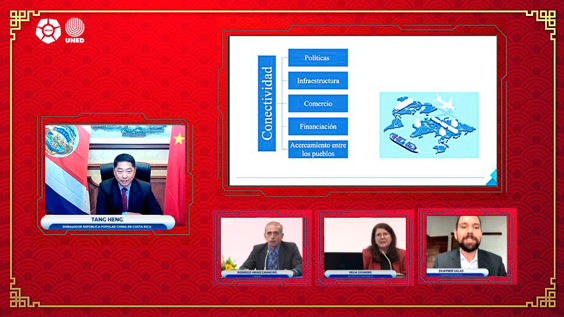 En el marco de la celebración del 10º aniversario de la Iniciativa de la Franja y la Ruta (IFR), OCEX y la DIC organizaron una videoconferencia que abordó los avances regionales de esta iniciativa estratégica de desarrollo de infraestructura global y de cooperación internacional de la República Popular China.
Para celebrar estas efemérides contamos con la presencia del señor Tang Heng, Embajador de China, quien analizó los impactos económicos, comerciales y diplomáticos de la IFR. Particular realce a esta actividad le dieron las profundas reflexiones de don Rodrigo Arias, Rector de la UNED. También contamos con las reflexiones de don Duayner Salas, Exviceministro de COMEX y de doña Velia Govaere, Exviceministra del MEIC, investigadora de OCEX y directora de la DIC.
Más de 140 países han suscrito memorandos de entendimientos (MOU) en ese emprendimiento internacional en el que China hace uso de su inmenso caudal financiero para contribuir al desarrollo económico de los países participantes. Costa Rica se sumó a esta iniciativa suscribiendo, desde 2018, un MOU, para aprovechar también el impulso que está dando China a la apertura comercial, la inversión y el desarrollo internacional.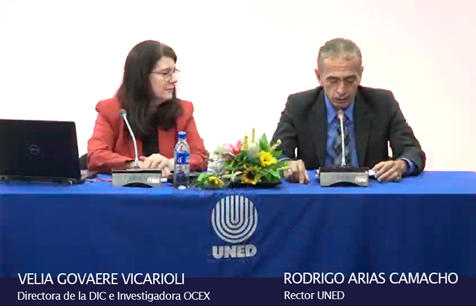
En la apertura del evento, don Rodrigo Arias Camacho recordó que nuestro país suscribió esta iniciativa en el 2018 y señaló que “Costa Rica entendió, entonces, que a través de esta iniciativa, China promueve apertura, inversión y desarrollo en más de 140 países, dando testimonio de su generosidad y visión, al hacer uso así de su inmenso caudal financiero.” En ese sentido, advirtió que “Con los escasos y limitados recursos fiscales de Costa Rica y nuestras formidables carencias de infraestructura, es un verdadero desafío nacional aprovechar más y mejor esta iniciativa que tantos frutos le ha generado a tantos pueblos del mundo, a lo largo de una década.”
Correspondió a Velia Govaere hacer unas reflexiones de apertura donde expresó que la Iniciativa de la Franja y la Ruta se asienta en tres ángulos ontológicos: “Primero, como un momento del desarrollo económico propio de China que requiere del progreso del mundo, para seguir creciendo. Segundo, como un momento culminante del espíritu solidario chino que invita a otros países a que se suban al tren expreso del desarrollo chino. Tercero, la Iniciativa de la Franja y la Ruta expresa el cambio de las realidades internacionales, donde los aires de oriente llegan a la historia con una filosofía de relaciones diferentes.”
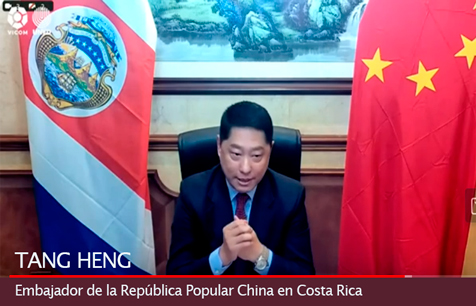 El Embajador Tang Heng destaca en su rica intervención como esta iniciativa tiene un carácter ya no chino sino global y que “en una década, ha pasado de ser una idea a una plataforma de cooperación global, con más de 200 documentos de cooperación firmados con 152 países y 32 organizaciones internacionales, movilizando casi un billón de dólares en inversiones y dando vida a más de 3000 proyectos.” (Acontecer, 2023, https://acontecer.uned.ac.cr/en-conferencia-virtual-ocex-abordo-el-tema-a-10-anos-de-la-franja-y-la-ruta).
Al referirse específicamente a nuestra región señala a América Latina y el Caribe como componentes medulares de esta iniciativa y nos recuerda que China es ya para muchos países del área su segundo socio comercial. En ese sentido señaló que para el 2023, el volumen de comercio entre China Latinoamérica rondaba los 500.000 millones de dólares y que China ha invertido más de 90.4 millones de dólares en 138 proyectos de infraestructura en la región, generando 600 mil empleos locales. Les compartimos la presentación del señor Embajador.
En sus palabras de cierre, don Duayner Salas, exviceministro de Comercio Exterior señala que la Iniciativa de la Franja y la Ruta presenta un generoso abanico de oportunidades para los países en vías de desarrollo. Finaliza su intervención indicando como el IFR posiciona a China como país comprometido con el multilateralismo, la globalización y una cooperación en beneficio mutuo.
OCEX pone a disposición de sus lectores el enlace de la videoconferencia conmemorativa del 10º aniversario del lanzamiento de la Iniciativa de la Franja y la Ruta: https://www.youtube.com/watch?v=H2MV4fL99pM&t=3699s
Cápsula #9-2023 | The Belt and Road Initiative (BRI): Impacts on Latin America and the Caribbean (LAC)
The Belt and Road Initiative (BRI): Impacts on Latin America and the Caribbean (LAC)
MBA. Hellen Ruiz Hidalgo
Strategic Communicator
Foreign Trade Observatory (OCEX)
Vice-Rectory for Research - Distance Learning State University (UNED)
Background. We are commemorating 10 years of what in common journalistic language came to be called the "New Silk Road", a Chinese initiative that culminates a long process of establishing connections between the People's Republic of China and the world. As a concrete initiative, its origin dates back to September 7, 2013, when Chinese President Xi Jinping proposed the joint construction of the Silk Road Economic Belt, in synergy, on this occasion, with Central Asia and with a foundation grounded, above all, in the development of land transport infrastructure. In October of the same year, Xi Jinping continued and expanded this proposal, in Indonesia, during the Informal Leaders' Meeting of the Asia-Pacific Economic Cooperation (APEC). On that occasion, the Chinese president extended to his proposal the maritime dimension of his initiative and proposed building the 21st Century Maritime Silk Road with the countries of the Association of Southeast Asian Nations (ASEAN).
The Chinese initiative has been called by various names: New Silk Road (NRS), One Route, One Road (OROR), Belt and Road Initiative (BRI). Among these names, the "Belt and Road Initiative" (BRI) stands out in English and is the designation we will use in this paper.
Little by little, this initiative was filled with concrete contents, new international meetings and a financing system promoted by the People's Republic.
Main entities providing financial support to the BRI
| Export-Import Bank of China |
China Eximbank is a state-owned and state-funded policy bank dedicated to supporting China's foreign trade, investment and international economic cooperation. |
| China Development Bank |
CDB is the world's largest development bank in terms of assets, loans and lending power. It is a key instrument for the Chinese government to fulfill economic development policies domestically and internationally. It is the largest public development bank in the world. Over the past 15 years, it has provided nearly $100 billion in sovereign loans to Latin America and has injected tens of billions more into special regional financing programs. |
| Asian Investment and Infrastructure Bank | The AIIB began operations in 2016 with 57 founding Members (37 regional and 20 non-regional). By the end of 2020, it had 103 approved Members representing approximately 79 percent of the world's population and 65 percent of global GDP. |
| Silk Road Special Fund |
The Silk Road Fund was established on December 29, 2014, in Beijing and on February 16, 2015, the People's Bank of China (its central bank) announced its start of operations with $40 billion. Its mission is priority investment in infrastructure, resource development, industrial and financial cooperation, in an effort to achieve common development and prosperity in the countries where the BRI operates. |
| New BRICS+ Development Bank |
The New BRICS Development Bank was created in 2015 by member countries as an alternative to the World Bank, an entity traditionally controlled by the United States, the European Union and Japan. As an expression of emerging countries, the BRICS are originally (Brazil, Russia, India, China and South Africa). After their September meeting, the inclusion, as of January 2024, of Argentina, Saudi Arabia, Egypt, Ethiopia, the United Arab Emirates and Iran was announced and their expanded membership is often referred to as BRICS+. |
Compiled by the author - 2023
Importance and significance. Undoubtedly, the BRI is China's most historically significant international economic strategy. Many analysts have noted that an economic initiative of such magnitude is probably unparalleled in world economic history. It is currently the largest ongoing project in the world, both in terms of the number of countries involved and the linked form of all the initiatives that, while ultimately connecting to China, also develop countries' domestic infrastructures on the one hand, and enhance their own regional and global interconnectedness on the other.
The BRI comprises a wide range of development and investment programs extending from East Asia to Europe, Africa and Latin America and seeks mainly to alleviate the problems of logistics, transportation and connectivity that can serve not only to reduce trade costs in the world and improve the linkage of the different countries with China, but also to improve infrastructures that become important assets for the endogenous industrial development of the participating countries, as well as for overcoming regional gaps that are very common in emerging countries.
For Beijing, this is the main economic and international cooperation strategy of the People's Republic of China, under the leadership of Xi Jinping. The BRI focuses on improving transportation infrastructures such as roads, railroads, airports and ports, improving logistics processes associated with trade and reducing physical barriers to trade.
The BRI is an initiative in which China assumes the financial risk, but it represents a flagship example of China's "Win-Win" strategy. China secures, for itself, its energy and raw material supply routes and, for the partner countries, in addition to securing access to China's own market, it offers them new opportunities for new logistics facilities to reduce transport costs and improve access to other markets. This battery of benefits is oriented towards a collective benefit for international economic growth. But on a national level, it opens up the possibility of developing internal productive policies, starting with the creation of Special Economic Zones. The creation of technological capabilities for global connectivity is also involved in this process.
Its realization projects gigantic investments in transportation and connectivity infrastructure in more than 149 states of the world. It focuses primarily on the construction of connectivity projects that would decisively improve trade logistics between Asia, Europe and Africa, linking it to the tradition of the famous "Silk Road" of more than 2,000 years ago, but which in its modern version also includes Latin America.
The BRI and the countries of Latin America and the Caribbean (LAC). For Latin America, the BRI is particularly relevant, given that the complexity of its geographies and the poor transport infrastructure throughout the region is compounded by a systemic lack of resources for its construction. All of this exacerbates the region's economic problems, as its logistical difficulties hinder its regional and international economic relations, increase the cost of its products placed in port and diminish its competitiveness in world markets.
The countries of Latin America and the Caribbean (LAC) suffer from major geographical obstacles. Large mountain ranges cut off contact between countries and also separate the basins of the two oceans. They are also faced with the double challenge of crossing huge tropical forests, which also hinder the transport of their goods, while at the same time necessitating the additional problems arising from their need to protect their ecologically fragile wetlands, jungle and forest areas.
On the other hand, given the distance that separates Latin America from Asia and the presence of the North American market, the orientation of its trade relations has traditionally been directed towards the countries of the North Atlantic, so that it has a small and deficient number of ports on the Pacific coast.
It should be remembered that China had been becoming, since the beginning of the century, the largest economic partner of most countries, especially in South America. This was the case, for example, in Costa Rica, where China was the second largest trading partner even before the establishment of diplomatic relations. In Latin America, as in many other countries in the world, such as Africa in particular, the BRI complements and enhances a system of trade-enhancing relations. It also creates a very broad, multiform and multidynamic form of productive investment.
In this way, the BRI addresses two major economic priorities of Latin America: transport infrastructure and port infrastructure on the Pacific coast.
In 2018, during the second China - CELAC forum, China invited all Latin American and Caribbean countries to join the initiative, issuing the Santiago Special Declaration.
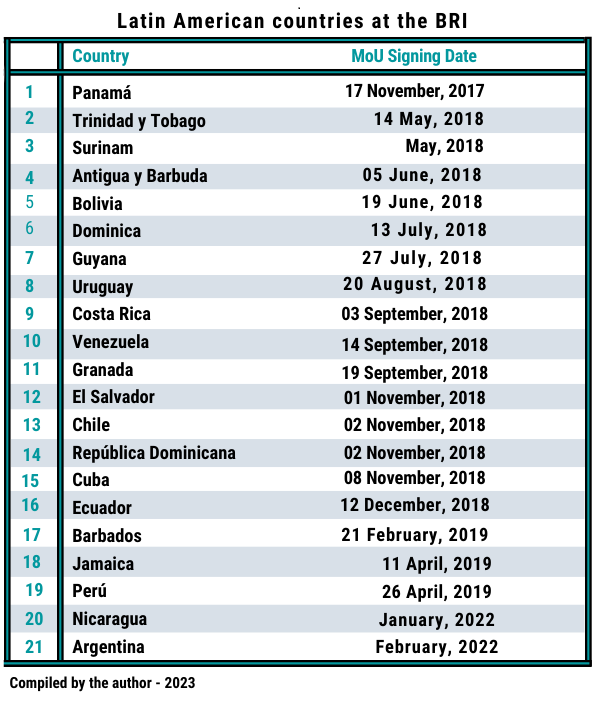
In 2022, 147 countries had already signed Memorandums of Understanding (MoU), also known as basic cooperation documents, with the People's Republic of China to participate in this initiative. Among the Latin American countries that had established a MoU with China, there are 21 countries.
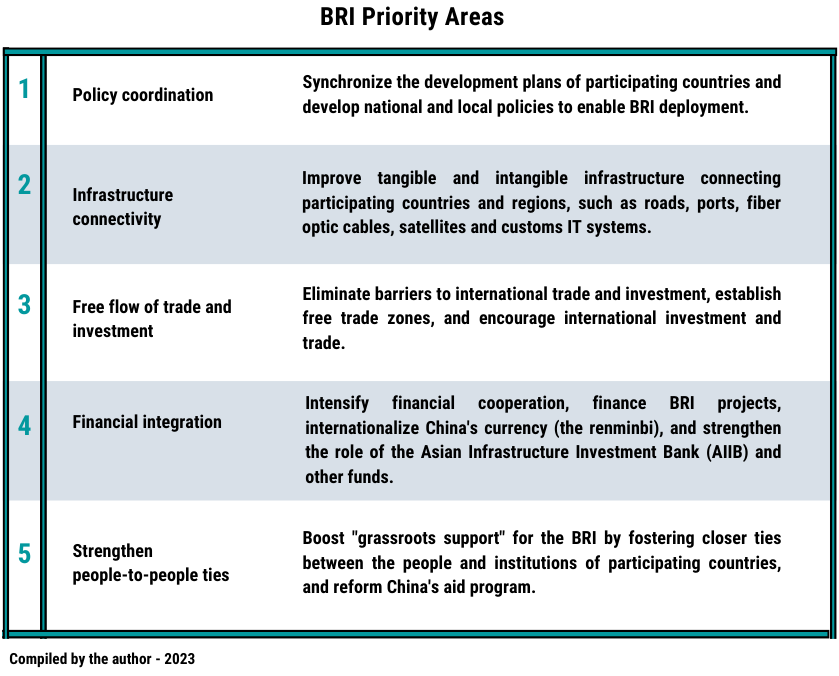
The five areas of priority focus of the BRI are detailed in the "Vision and Actions of the Chinese Government" document.
Strategic and regional nature of the BRI. It is very important to distinguish, on the one hand, the trade relations and other agreements, for example, public or private investment agreements that exist between the different Latin American countries and China and, on the other hand, the specific strategic insertion of these countries in the BRI. Argentina, for example, is one of the Latin American countries with the strongest ties with China, yet it is not a member of the BRI. Although both movements obviously have links with the People's Republic, trade and investment relations correspond to the normal traditional relations between the countries. On the other hand, the insertion of a country or several countries in the BRI has a strategic character, regionally concerted as axes of economic, technological and industrial development of the countries linked to the BRI. What distinguishes the BRI is its regional strategic character, beyond the mere relationship with the countries.
In this regard, the Chinese government has published two White Papers on China's policy towards Latin America and the Caribbean, one in 2008 and the other in 2016. In these documents, it is emphasized that China considers its relations with Latin America and the Caribbean within an integrated regional cooperation space.
Even so, in truly emblematic cases of some countries, such as Argentina, China's trade has grown enormously, as well as investments, and yet those countries have not signed memoranda of understanding to join the BRI. In fact, China is Argentina's main agro-industrial partner, its second largest trading partner and the third largest foreign investor in the country.
Foreign debt in BRI participation. The People's Republic's gigantic investments do not seek to place countries in a foreign debt trap. On the contrary, the very progress of relations with China is based on the assumption that the countries make economic progress so that their relationship with China is sustainable and the debt contracted becomes an instrument of progress and, in this way, also guarantees the countries' ability to pay. And precisely for this reason, in the event that the countries that take on these loans have financial difficulties in servicing this debt, China offers non-monetary repayment conditions, through the export goods that they traditionally export to China. This is one of the particularities of Chinese loans within the BRI scheme. Another is that its credits are not used either to cover the countries' regular budgets or to repay other external debts. This ensures that they are fully used for investment, which is a dynamic way of creating wealth that will make it possible to service the debt itself.
That is why China's approach to the expansion and consolidation of the BRI is above all strategic and regional in nature. The BRI partners are, on each occasion, part of groups of countries and the initiatives in which it takes part within the BRI link them and, at the same time, empower them, in forms of commercial and economic development that are not limited to trade with China. Such is the case of the ambitious project for the North-South connection of Central America from Panama, or the East-West link from Peru and Ecuador to Brazil, the development of first-world ports on the Pacific coast in El Salvador, the expansion of the Panama Canal, etc.
Latin America is a strategic area for the BRI. On the other hand, Latin America is a strategic area for the BRI, with an enormous potential for development, since its enormous geographic area, comprising 13.6% of the earth's surface, has only 8% of the world's population. With a GDP similar to that of India, which is the third largest economy after the United States and China, Latin America represents one of the main reserves of biodiversity in the world, has 22% of the world's oil reserves, abundant raw materials and large reserves of strategic minerals such as copper and lithium. Accordingly, we must understand the importance of Latin America from the point of view of China's imports and exports. China imports from Latin America 28.55% of its total imports of agricultural products, 44.44% of its imports of plants, 12.3% of food, tobacco and dairy products. In addition, China buys 12.33% of its world imports of metal products from Latin America. What is decisive here is to understand the relative weight of these Chinese imports. As a whole, in products such as food, agricultural products, minerals, metals, fuels and textiles, China imports a greater proportion from Latin America than from the rest of the world.
Obviously, China's industrial growth has meant that China's demand for Latin American products has been dominated by primary products and minerals such as soybeans, metals and oil, while China's exports to Latin America have been concentrated in manufactured goods. As a result, China is increasingly exporting mid- and high-end technology products to Latin America. In this regard, Chinese exports of medium technology already account for 33.14% of Latin American imports of this range and Chinese exports of high technology are 28.63%. Hence, it is understood that, today, China not only has a raw material or agricultural connection with Latin America, but also participates in a technological connection.
In this sense, it is relevant to see how most of China's Foreign Direct Investment in Latin America is in the area of ICT, with 37.6% of all that China invests in Latin America. Of great impact is Chinese investment in science and technology services in Latin America, as it has a higher percentage than the overall structure of China's outward FDI. While only 2.3% of all outward FDI from China is concentrated in science and technology services, in Latin America it is 5.9% of all Chinese FDI in the region. In other words, Latin America is the region in the world with the highest proportion of Chinese FDI in science and technology. All this shows how the evolution of China's trade with Latin America is very dynamic and is gradually moving beyond the classic "center-periphery" relationship, typical of neocolonialism, where Latin America exports primary products and imports industrial products. In fact, Latin America's terms of trade with China have remained stable or improved in favor of Latin America.
The country with the largest exports to China is Brazil, followed in descending order by Chile, Peru, Mexico, Argentina and Colombia. Uruguay is the small Latin American country with the largest exports to China as it has been the largest market for Uruguay's exports since 2013. Hence the mutual interest in negotiating a Free Trade Agreement has arisen. So far this has not been possible due to Uruguay's membership in the Southern Common Market (MERCOSUR), a regional integration process in which it accompanies Argentina, Brazil and Paraguay. It is important to note that China is MERCOSUR's main trading partner.
The BRI as a global productive architecture. Dierckxsens and Formento (2015), consider that the BRI is essentially a productive-industrial project that, as such, articulates the proposal of a new global productive architecture, since it encompasses 4.2 billion inhabitants, 56% of the world population, with a nominal GDP that reaches 43% of the global GDP. In purchasing power parity (PPP), the countries comprising the BRI account for 52% of world GDP.
As mentioned above, the financial backing for BRI projects is supported by renmimbi bonds, with dollar equivalents, from three key financial institutions:
1) The Silk Rd. Infrastructure Fund (Silk Rd. Infrastructure Fund), for US$40 billion.
2) The Asia Infrastructure and Investment Bank (Asian Infrastr. Invest. Bank), for US$100 billion.
3) The New Development Bank of the BRICS countries (New Dev. Bank of the BRICS countries, for US$100 billion.
Therefore, this whole perspective of the BRI does not come alone, but is integrated with the economic alliance of the BRICS+ (political and economic forum formed by Brazil, Russia, India, China and South Africa. As of January 1, 2024, Argentina, Egypt, Iran, United Arab Emirates, Saudi Arabia and Ethiopia will join the BRICS+.) Hence, it is a productive industrial project based on the real economy, outside the financial speculation of hedge funds. Its strength derives not only from the fact that its main thrust is provided by the People's Republic of China as the main economic power on the rise, but also from the fact that it structures the coordination of a set of emerging regional blocs that mutually reinforce each other.
Development of the BRI in international forums. Just four years after the BRI was launched, on May 14, 2017, the first "One Belt, One Road Forum for International Cooperation" was convened in Beijing. This Forum became one of the most important international events. It was attended by nearly 1,200 delegates from more than 130 countries around the world, including 28 presidents and prime ministers and one hundred official ministerial delegations. Latin America was represented at the forum. President Macri of Argentina and President Bachelet of Chile were the most prominent Latin American figures. At this forum, President Xi Jinping secured financing from Chinese banks for more than US$120 billion and stressed the importance of the BRI in generating infrastructure projects.
This was the occasion on which Xi Jinping outlined five "paths" for the proposed Silk Road:
- Path for peace
- Path for prosperity;
- Path for openness and trade exchange;
- Path for innovation and development of the 21st Century Digital Silk Road (developing digital economy, artificial intelligence, nanotechnology, quantum computing);
- Path of civilizational dialogue, cultural exchange, coexistence of cultures, mutual respect and trust.
With great realism, Xi Jinping recalled that "the ancient Silk Roads prospered in times of peace, but lost vigor in times of war. This initiative requires a peaceful and stable environment." From which he deduced the need to "foster a new type of international relations based on cooperation, partnership and friendship, without confrontation."
China has a very sophisticated approach to Latin America. In the framework of the BRI, China has articulated a system of regional meetings, starting in 2014, within the scheme of "Forum for Cooperation between China and the Community of Latin American and Caribbean States (China-CELAC). There China articulates what it calls the "1+3+6" strategy.
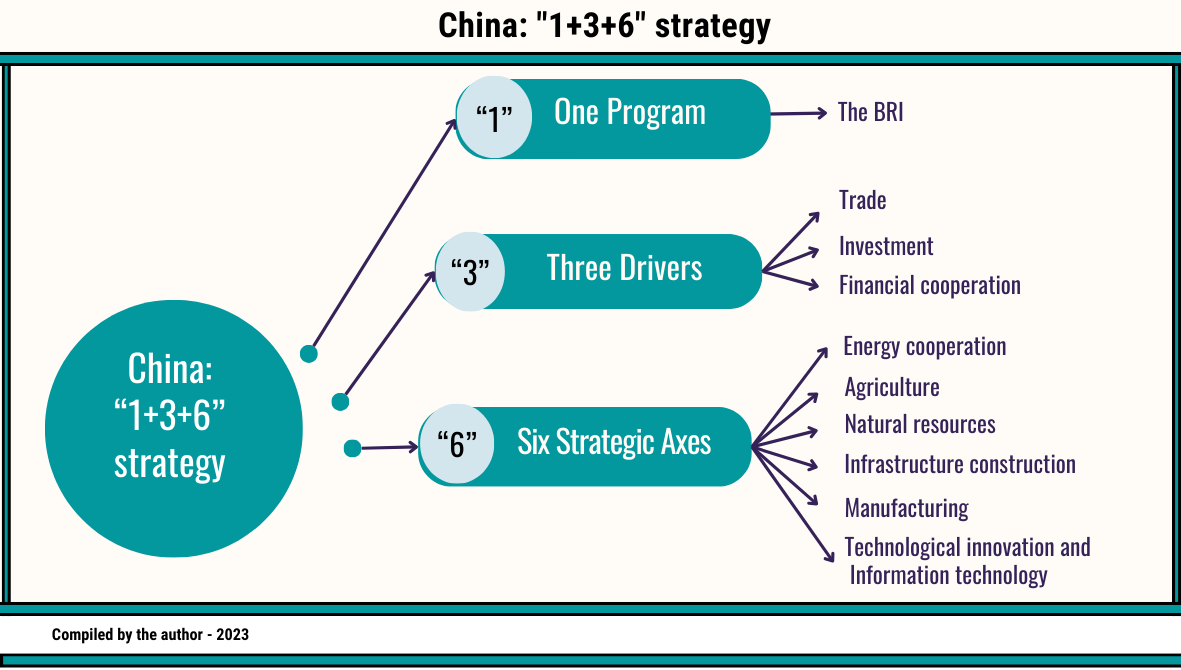
On this last point it should be said that the importance that China attaches to cooperation, investment and trade in the strategic axis of Information Technology can be appreciated with its commitment to invest $250 billion between 2015 and 2019.
From the diplomatic point of view: two types of partnership. China establishes special relationships with countries where it finds that its political elites are particularly sensitive to raising the profile of its relations with China or with countries that are simply priorities for China. With them it establishes two types of "Partnerships": the "Strategic Partnerships" and the "Comprehensive Strategic Partnerships". As Aponte García (2018) points out, the "Strategic Partnerships" share objectives in the economic area and in the political area, while the "Comprehensive Strategic Partnerships" share, in addition, objectives in the scientific, technological and even in the military cooperation (security) area.
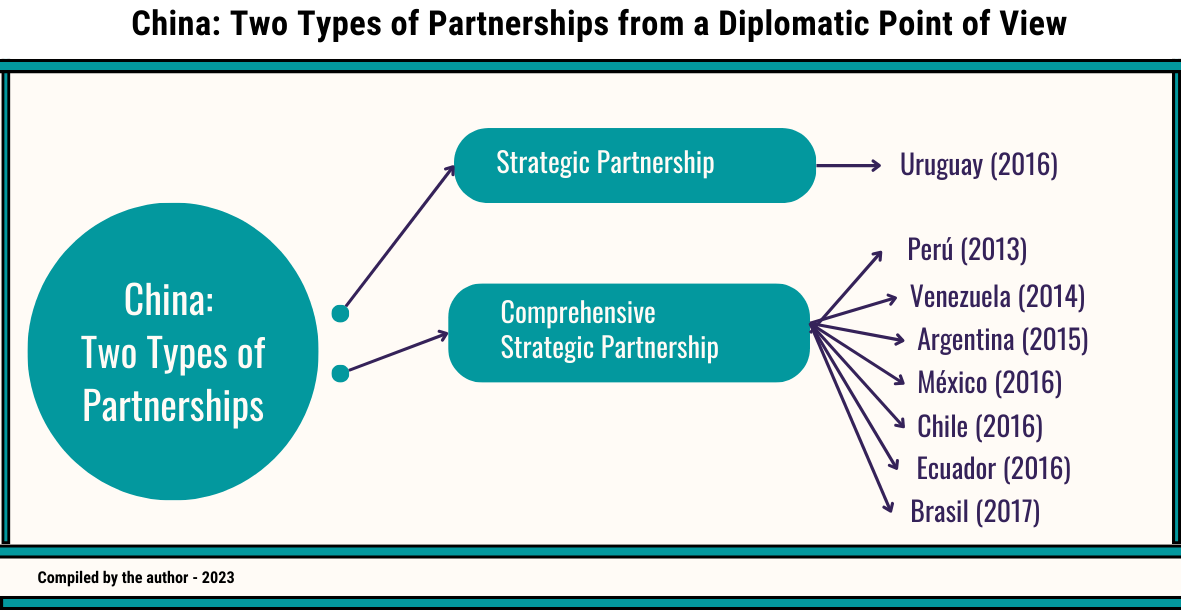
China's policy does not end with the BRI, but together with it it becomes a holistic approach that, in addition to improving trade connectivity, closely touches all the problems of economic and industrial development in Latin America. It is worth mentioning some of the most emblematic projects by country:
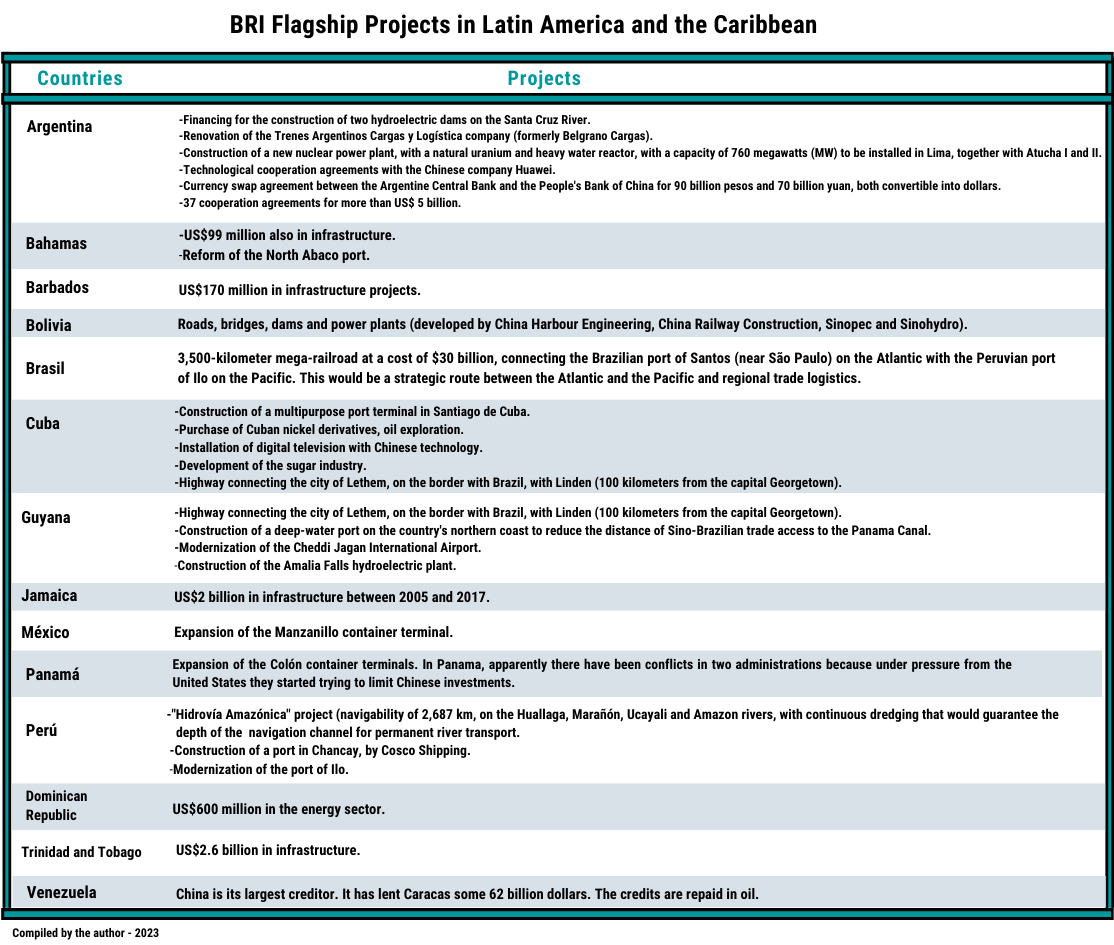
Costa Rica in the BRI. This year marks the sixth anniversary of the signing of the MOU between China and Costa Rica on Cooperation within the framework of the Belt and Road. The trade volume between China and Costa Rica is close to US$3.2 billion. From January to July of this year, there has been a year-on-year increase of almost 33%. On the other hand, Costa Rican exports exceeded US$1.6 billion, with a year-on-year growth of nearly 55%. Both parties seek to further strengthen political dialogue and the coupling of their respective development strategies. They are in the process of exploring the potential for cooperation in areas such as the digital economy, green development, e-commerce and health. However, pressures from the United States have moved the government to question the use of Chinese technology in digital communications.
Recommended reference material:
[i] Eddie Tapiero. La Ruta de la Seda y Panamá Análisis Económico. 2017. En: https://www.academia.edu/33718554/La_Ruta_de_la_Seda_y_Panam%C3%A1
[i] Consultar la base de datos de préstamos del Banco de Desarrollo de China a países latinoamericanos en: https://www.thedialogue.org/map_list/
[i] Consultar el portal del Banco Asiático en Inversión e Infraestructura en: https://www.aiib.org/en/about-aiib/index.html
[i] Para éstas y otras informaciones relacionadas con las políticas de China, recomendamos consultar el “Observatorio de la Política de China, en: https://politica-china.org/
[i] Para información actualizada, documentos históricos y otros asuntos relacionados con la IFR, consultar el Portal de la Franja y la Ruta, en: https://eng.yidaiyilu.gov.cn/
[ii] Documento accesible en el Ministerio de Relación Exteriores de Costa Rica. En: https://rree.go.cr/files/includes/files.php?id=1316&tipo=documentoshttps://rree.go.cr/files/includes/files.php?id=1316&tipo=documentos
[iii] Iniciativa de construcción conjunta de la Franja y la Ruta. Avances, contribuciones y perspectivas. Oficina del Grupo Dirigente para el Fomento de la Construcción de la Franja y la Ruta. 2019. En: https://www.yidaiyilu.gov.cn/wcm.files/upload/CMSydylgw/201904/201904240811021.pdf.
[i] Comisión de Desarrollo Nacional y Reforma, Ministerio de Asuntos Exteriores y Ministerio de Comercio (2015) “Vision and Actions on Jointly Building Silk Road Economic Belt and 21st-Century Maritime Silk Road”: https://www.fmprc.gov.cn/eng/topics_665678/2015zt/xjpcxbayzlt2015nnh/201503/t20150328_705553.html
[i] Dierckxsens, W. y Formento, W. (2015) “La batalla de los imperios financieros por el mundo ¿Un mundo en transición histórica?”. Ponencia presentada en la VII Conferencia Latinoamericana y Caribeña de Ciencias Sociales (CLACSO). En: https://repositorio.flacsoandes.edu.ec/bitstream/10469/10593/1/REXTN-MS38-01-Dierckxsens.pdf
[i] Yunxia, Yue. 2022. Diplomacia económica y la Iniciativa de la Franja y la Ruta en América Latina. Artículo aparecido en “Dimensiones de la diplomacia de China en América Latina y el Caribe”, editado por Josette Altman Borbón y Sergio Rivero. FLACSO. San José, Costa Rica. En: https://www.flacso.org/sites/default/files/2022-03/Dimensiones%20de%20la%20diplomacia%20de%20China%20en%20Am%C3%A9rica%20Latina%20y%20el%20Caribe.pdf
[ii] Consultar sobre MERCOSUR en: https://www.mercosur.int/quienes-somos/en-pocas-palabras/
[i] Discurso de Xi Jinping en la inauguración del Foro “Una Franja, Una Ruta para la cooperación internacional. En: https://www.alainet.org/es/articulo/194589
[i] Aponte García, M. (2018) “La geopolítica de la integración regional en ALC: Debates estratégicos en torno a EEUU y China”, ALAI, en línea. Disponible en: https://www.alainet.org/es/articulo/194589
Presentación del señor Tang Heng, Embajador de la República Popular China en Costa Rica (2023). En:
Presentación_Embajador_Tang_Herng.pdf_A 10 años de la Franja y la Ruta.
Más artículos…
Página 18 de 131

