


Información general
La quimera de alcanzar a China
Velia Govaere, investigadora de OCEX, señala que, desde el gobierno de Obama, todas las administraciones de Estados Unidos han venido considerando tomar medidas para contrarrestar ascenso económico de China, considerado desde entonces como el principal rival tanto comercial como geopolítico de Estados Unidos. Pero el tema no es solamente mejorar el déficit comercial de Estados Unidos frente al mundo, sino, más profundamente, restaurar la base manufacturera de la economía estadounidense ya que el desbalance comercial de Estados Unidos tiene como punto de partida su propia desindustrialización, que se dio al mismo tiempo que ser producía la industrialización china.
En resumen. Estados Unidos logra producir solamente un tercio de la producción china. De ahí que las políticas comerciales y económicas de Trump buscan revertir lo andado, dar pasos hacia atrás en la historia, buscando un retorno de sus empresas, llegar a aquel lugar desde donde partió el dilema actual. Eso no es tan simple, porque la ingeniería económica inversa también tiene efectos diferentes a los deseados. ¿Queremos ver, entonces, adónde nos lleva la quimera de querer alcanzar a China? Seguidamente, les compartimos el artículo en: https://www.larevista.cr/velia-govaere-la-quimera-de-alcanzar-a-china/
imagenes claras
 |
| Observatorio de Comercio Exterior | N°1 -2025 |
| Boletín bimensual de OCEX ofrecerá una visión actualizada e incluyente del comercio exterior |
| "Comercio exterior como motor de desarrollo nacional socialmente equitativo y ecológicamente sostenible" |
I Congreso Mundial de Clásicos, Pekín |
 OCEX participó en el Primer Congreso Mundial de Clásicos, en Pekín, con una ponencia sobre las relaciones latinoamericanas de comercio, inversión y cooperación con China. Leer más... |
Ponencia I Congreso Mundial de Clásicos |
 Velia Govaere comparte ponencia en inglés sobre las relaciones latinoamericanas de comercio, inversión y cooperación con China, en el Primer Congreso Mundial de Clásicos. Leer más... |
Impactos Acuerdo de Contratación Pública |
 OCEX organizó un evento sobre los impactos que genera adherirse a este Acuerdo de la OMC, tanto para nuestro país, como, en especial, para su gestión desde la UNED. Leer más... |
Codesarrollo entre América Latina, Caribe y China |
 OCEX participó en el I Foro de la Civilización Moderna del Sur Global: “Codesarrollo entre América Latina, Caribe y China”, organizado por el Instituto Confucio de la UCR. Leer más... |
A las puertas de un desastre |
 OCEX comparte el artículo que analiza la peligrosidad de la guerra en Ucrania. Velia Govaere, investigadora de OCEX, contribuyó con el grupo de académicos consultados. Leer más... |
| Observatorio de Comercio Exterior (OCEX) - Costa Rica Visítenos en www.uned.ac.cr/ocex |
Enlazando competitividad
El 25 de julio de 2023, el Observatorio de Comercio Exterior (OCEX) la Dirección de Internacionalización y Cooperación (DIC) y la oficina de becas institucionales (COBI) de la UNED sirven de puente de difusión de la excepcional experiencia hemisférica del programa de Intercambio para la Competitividad de las Américas, conocido por sus siglas en inglés como ACE.
El programa ACE es una de las principales iniciativas de la Red Interamericana de Competitividad (RIAC), bajo dirección de la OEA, que ejerce su Secretaría Técnica. La Organización de Estados Americanos (OEA), el Departamento de Estado y el Departamento de Comercio de los Estados Unidos coordinan este programa cuyo propósito es construir redes académicas, empresariales y de desarrollo local para fomentar el mejoramiento de la competitividad en las Américas y aumentar las oportunidades de comercio e inversión.
ACE reúne hasta 50 altos responsables de la toma de decisiones gubernamentales, empresariales, académicas de toda América -y más allá- para experimentar de primera mano la diversa gama de proyectos, inversiones estratégicas, asociaciones público-privadas y mejores prácticas del ecosistema económico, de innovación y emprendimiento de una región o país en particular. ACE es la más importante red hemisférica de intercambio de experiencias pertinentes al desarrollo económico, innovación y emprendimiento de las Américas, pero en la que participan también otros países, como Alemania, Israel, entre otros.
FOTO DE DOOKY CHASE
Govaere señala en su introducción, al referirse a ACE que “desde que aparece en un país o en un sector, una experiencia exitosa hasta que es reconocida y aprovechada por otras empresas, segmentos y países, pasa un tiempo de inevitable espera del reconocimiento debido. Por eso, se vuelve enormemente importante que países, empresas, academia y centros de investigación construyan puentes que acerquen destrezas productivas así como innovadoras inteligencias de mercado y, sobre todo y ante todo, que se establezcan las formas en que se articulan los actores, para permitir prontas emulaciones y rápida multiplicación de impactos positivos. (…) La Organización de Estados Americanos en coordinación con el Departamento de Estado y el Departamento de Comercio de los Estados Unidos han desarrollado un programa emblemático que aborda exactamente esta temática. Se trata del programa de Intercambio para la Competitividad de las Américas”.
En esta videoconferencia, Velia Govaere en su calidad de punto de enlace de la UNED en la RIAC explica su experiencia en diversas ediciones de ACE concentrando su atención en su 14 edición en el Estado de Luisiana. En esta presentación se tuvo el honor de contar con la participación de Adriana Bonilla, gestora del programa ACE en el seno de la Organización de Estados Americanos quien también nos relata los alcances e impactos de este programa desde su génesis.
FOTO DE ADRIANA con MARYSE ROBERT (OEA) EN ACE LUISIANA y a Barrett Haga.
Ponemos para su conocimiento y a disposición de nuestros lectores esta emblemática experiencia hemisférica en el enlace:
Coronavirus: economic impacts in Latin America
MBA. Hellen Ruiz Hidalgo
Strategic Communicator, (OCEX-UNED)
The Foreign Trade Observatory (OCEX) presents in this "informative capsule" the consequences of the health crisis in Latin America. We will pay special attention to the fiscal, social, productive and economic outcomes.
In our account, we will draw extensively on some of the most relevant conclusions of the "Economic Survey of Latin America and the Caribbean 2020: main determinants of fiscal and monetary policies in the post-pandemic era of COVID-19", authored by the Economic Commission for Latin America and the Caribbean (ECLAC). We will focus on the economic, social and productive effects resulting from the pandemic and on the decisive factors of these outcomes for public policies in the coming years.
Since the outbreak of the coronavirus, as a global pandemic, the concern of the Latin American region was focused on preventing mass deaths, containing the number of those infected, and providing hospital treatment without exceeding the installed capacities of the health systems. This concern, focused primarily on health issues, led to the requirement to undertake drastic measures of social distancing, which would eventually mean the almost total paralysis of all economies in the world.
Latin America is facing a triple challengeIn Latin America, the policies of adjustment and relief of the health impacts of the pandemic had, have and will have great repercussions on the economic order, and it is probably this aspect that will dominate the policy agenda of Latin American countries in the coming years.
To understand the scope of the economic condition resulting from the health crisis, it is important, first of all, to bear in mind that Latin America was just emerging from another widespread economic crisis, consequential of the financial crisis of 2008, which has been called the "subprime crisis", because it arose from the financial problems derived from the widespread insolvency of high-risk mortgages, which had become a gigantic real estate bubble that, when they fell into insolvency, affected the entire international financial system and resulted in the biggest world recession since the Great Depression of 1929. More information at: Problems of credit insurance and risk rating agencies.
At this time, all tax systems were forced to implement counter-cyclical policies that involved heavy expenditure by the treasury, leaving Latin America's public finances in a particularly vulnerable state.
The most relevant negative outcomes are going to be slow economic growth, worsening inequality and a higher level of poverty resulting from widespread unemployment. The magnitude of these impacts constitutes, in the words of ECLAC, "the worst crisis in 100 years”.
The worst crisis in 100 years
The most relevant negative outcomes are going to be slow economic growth, worsening inequality and a higher level of poverty resulting from widespread unemployment. The magnitude of these impacts constitutes, in the words of ECLAC, "the worst crisis in 100 years”.
In her presentation, which we are presenting here, specialist Alicia Bárcena, ECLAC's Executive Secretary, explains that the best way to describe the current severity is through its impact on the personal wealth of Latin Americans, with widespread impoverishment.
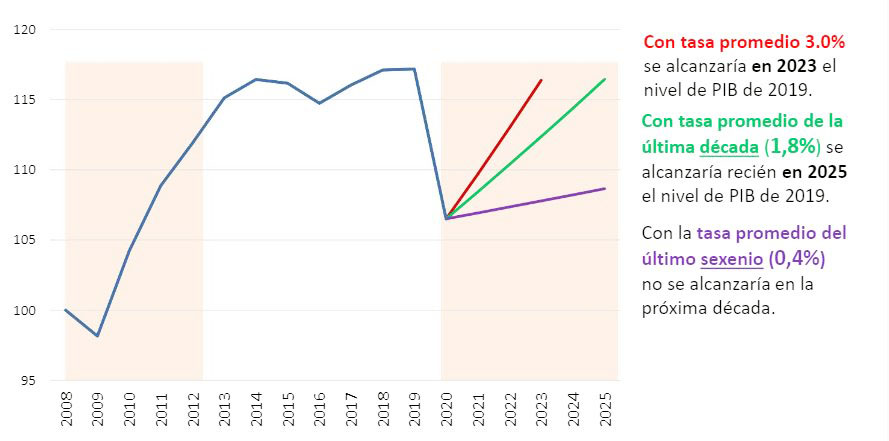
By the beginning of 2021, Latin America's per capita gross domestic product (GDP) will, on average, have fallen back to the levels it had 10 years earlier. Thus, once again, the well-known wedge of a "lost decade" is retaken, the same understanding that was held in the 80s of the last century and that has a wide glossary of long term implications.
LATIN AMERICA LATINA AND THE CARIBBEAN:
EVOLUTION OF THE GDP
(Index 1990=100)
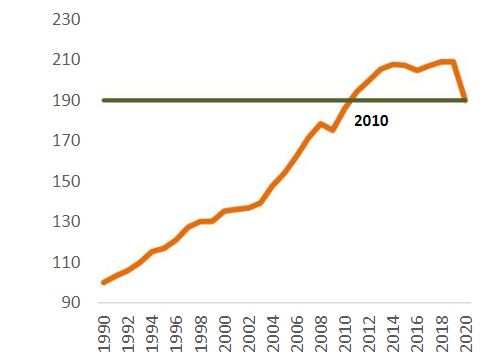
Source: Economic Survey of Latin America and the Caribbean (ECLAC). Year 2020.
It is estimated that there will be an increase of 18 million unemployed people and ECLAC estimates that the average unemployment rate in Latin America will be 13.5%. In our opinion, this estimate is probably very conservative. In Costa Rica alone, the National Institute of Statistics and Census (INEC) reports, in July, 2020, a 40% rate of open unemployment in poor households.
LATIN AMERICA: LABOR INDICATORS
(Millions of people)
|
|
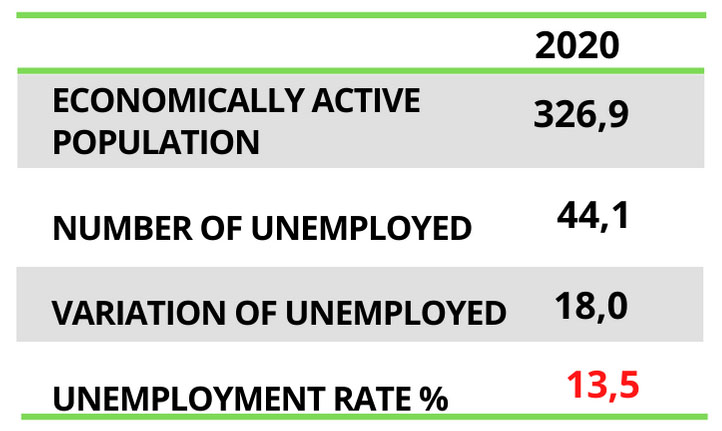
Source: Economic Survey of Latin America and the Caribbean (ECLAC). Year 2020.
In 2019 the average poverty rate in Latin America, according to ECLAC, was 30.3% of the population. As an impact of the pandemic, in just one year, poverty will increase by 7.3%, equivalent to 15 years of decline. Translated into human terms, that will mean 231 million people in a state of poverty. On the other hand, extreme poverty would be set back by 10 years, reaching 15.6% of the population, in a tragic scenario of 96 million people without the capacity to meet their most basic needs for food, shelter, health, etc.
This critical scenario is the result of two impacts of the pandemic seen as a synergistic event: the decrease in economic activity and, as a result, the decrease in the capacity of governments to counteract the crisis with social programs. The greatest impact of these two components of what we can call "syndemics" (interaction of the health and the social) is the worsening of the living conditions of the most vulnerable strata of the population.
Particularly determining are the impacts on investment, on private and productive consumption, on the level of export of goods and services, all of which are decisive indicators of economic activity and of the welfare of people.
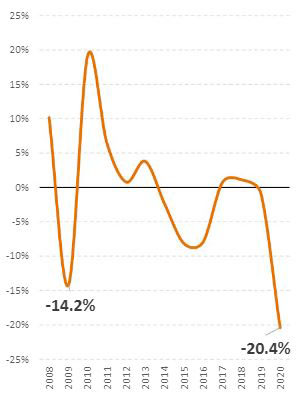
The investment that had a 14% fall in the financial crisis of 2008 is going to have a collapse of more than 20% this year. This drop in investment is reflected in a more dramatic way in the calculation, also probably conservative, of the closure of 2.7 million formal businesses throughout the region. This blow to investment will mean a corresponding decrease in the supply of jobs, while at the same time, greater pressure towards future investments that will require fewer jobs.
|
LATIN AMERICA: INVESTMENT VARIATION RATE
Source: Economic Commission for Latin America and the Caribbean (ECLAC), based on official figures. Note: 2020 are projections. |
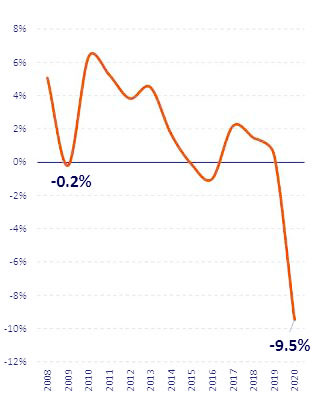
On the other hand, the decline in household income and the increase in the unemployment level will strongly reduce private consumption, which is a determinant of aggregate demand and a fundamental driver of investment and productive supply. Private consumption will fall by 9.5% in just one year.
|
LATIN AMERICA: RATE OF CHANGE IN PRIVATE CONSUMPTION
Source: Economic Commission for Latin America and the Caribbean (ECLAC), based on official figures. Note: 2020 are projections. According to data from ECLAC, Costa Rica is positioned as a country that will see its GDP less affected, placing it with a fall of 5.5%, much less than that of 13% in Peru and 10.5% in Argentina. The average decline in GDP in Central America is -6.2% and the average for South America is -9.4%. Assumptions for economic recovery in Latin America
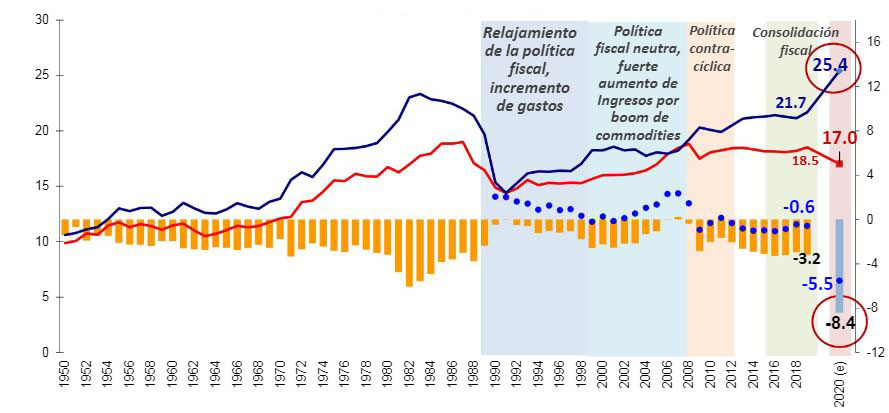
The pandemic changed the orientation of fiscal policy Unlike Costa Rica, where the primary deficit had been growing since the subprime crisis, in Latin America an effort had been made to systematically reduce the primary deficit, reaching a Latin American average primary deficit of only 0.6% by 2016. With the arrival of Covid-19, Latin American States were forced to resort to the public coffers to mitigate the social and economic effects of the pandemic.
Source: Economic Survey of Latin America and the Caribbean (ECLAC). Year 2020. The graph "Central Government Fiscal Indicators" shows the behavior of the public treasury in four major periods:
This is the discouraging panorama of the fiscal accounts, the Latin American States find themselves in need of stimulating the economy, while at the same time they must face their own debts, having less income due to the economic impact of the pandemic.
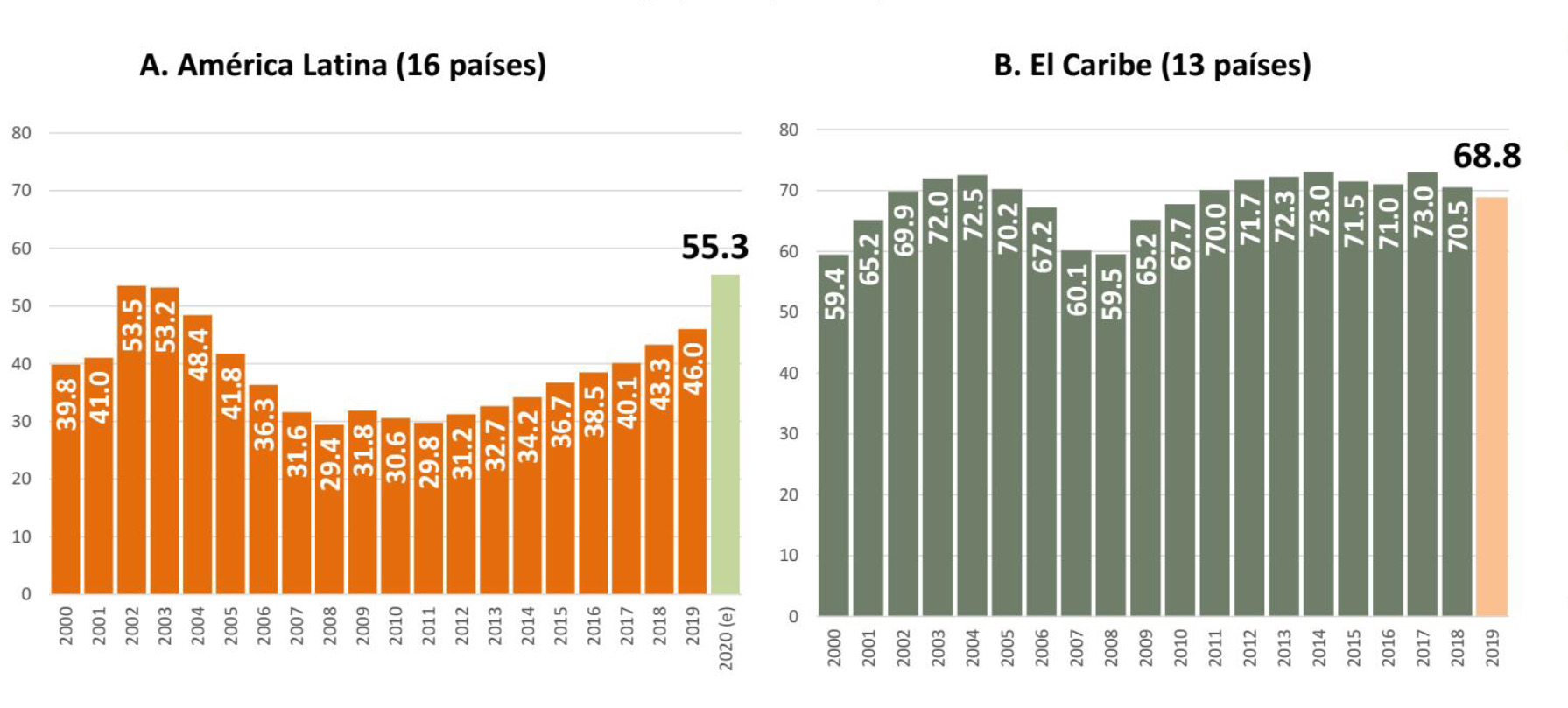
The graph on central government gross public debt shows this trend that we had noted both before and after the subprime crisis and at the time of the pandemic. Since 2009, a curve of increasing public debt begins. But, since 2012, a decrease in the percentages of debt in relation to GDP has been observed in Latin AmeriThese efforts, which did not take place in Costa Rica, were interrupted by the pandemic. Costa Rica was caught in an even more vulnerable situation. The goal is to maintain an active fiscal policy in a context of lower tax revenues and higher indebtedness. Challenging situation. Latin America is facing a triple challenge On the one hand, Latin American States should (1) intervene with fiscal policies to support economic recovery, and likewise, they should shows the behavior of the public treasury in four major periods: (2) implement measures to mitigate the impacts of poverty by increasing their social spending. Furthermore, they should (3) carry out these active interventions in the economy, since, precisely because we are in a crisis of income and indebtedness, there are insufficient financial resources for points (1) and (2). In order to face, simultaneously, the payment of their debt and to carry out their interventions in the economy, the Latin American States are forced:
To maintain an expansive fiscal policy, a sustainability framework is required that focuses on income, that is, on the components linked to an improvement in tax collection. Measures related to:
- Consolidate income tax for individuals and corporations.
These challenges are posed by ECLAC based on a double framework, firstly by supporting fiscal sustainability focused on increasing state revenues. Secondly, by orienting public spending towards economic reactivation. Active fiscal policy must link the short term (emergency) with the medium and long term. Similarly, it must direct public spending towards reactivation, economic transformation and addressing the social crisis aggravated by the pandemic. In other words, the problem has three axes that must be addressed at the same time and that are grouped into three orders of supportive initiatives.
1. Demand-related support:
2. Supply-side stimulus:
3. Promotion of social inclusion: Generalization of social protection systems: health, gender, pensions, education, unemployment insurance and universal basic income. Bibliography consulted:
|

Más artículos…
Página 1 de 6

