


Boletines-Artículos
| 2010-2019 | Boletines |
Año 2019
Boletín N°6/2019. Leer más...
Boletín N°5/2019. Leer más...
Boletín N°4/2019. Leer más...
Boletín N°3/2019. Leer más...
Boletín N°2/2019. Leer más...
Boletín N°1/2019. Leer más...
Año 2018
Boletín N°6/2018. Leer más...
Boletín N°5/2018. Leer más...
Boletín N°4/2018. Leer más...
Boletín N°3/2018. Leer más...
Boletín N°2/2018. Leer más...
Boletín N°1/2018. Leer más...
Año 2017
Boletín N°6/2017. Leer más...
Boletín N°5/2017. Leer más...
Boletín N°4/2017. Leer más...
Boletín N°3/2017. Leer más...
Boletín N°2/2017. Leer más...
Boletín N°1/2017. Leer más...
Año 2016
Boletín N°6/2016. Leer más...
Boletín N°5/2016. Leer más...
Boletín N°4/2016. Leer más...
Boletín N°3/2016. Leer más...
Boletín N°2/2016. Leer más...
Boletín N°1/2016. Leer más...
Año 2015
Boletín N°6/2015. Leer más...
Boletín N°5/2015. Leer más...
Boletín N°4/2015. Leer más...
Boletín N°3/2015. Leer más...
Boletín N°2/2015. Leer más...
Boletín N°1/2015. Leer más...
Año 2014
Boletín N°6/2014. Leer más...
Boletín N°5/2014. Leer más...
Boletín N°4/2014. Leer más...
Boletín N°3/2014. Leer más...
Boletín N°2/2014. Leer más...
Boletín N°1/2014. Leer más...
Año 2013
Boletín N°6/2013. Leer más...
Boletín N°5/2013. Leer más...
Boletín N°4/2013. Leer más...
Boletín N°3/2013. Leer más...
Boletín N°2/2013. Leer más...
Boletín N°1/2013. Leer más...
Año 2012
Boletín N°6/ 2012. Leer más...
Boletín N°5/ 2012. Leer más...
Boletín N°4/2012. Leer más...
Boletín N°3/2012. Leer más...
Boletín N°2/2012. Leer más...
Boletín N°1/2012. Leer más...
Año 2011
Boletín N°6/2011. Leer más...
Boletín N°5/2011. Leer más...
Boletín N°4/2011. Leer más...
Boletín N°3/2011. Leer más...
Boletín N°2/2011. Leer más...
Boletín N°1/2011. Leer más...
Año 2010
Boletín N°5/2010. Leer más...
Boletín N°4/2010. Leer más...
Boletín N°3/2010. Leer más...
Boletín N°2/2010. Leer más...
Boletín N°1/2010. Leer más...
Capsule #1-2024 | BRICS: an alternative geopolitical and economic bloc
MBA. Hellen Ruiz Hidalgo
Strategic Communicator
Foreign Trade Observatory (OCEX)
Vice-Rectory for Research - Distance Learning State University (UNED)
Introduction Without having a precise date of its beginning, at least from the beginning of this century, the international panorama has been in a geopolitical process of transformation. One its main traits is, certainly, the relative lessening of the significance of the great powers that dominated the post-war and the post-Cold War commercial scenario, the emergence of national players with extensive territories and a large population, but that, until recently, they have occupied a space of less relevance.
In 1980, Antoine W. Van Agtmael, an economist working for the World Bank's International Finance Corporation coined the term “emerging” which gave rise to several related concepts such as “emerging markets” or, later, “emerging countries.” The outset of this concept, primarily oriented for financial investment, was, in fact, 10 years ahead of globalization and 20 years before the actual emergence of these countries. At the beginning of this century, Van Agtmael was already talking about “The Century of Emerging Markets”. Many emerging countries seem to have made the decision to enter and to show their presence in the greatest number of international political spaces (Maihold y Villamar, 2016).
These types of market-countries have been leaving the purely financial or commercial sphere and have entered into processes of geopolitical association with the express objective of participating more strongly in the governance of the world economy (Haibin, Niu, 2012). Its most characteristic associative expression are the countries currently called BRICS+, an associative acronym for Brazil, Russia, India, South Africa and several other countries (the “+” refers to the new members of the Middle East and North Africa: Egypt, Ethiopia, Iran , Saudi Arabia and the United Arab Emirates). With these new inclusions, the BRICS+ represent already more than 45% of the world's population and their collective GDP (PPP) constitutes currently a larger part of the world's GDP than the G7 countries, 36% vs 30% (Takushi, Christian, 2023).
The BRICS+ countries are flanked by countries considered “developed” and “underdeveloped” and have one or more of certain distinctive characteristics in common (Salama, Pierre. 2014):
- Extensive territory. with abundance of natural and extractive resources;
- High population volume, combined with high levels of poverty and low per-capita income;
- Economic openness to trade and Foreign Direct Investment (FDI) that seeks efficiency;
- Growth potential of its internal consumption;
- Higher annual economic growth rate than the average of developed countries.
- Monetary vulnerability, dependent on the need to defend the competitiveness of its exports, even with monetary manipulation of its exchange rate.
- Reduced middle class, which slows down technological development, creates inequalities in the distribution of wealth, which in reality induces high political instability.
This capsule seeks to offer panoramic information about the BRICS+, but not in its economic or commercial aspects, but in its aspiration for active and decision-making participation in the governance of the world economy. From this angle, the BRICS+ will be approached within the context of a change of era marked, among other things, by changes in the relative weight of the countries that rule global geopolitical governance. That regency has been dominated, since 1975, by the G7 countries, under American leadership. The BRICS+ manifest themselves as a challenge to the G7's control of the multilateral organizations that govern the world economy. The BRICS+ propose a movement towards multilateralism without hegemonies.
That is why this capsule begins discerning the formation of global governance, based on the Bretton Woods Agreements, as background to the presentation of the BRICS+.
Background 2001 – The economic anachronism of the G7: Bretton Woods
Between July 1 and 22, 1944, within the framework of the newly founded United Nations, an international economic and financial conference was convened in Bretton Woods, New Hampshire, United States. Its aim was to create a stable global economic and financial system. The result of that conference were the so-called “Bretton Woods Agreements”, in which the main economic, commercial and financial institutions that oversee the world economy were created: the GATT, World Bank and the International Monetary Fund (Marín Sánchez, 2011). Its purpose was to establish a stable multilateral economic and financial system that would oversee all countries in the post-war period. In this way, it has been possible to ensure free trade, promote economic growth, prevent financial crises and protect countries from the protectionism that conditioned, in part, the outbreak of the two great world wars. One of the premises of the functioning of these institutions and the international economy was the creation of the North American dollar standard. This system forced the countries of the International Monetary Fund (IMF) to maintain a fixed exchange rate with respect to the dollar, the US central bank to back its currency with gold and to deliver from its gold reserves, one ounce for every $35 dollars they would like to convert.
The Breakup of the Dollar-Standard. In the 70s of the previous century, a global financial crisis occurred and the United States could not maintain the same convertibility rate of its currency for gold. As a result, Richard Nixon, then president of the United States, suspended this monetary regime on August 15, 1971 and, since 1973, in the currency markets, countries were allowed to freely float their currencies. From that moment on, national currencies do not have to be anchored to a fixed exchange rate and central banks are not obliged to link their policy to maintaining a specific parity. It is the birth of national monetary policies, themselves. This created a new situation, with a high possibility of volatility that could lead to highly dangerous international conditions (Duque, 2014).
That is, by floating their exchange rate, countries could lower the national costs of their products, thus promoting their exports and inhibiting their imports. It is the management of its competitiveness through the manipulation of its currencies, improving its trade balance and affecting the trade balance of its partners, that could lead, eventually, to new forms of trade wars through manipulation of the foreign exchange.
Birth of the G7. The United States understood that to avoid this there was a need to establish permanent forums for financial, economic and political coordination between the most important industrial and commercial powers. Thus, in 1975, the G7 was born. It is not an official, formal entity and therefore lacks the authority to enforce the plans it discusses or the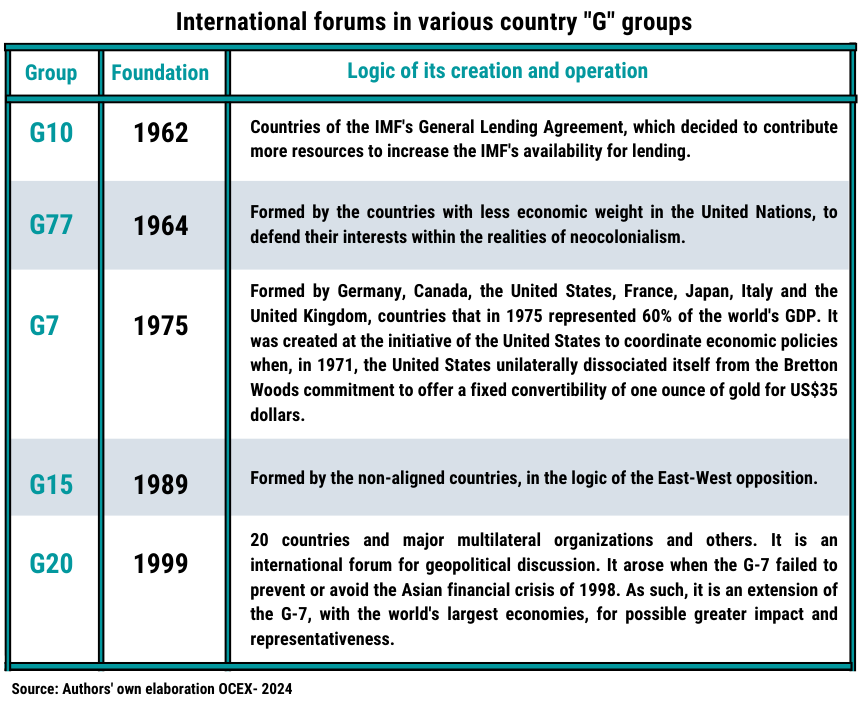 policies it recommends. It is, rather, an intergovernmental political and economic association and setting, made up of the countries accredited as the largest developed economies in the world and, as such, the decisive nations in world trade, which at the time were: France, Germany, Italy, Japan, the United States, the United Kingdom and Canada. The leaders of the governments of these countries meet periodically to discuss economic and monetary issues, since their main objective is to act in concert to address global problems, especially economic matters. The resolutions adopted by the G7, at the end of each meeting, are not binding, but merely indicative. Its ultimate purpose is to design a joint action plan with which to respond to the challenges. Since its creation, the G7 has addressed and reached agreements on financial crises, monetary problems and critical trade issues, such as the oil supply crisis.
The anachronism of the G7. At the end of 2001, Jim O'Neill, one of the most important analysts at Golden Sachs, wrote a report in which he tried to demonstrate that the G7 composition was no longer a forum in which truly meaningful coordination of the world economic policy could be really achieved (O'Neill, 2001). His argument was that while some of the countries that make up the G7 did not really have global weight, such as Italy or Canada, other countries, which are not part of the G7, had acquired greater weight, meanwhile, and should be part of economic governance. central world. O'Neill argued that the countries that made up the G7 had been left with an anachronistic weight. Therefore, the world forum they formed was no longer the appropriate expression of the relative weight of nations and, as such, had lost its ability to confront global problems.
Hence he proposed a reform of the G7. He made a metaphor, he said that the G7 wall had to be put with better bricks than the ones it has. His article was called: Building Better Global Economic BRICs. This title was a play on words. He used the pronunciation of the English word bricks (Brics), which means bricks, but in that onomatopoeia he introduced, at the same time, a suggestion: that pronunciation (BRIC) is also the acronym that is derived from the countries Brazil, Russia, India and China.
BRIC - A first attempt at geopolitical rapprochement.The functional analysis. O’Neill’s G7 reform proposal was merely functional. He showed that the impacts of the monetary, economic and trade policies of Brazil, Russia, India and China had much more weight, in the global economy, than those of Italy and Canada, to take, as an example, two member countries of the G7. For this reason, O'Neill wrote, the economy of the world would work better “If the G7 became a forum in which true coordination of global economic policy was debated” (op.cit).
Of course, O'Neill's proposal was never taken into consideration, because the G7 is a geopolitical grouping, not just an economic one. However, his analysis continued to make noise among analysts. In 2003, Dominic Wilson y Roopa Purushothaman, also of Golden Sachs, following O'Neill's reasoning, published an analysis entitled “Dreaming of the BRICs: The course towards 2050”. In that analysis they confirmed O'Neill's forecasts and carried them forward. Conclusions that they themselves presented as truly dramatic: in 2024, they said, the BRICs would represent 50% of the economic weight of the entire G7. In 2039, they would surpass it. And yet, the G7, the club of the West and the hegemonic dominance of the United States, would continue to exclude what would be the largest segment of the world economy. They were showing the critical development of a geopolitical contradiction that had to be faced.
The continuity of an idea that tend to self-enforcing itself. In their article, Wilson and Purushothaman said that the expected results were impressive. Brazil, Russia, India and China - the BRIC economies at the time - were on their way to becoming the largest force in the world economy, within the next 50 years. They said that within 30 years, in the G7, only the United States and Japan would be major economic forces. And yet, they questioned that nothing pointed to a change in the composition of the G7, which made it openly exclusive and low-functional. Since then, academic analyzes confirming these Goldman Sachs reports have multiplied. We have to say that several years passed without anything happening.
A first attempt at a geopolitical approach. From economic analysis to geopolitics. On September 20, 2006, Vladimir Putin invited the foreign ministers of China, India and Brazil to meet informally, taking advantage of the presence of the three in New York, on the occasion of the 61st General Assembly of the United Nations. The spokesperson for the meeting was, of course, Russian Foreign Minister Sergei Lavrov. There he shared with the press that Putin had conceived the need to find some way to institutionalize the collaboration of those four countries. International economic events would reinforce that initiative. The following year, in 2007, China's GDP surpassed that of Germany. In 2008, Brazil, China and the oil countries established a common sovereign fund, as a vehicle to invest excess capital.
The global economic crisis accelerates the processes. The 2008 financial crisis meant a real boom for large emerging countries. At the lowest point of the crisis, in 2009, India achieved the highest growth rate in its history, almost 10%. At that time, the conditions were ripe to assume a collective line of international politics. On June 16, 2009, Brazil, India and China responded confidently to a Russia's call in Yekaterinburg to create a new world forum: the BRIC.
The following year, South Africa joined, adding, in 2010, the letter “S” to the acronym, which became BRICS. With the incorporation of South Africa, the BRICS cover 30% of the planet's territory and 42% of the world's population. In 2023, the BRICS accounted for more than 23% of the world's gross domestic product (GDP) and 18% of international trade. (Takushi, 2023) emphasizes the speed and amazingness of the rise of the BRICS countries: “The rise of China-Russia-India-Brazil-South Africa is absolutely amazing. In 2000, these five BRICS nations barely represented 18% of world GDP, compared to 47% for the G7, that year. This year, the BRICS reached 32.1% of world GDP, compared to 31.4% of the G7 (PPA).”
At their very birth, these countries appear to be contentious and vindictive (Radulescua, 2014). There they warned, for the first time since the fall of the Berlin Wall, the internatio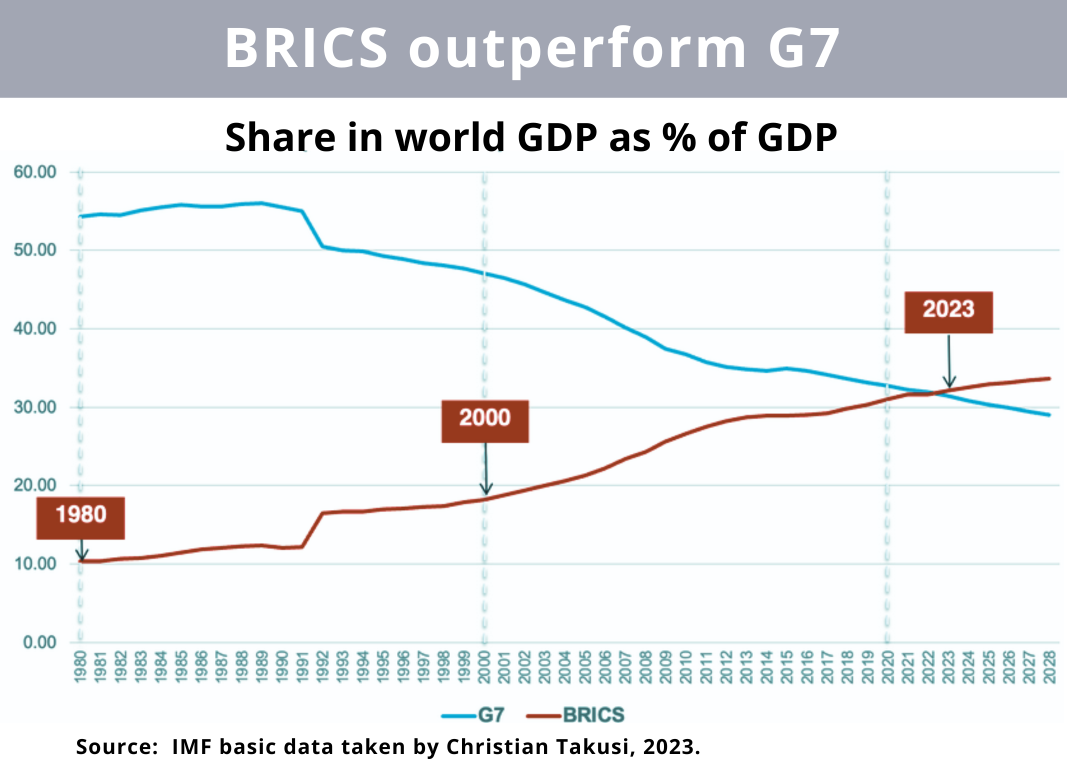 nal need to build, "a more democratic and just multipolar world order, based on the international rule of law, equality, mutual respect, cooperation, action coordinated and collective decision-making where the interests of all States will truly be taken into account" (Declaración de Ekaterinburgo, 2009).
The weight of China's geopolitical leadership. Those are the BRICS countries. Thus their international coordination was born. But, although the first step of the initiative, in itself, was the product of the urge of the Russian political leadership, the decisive weight of its processes has been determined by China's leadership, which has been at pains to offer a horizontal rather than vertical type of leadership.
Long before the BRICS, since the beginning of the century and even before its entry into the World Trade Organization (WTO), China had been understanding the need to eventually counteract the arbitrary weight exercised by the G7 and how this would only be possible through South-South collaboration and all the way through the strengthening of the economic capacities of the countries of the Global South. China acted first in Central Asia, with the Shanghai Cooperation Organization, created at the initiative of China in 2001, where Russia was also present. Next was the China-Africa Forum, also known as FOCA. Therefore, when the Russian initiative for the formation of the BRICs appeared, China joined in and enthusiastically embraced it and quickly took the lead. In 2012, the Belt and Road Initiative, also known as the New Silk Road, was launched, focused on cooperation, financing and infrastructure development. In that same sense, the immense network of development banks in China was created, which includes the China Development Bank, the China-Africa Development Bank, the China Construction Bank; the Export-Import Bank of China and the Asian Infrastructure Investment Bank. The New BRICS Development Bank and the Contingency Reserve Agreement are added to this financial network.
At some point, before the beginning of the century, China began to discuss in different forums what was called the Beijing Consensus, as a development model in contrast to the neoliberalism of the Washington Consensus (Fanjul, 2009). Thus, due to its commercial weight, the success of its economic policies and the increasing clarity of its positions within the BRICS, aimed at the creation of a multipolar international order, it can be said that China is the leading political, ideological and economic force in the BRICS forum. (Yağci, 2016).
The concept of the Global South. The BRICS have come to give an organic and geopolitical expression to all the countries that are included in the concept of the Global South. This refers us to a conceptualization of countries that is gaining more and more notoriety in the world. It is a set of countries that are geographically and culturally heterogeneous, but that share common historical, political and economic elements (Jiagui, 2020). The concept of the Global South identifies countries that historically suffered colonization processes, do not really have defining weight in international politics and aspire to economic growth that allows them to increase their participation in the distribution of the world's wealth.
It is an emerging geopolitical reality (Pelfini, 2015) that is linked to old contrasting concepts, used by the social sciences and also by politics, such as: center/periphery; North/South; East/West; development/underdevelopment. This reference even includes developed/underdeveloped (or, euphemistically, “developing”) countries. There are also references to the geopolitical alignments of the Cold War era, such as aligned/non-aligned countries.
What is new about its understanding as the Global South is its reference to a world that, while globalized, is also segmented between the countries that benefit most from globalization and the countries that feel that their participation in the world system leaves them behind in human development and social well-being. It is a collective understanding of demonstrable distributive malaise, which is an expression of a polarized world reality, such as the Global North, in its dominant segment, and the Global South, as the sector of countries with contrasting and aspirational realities, which were previously called “Third World". The BRICS come to offer an alternative and open path and, as such, become vectors with leadership in the Global South (Sahay, 2023).
The following capsule will explain more specifically the birth and evolution of the BRICS, its development since its summits, the current situation and the controversies and perspectives that arise.
References
- Duque, Armando. 2014. De Bretton Woods a la crisis. Universidad Central de Chile. En: https://afese.com/img/revistas/revista56/woods.pdf
- Fanjul, Enrique. 2009. El Consenso de Pekín: ¿un nuevo modelo para los países en desarrollo? ARI Nº 122/2009. Real Instituto Elcano. En: https://www.files.ethz.ch/isn/145871/ARI122-2009_Fanjul_Consenso_Pekin_paises_desarrollo.pdf
- Haibin, Niu. 2012. Los BRICS en la gobernanza global: ¿una fuerza progresista? - Friedriech Ebert Stiftung (FES). New York. En: https://library.fes.de/pdf-files/iez/09592.pdf
- Maihold, Günther y Villamar, Zirahuén. 2016. El G20 y los países emergentes. Foro internacional. Vol.56 no.1 Ciudad de México. México. En: https://www.scielo.org.mx/scielo.php?script=sci_arttext&pid=S0185-013X2016000100165
- Marín Sánchez, Eva. 2011. Una aproximación al papel de las instituciones de Bretton Woods en la actual crisis económica internacional. Tesis de grado. Universidad Politécnica de Cartagena. En:https://repositorio.upct.es/xmlui/bitstream/handle/10317/1909/tfg9.pdf?sequence=1&isAllowed=y
- O’Neil, Jim. 2001. Building Better Global Economic BRICs. Global Economics Paper No: 66. Golden Sachs. New York. En: https://www.goldmansachs.com/intelligence/archive/building-better.html
- Salama, Pierre. 2014. Las economías emergentes, ¿el hundimiento? Foro Internacional, vol. LIV, núm. 1, México. En: https://www.redalyc.org/pdf/599/59940020001.pdf
- Takushi, Christian, 2023. Geopolitical Update: BRICS overtake G7, 29 nations defy the USD and the West. Geopolitical Research Web Site. Suiza. En: https://geopoliticalresearch.com/?p=19385
- Wilson, Dominic y Purushothaman, Roopa. 2003. Dreaming With BRICs: The Path to 2050. Global Economics Paper No: 99. Goldman Sachs. New York. En: https://www.goldmansachs.com/intelligence/archive/archive-pdfs/brics-dream.pdf
- Yağci, Mustafa. 2016. A Beijing Consensus in the Making: The Rise of Chinese Initiatives in the International Political Economy and Implications for Developing Countries. PERCEPTIONS, Journal of International Affairs. Volume XXI, Number 2, pp. 29-56. En: https://dergipark.org.tr/en/download/article-file/815718
- Radulescua, Irina Gabriela, Panait, Mirela, Voicab, Catalin. 2014. BRICS countries challenge to the world economy new trends. Procedia Economics and Finance 8 (2014) 605 – 613. ScienceDirect. En: https://www.academia.edu/19402506/BRICS_Countries_Challenge_to_the_World_Economy_New_Trends?auto=download&email_work_card=download-paper
- Jiagui, Chen, Xiaoijing, Zhang., 2010. Shared Rapid Economic Growth, BRICS Have Different Development Modes, China Economist, Vol. 5, No.1/2010. En: https://papers.ssrn.com/sol3/papers.cfm?abstract_id=1538749
- Sahay, Tim, Mackenzie, Kate (2023). El nuevo orden de los BRICS. Le Grand Continente. En: https://legrandcontinent.eu/es/2023/09/05/el-nuevo-orden-de-los-brics/
- Pelfini, Alejandro y Fulquet, Gastón (coordinadores). 2015- Los BRICS en la construcción de la multipolaridad: ¿reforma o adaptación? CLACSO. Buenos Aires. En: https://biblioteca-repositorio.clacso.edu.ar/bitstream/CLACSO/14303/1/Interior.pdf
Cápsula #1-2024 | BRICS: un bloque geopolítico y económico alternativo
MBA. Hellen Ruiz Hidalgo
Comunicadora Estratégica
Observatorio de Comercio Exterior (OCEX)
Vicerrectoría de Investigación - Universidad Estatal a Distancia (UNED)
Introducción. Sin tener una fecha precisa de su inicio, por lo menos a partir del comienzo de este siglo, el panorama internacional ha estado en un proceso geopolítico de transformación. Entre sus aristas se encuentra, sin duda, la disminución relativa del peso de las grandes potencias que dominaron el escenario comercial de post-guerra y post-guerra fría, el surgimiento de actores nacionales de territorios extensos y numerosa población, pero que, hasta hace muy poco, han ocupado un espacio de menor relevancia.
En 1980, Antoine W. Van Agtmael, un economista que trabajaba para la Corporación Financiera Internacional del Banco Mundial acuñó el término “emergente” que dio inicio a varios conceptos relacionados, como “mercados emergentes” o, más tarde, “países emergentes”. El nacimiento de ese concepto, fundamentalmente orientado a la inversión financiera, se adelantaba, de hecho, 10 años a la globalización y 20 años al surgimiento propiamente dicho de estos países. A comienzos de este siglo, Van Agtmael hablaba ya de “El Siglo de los Mercados Emergentes”. Muchos países emergentes parecen haber tomado la decisión de ingresar y mostrar su presencia en el mayor número de espacios de política internacional. (Maihold y Villamar, 2016)
Este tipo de mercados-países han ido saliendo de la esfera meramente financiera o comercial y han entrado en procesos de asociación geopolítica con el objetivo expreso de participar con mayor fuerza en la gobernanza de la economía mundial (Haibin, Niu, 2012). Su expresión asociativa más característica son los países llamados actualmente BRICS+, acrónimo asociativo de Brasil, Rusia, India, Sudáfrica y varios países más (el “+” se refiere a los nuevos miembros de Oriente Medio y Norte de África: Egipto, Etiopía, Irán, Arabia Saudí y los Emiratos Árabes Unidos). Con estas nuevas adhesiones, los BRICS+ ya representan más del 45% de la población mundial y su PIB colectivo (PPA), constituye actualmente una parte mayor del PIB mundial que los países del G7, 36% vs 30% (Takushi, Christian, 2023).
Los países BRICS+ se sitúan entre los países considerados “desarrollados” y los “subdesarrollados” y tienen en común una o varias de ciertas características distintivas (Salama, Pierre. 2014):
- Extenso territorio. con abundancia de recursos naturales y extractivos;
- Alto volumen de población, combinado con altos niveles de pobreza y baja renta per-cápita;
- apertura económica al comercio y a la Inversión Extranjera Directa (IED) que busca eficiencia;
- potencial de crecimiento de su consumo interno;
- mayor índice de crecimiento económico anual que el promedio de los países desarrollados;
- Vulnerabilidad monetaria, dependiente de la necesidad de defender la competitividad de sus exportaciones, incluso con manipulación monetaria de su tasa de cambio;
- Clase media reducida, lo que frena el desarrollo tecnológico propio, crea desigualdades en el reparto de la riqueza, que deriva en alta inestabilidad política potencial.
Esta cápsula busca ofrecer información panorámica de los BRICS+, pero no en sus aspectos económicos o comerciales, sino en su voluntad de participación activa y decisoria en la gobernanza de la economía mundial. Desde este ángulo, los BRICS+ serán abordados dentro del contexto de un cambio de época marcada, entre otras cosas, por cambios en el peso relativo de los países que rigen la gobernanza geopolítica mundial. Esa regencia ha sido dominada, desde 1975, por los países del G7, bajo liderazgo estadounidense. Los BRICS+ se manifiestan como un desafío al control del G7 de los organismos multilaterales que rigen la economía mundial. Los BRICS+ plantean un movimiento hacia un multilateralismo sin hegemonías.
Es por eso, que esta cápsula comienza con el planteamiento de la formación de la gobernanza mundial, a partir de los Acuerdos de Bretton Woods, como antecedentes de la exposición de los BRICS+.
Antecedentes. 2001 – El anacronismo económico del G7: Bretton Woods
Entre el 1 y el 22 de julio de 1944, en el marco de las recién fundadas Naciones Unidas, fue convocada una conferencia económica y financiera internacional en Bretton Woods, New Hampshire, Estados Unidos. Se buscaba crear un sistema mundial económico y financiero estable. El resultado de esa conferencia fueron los así llamados “Acuerdos de Bretton Woods”, en los que se crearon las principales instituciones económicas, comerciales y financieras que rigen la economía mundial: el GATT, Banco Mundial y Fondo Monetario Internacional (Marín Sánchez, 2011). Sus objetivos eran establecer un sistema económico y financiero multilateral estable que rigiera a todos los países en la post-guerra. De esa manera, se ha podido asegurar el libre comercio, promover el crecimiento económico, prevenir las crisis financieras y resguardar a los países del proteccionismo que condicionó, en parte, el desencadenamiento de las dos grandes guerras mundiales. Una de las premisas del funcionamiento de esas instituciones y de la economía internacional fue la creación del patrón-dólar norteamericano. Ese sistema obligaba a los países del Fondo Monetario Internacional (FMI) a mantener un tipo de cambio fijo respecto al dólar, al banco central estadounidense a respaldar su divisa con el oro y a entregar de sus reservas en oro, una onza por cada $35 dólares que se quisieran convertir.
La ruptura del Patrón-Dólar. En los años 70 del siglo anterior se produjo una crisis financiera mundial y los Estados Unidos no pudieron mantener la misma tasa de convertibilidad de su moneda por el oro. Como resultado, Richard Nixon, presidente entonces de EE.UU. suspendió este régimen monetario, el 15 de agosto de 1971 y, desde 1973, en los mercados de divisas, se permitió que los países tengan libre flotación de sus monedas. Desde ese momento, las monedas nacionales no tienen por qué estar ancladas a un tipo de cambio fijo y los bancos centrales tampoco están obligados a vincular su política a mantener una paridad concreta. Es el nacimiento de las políticas monetarias nacionales, propiamente dichas. Eso creó una situación nueva, con alta posibilidad de volatilidad que podría conducir a condiciones internacionales altamente peligrosas (Duque, 2014).
Es decir, a partir de la flotación que decidieran de su tipo de cambio, los países podrían bajar los costos nacionales de sus productos, promover así sus exportaciones e inhibir sus importaciones. Es el manejo de su competitividad por la vía de la manipulación de sus monedas, mejorando su balanza comercial y afectando la balanza comercial de sus socios, de forma que eso podría conducir, eventualmente, a nuevas formas de guerras comerciales por vía de manipulación de las divisas.
Nacimiento del G7. Los Estados Unidos comprendieron que para evitar eso existía la necesidad de establecer foros permanentes de coordinación financiera, económica y política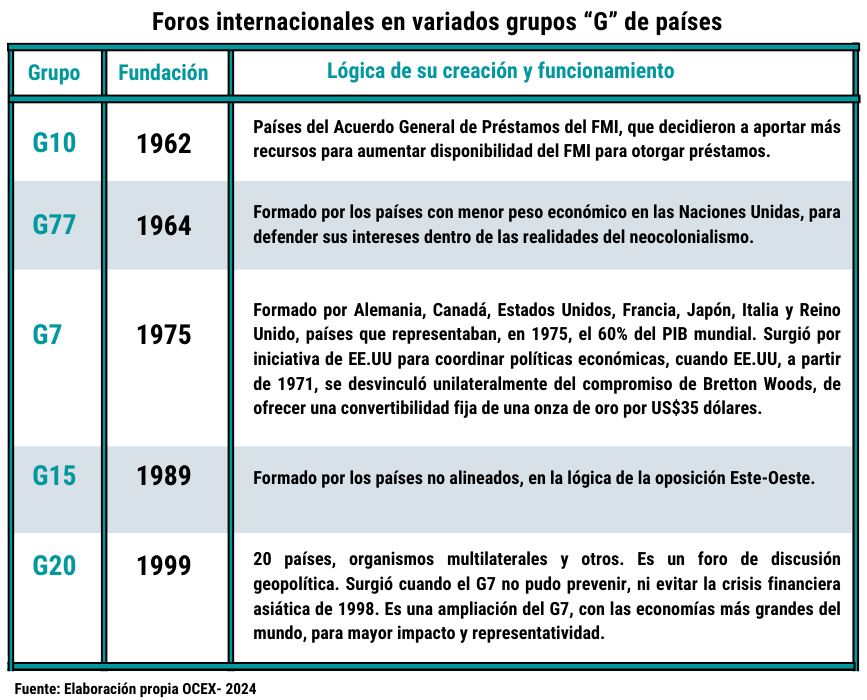 entre las potencias industriales y comerciales más importantes. Fue así que, en 1975, nació el G7. No es una entidad oficial y formal y, por tanto, carece de autoridad para hacer cumplir los planes que discute o las políticas que recomienda. Es, más bien, una asociación y foro político y económico intergubernamental, conformado por los países acreditados como las mayores economías desarrolladas del mundo y, como tales, las naciones decisivas en el comercio mundial, que en su momento eran: Francia, Alemania, Italia, Japón, Estados Unidos, Reino Unido y Canadá. Los líderes de los gobiernos de estos países se reúnen periódicamente para tratar asuntos económicos y monetarios, ya que su principal objetivo es actuar de forma concertada para enfrentar los problemas mundiales, especialmente, las cuestiones económicas. Las resoluciones adoptadas por el G7, al final de cada foro, no son vinculantes, sino meramente orientativas. Su finalidad última es diseñar un plan de acción conjunta con el que dar respuesta a los desafíos. Desde su creación, el G7 ha abordado y llegado a acuerdos sobre crisis financieras, problemas monetarios y temas álgidos del comercio, como la crisis de abastecimiento de petróleo.
El anacronismo del G7. A finales de 2001, Jim O’Neill, uno de los más importantes analistas de Golden Sachs, redactó un informe donde trató de demostrar que la composición del G7 ya no era un foro en el que se pudiera establecer efectivamente una verdadera coordinación significativa de la política económica mundial (O’Neill, 2001). Su argumento era que mientras algunos de los países que integran el G7 realmente no tenían peso mundial, como Italia o Canadá, otros países, que no forman parte del G7, habían adquirido mayor peso, entre tanto, y deberían formar parte de la gobernanza económica mundial central. O’Neill planteaba que los países que formaban el G7 habían quedado con un peso anacrónico y que, por tanto, el foro mundial que conformaban ya no era la expresión apropiada del peso relativo de las naciones y que, como tal, había perdido su habilidad para enfrentar las problemáticas mundiales.
De ahí que propuso una reforma del G7. El hizo una metáfora, dijo que a la pared del G7 había que ponerle mejores ladrillos que los que tiene. Su artículo se llamó: Building Better Global Economic BRICs. Este título era un juego de palabras. Usó la pronunciación la palabra bricks del inglés (Brics), que significa ladrillos, pero en esa onomatopeya introducía, al mismo tiempo una sugerencia: esa pronunciación (BRIC) es también el acrónimo que se deriva de los países Brasil, Rusia, India y China.
BRIC - Un primer intento de aproximación geopolítica: el análisis funcional. La propuesta de reforma del G7 de O’Neill era meramente funcional. Él mostraba que los impactos de las políticas monetarias, económicas y comerciales de Brasil, Rusia, India y China tenían mucho más peso, en la economía global, que las de Italia y Canadá, para poner, como ejemplo, dos países miembros del G7. Por eso, escribía O’Neill, la economía del mundo funcionaría mejor “Si el G7 se convirtiera en un foro en el que se debatiera una verdadera coordinación de la política económica mundial” (op.cit).
Por supuesto que la propuesta de O’Neill jamás fue tomada en consideración, porque el G7 es una agrupación geopolítica, no económica. Sin embargo, sus análisis siguieron haciendo ruido entre los analistas. En 2003, Dominic Wilson y Roopa Purushothaman, también de Golden Sachs, siguiendo el razonamiento de O’Neill, publicaron un análisis titulado Soñando con los BRIC: El rumbo hacia 2050. En ese análisis confirmaban los pronósticos de O’Neill y los llevaban a conclusiones que ellos mismos presentaban como realmente dramáticas: en 2024, decían, los BRIC significarían el 50% del peso económico de todo el G7. En 2039, lo sobrepasarían. Y, sin embargo, el G7, club de occidente y del dominio hegemónico de los Estados Unidos seguiría excluyendo a lo que sería el segmento más grande de la economía mundial. Se trataba del desarrollo de una contradicción geopolítica que debía ser enfrentada.
La continuidad de una idea que se impone. En su artículo, Wilson y Purushothaman decían que los resultados esperados eran impresionantes. Brasil, Rusia, India y China -las economías BRIC de ese momento- estaban camino a convertirse en la mayor fuerza de la economía mundial, en los próximos 50 años. Decían que antes de 30 años, en el G7, solo Estados Unidos y Japón serían fuerzas económicas de peso. Y, sin embargo, se cuestionaban que nada apuntaba a un cambio en la composición del G7, lo que lo hacía abiertamente excluyente y de baja funcionalidad. Desde entonces se multiplicaron los análisis académicos que confirmaban esos reportes de Goldman Sachs. Tenemos que decir que pasaron varios años sin que nada ocurriera.
Un primer intento de aproximación geopolítica. Del análisis económico a la geopolítica. El 20 de septiembre de 2006, Vladimir Putin invitó a los ministros de relaciones exteriores de China, India y Brasil a reunirse informalmente, aprovechando la presencia de los tres en New York, con ocasión de la 61 Asamblea General de las Naciones Unidas. El vocero de la reunión fue, por supuesto el Ministro de Relaciones Exteriores de Rusia Sergei Lavrov. Ahí compartió con la prensa que Putin había concebido la necesidad de buscar alguna forma de institucionalizar la colaboración de esos cuatro países. Los acontecimientos económicos internacionales reforzarían esa iniciativa. Al año siguiente, en 2007, el PIB de China sobrepasó al de Alemania. En 2008, Brasil, China y los países petroleros establecieron un fondo común soberano, como vehículo para invertir los excesos de capital.}
La crisis económica mundial acelera los procesos. La crisis financiera de 2008 significó un verdadero boom para los grandes países emergentes. En el punto más bajo de la crisis, en 2009, India alcanzó la mayor tasa de crecimiento de su historia, casi 10%. En esos momentos, las condiciones estaban maduras para asumir una línea colectiva de política internacional. El 16 de junio de 2009, Brasil, India y China responden a la convocatoria de Rusia en Ekaterimburgo, para crear un nuevo foro mundial: el BRIC.
Al año siguiente, se adhirió Sudáfrica, añadiendo, en 2010, la letra S al acrónimo, que quedó como BRICS. Con la incorporación de Sudáfrica, los BRICS cubren el 30 % del territorio del planeta y el 42% de la población mundial. En 2023 los BRICS respondían por más del 23 % del producto interior bruto mundial (PIB) y por el 18% del comercio internacional. (Takushi, 2023) enfatiza la velocidad y lo asombroso del surgimiento de los países BRICS: “El auge de China-Rusia-India-Brasil-Sudáfrica es absolutamente asombroso. En el año 2000, estas cinco naciones del BRICS apenas representaban el 18% del PIB mundial, frente al 47% del G7. Este año, los BRICS alcanzan el 32,1% frente al 31,4% del G7 (PPA)”.
En su mismo nacimiento, estos países aparecen contestatarios (Radulescua, 2014). Ahí advierten, por primera vez desde la caída del muro de Berlín, la necesidad internacional de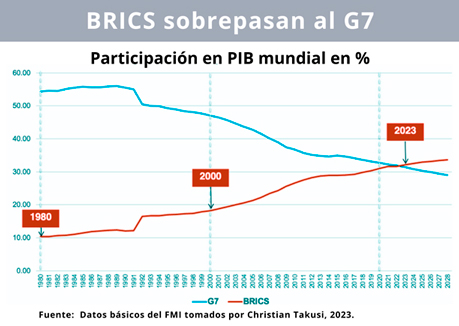 construir, "un orden mundial multipolar más democrático y justo, basado en el Estado de Derecho internacional, la igualdad, el respeto mutuo, la cooperación, la acción coordinada y la toma colectiva de decisiones en donde se tomarán realmente en cuenta los intereses de todos los Estados" (Declaración de Ekaterinburgo, 2009).
El peso del liderazgo geopolítico de China. Esos son los países BRICS. Así Nació su coordinación internacional. Pero, aunque el primer paso de la iniciativa, en sí misma, fue producto del impulso de la dirigencia política rusa, el peso determinante de sus procesos ha estado determinado por el liderazgo de China, que se ha esmerado en ofrecer un tipo horizontal y no vertical de conducción.
Mucho antes de los BRICS, desde comienzos de siglo y aún antes de su ingreso a la Organización Mundial de Comercio (OMC), China había ido comprendiendo la necesidad de contrarrestar, eventualmente, el peso arbitrario que ejerce el G7 y cómo eso sólo sería posible por medio de la colaboración Sur-Sur y el reforzamiento de las capacidades económicas de los países del Sur-Global. Primero actuó China en Asia central, con la Organización de Cooperación de Shanghai, creada por iniciativa China en 2001, donde también estaba Rusia. Después fue el Foro China-África, también conocido como FOCA. Por eso, cuando apareció la iniciativa rusa de la formación de los BRIC, China asumió con entusiasmo y se puso rápidamente a la cabeza. En 2012, arrancó la Iniciativa de la Franja y la Ruta, también conocida como la Nueva Ruta de la Seda, centrada en cooperación, financiamiento y desarrollo de infraestructuras. En ese mismo sentido se crea la inmensa red de bancos de desarrollo de China, donde están el China Development Bank, el China-Africa Development Bank, el China Construction Bank; el Eximpor-Import Bank of China y el Banco Asiático de Inversiones en Infraestructura. A esa red financiera se suma el Nuevo Banco de Desarrollo de los BRICS y el Acuerdo de Reservas de Contingencia.
En algún momento, antes de comienzos de siglo, China comenzó a discutir en diferentes foros lo que se dio en llamar el Consenso de Pekín o Consenso de Beijing, como un modelo de desarrollo en contraposición al neoliberalismo del Consenso de Washington (Fanjul, 2009). De esa manera, tanto por su peso comercial, como por el éxito de sus políticas económicas y por la cada vez mayor claridad de sus posiciones en el seno de los BRICS, orientadas a la creación de un orden internacional multipolar, se puede decir que China es la fuerza política, ideológica y económica que ejerce liderazgo en el foro de los BRICS (Yağci, 2016).
El concepto del Sur-Global. Los BRICS han venido a darle una expresión orgánica y geopolítica a todos los países que se engloban en el concepto de Sur Global. Éste nos remite a una conceptualización de países que gana cada vez más notoriedad en el mundo. Se trata de un conjunto de países geográfica y culturalmente heterogéneos, pero que comparten elementos históricos, políticos y económicos comunes (Jiagui, 2020). En el concepto de Sur Global se identifican países que padecieron históricamente procesos de colonización, no tienen realmente peso definitorio en la política internacional y aspiran a un crecimiento económico que les permita aumentar su participación en la distribución de la riqueza del mundo.
Se trata de una realidad geopolítica emergente (Pelfini, 2015) que se vincula con viejos conceptos contrastados, utilizados por las ciencias sociales y también por la política, como: centro/periferia; norte/sur; oriente/occidente; desarrollo/subdesarrollo. Incluso, esta referencia incluye países desarrollados/subdesarrollados (o, eufemísticamente, “en desarrollo”. También existen referencias a las alineaciones geopolíticas de la época de la guerra fría, como países alineados/no alineados.
Lo nuevo de su comprensión como Sur Global es su referencia a un mundo que a la vez que es globalizado es también segmentado entre los países que más se benefician de la globalización y los países que sienten que su participación en el sistema del mundo los deja atrás, en desarrollo humano y bienestar social. Se trata de una comprensión colectiva de malestares distributivos demostrables, que son expresión de una realidad mundial polarizada, como Norte Global, en su segmento dominante, y Sur Global, como el sector de países de realidades contrastadas y aspiracionales, que antes eran denominadas “Tercer Mundo”. Los BRICS vienen a ofrecer un camino alternativo y abierto y, como tales, se convierten en vectores con liderazgo en el Sur-Global (Sahay, 2023).
En la siguiente cápsula se explicará más específicamente el nacimiento y evolución de los BRICS, su evolución a partir de sus cumbres, la situación actual y las controversias y perspectivas que se plantean.
Referencias
- Duque, Armando. 2014. De Bretton Woods a la crisis. Universidad Central de Chile. En: https://afese.com/img/revistas/revista56/woods.pdf
- Fanjul, Enrique. 2009. El Consenso de Pekín: ¿un nuevo modelo para los países en desarrollo? ARI Nº 122/2009. Real Instituto Elcano. En: https://www.files.ethz.ch/isn/145871/ARI122-2009_Fanjul_Consenso_Pekin_paises_desarrollo.pdf
- Haibin, Niu. 2012. Los BRICS en la gobernanza global: ¿una fuerza progresista? - Friedriech Ebert Stiftung (FES). New York. En: https://library.fes.de/pdf-files/iez/09592.pdf
- Maihold, Günther y Villamar, Zirahuén. 2016. El G20 y los países emergentes. Foro internacional. Vol.56 no.1 Ciudad de México. México. En: https://www.scielo.org.mx/scielo.php?script=sci_arttext&pid=S0185-013X2016000100165
- Marín Sánchez, Eva. 2011. Una aproximación al papel de las instituciones de Bretton Woods en la actual crisis económica internacional. Tesis de grado. Universidad Politécnica de Cartagena. En:https://repositorio.upct.es/xmlui/bitstream/handle/10317/1909/tfg9.pdf?sequence=1&isAllowed=y
- O’Neil, Jim. 2001. Building Better Global Economic BRICs. Global Economics Paper No: 66. Golden Sachs. New York. En: https://www.goldmansachs.com/intelligence/archive/building-better.html
- Salama, Pierre. 2014. Las economías emergentes, ¿el hundimiento? Foro Internacional, vol. LIV, núm. 1, México. En: https://www.redalyc.org/pdf/599/59940020001.pdf
- Takushi, Christian, 2023. Geopolitical Update: BRICS overtake G7, 29 nations defy the USD and the West. Geopolitical Research Web Site. Suiza. En: https://geopoliticalresearch.com/?p=19385
- Wilson, Dominic y Purushothaman, Roopa. 2003. Dreaming With BRICs: The Path to 2050. Global Economics Paper No: 99. Goldman Sachs. New York. En: https://www.goldmansachs.com/intelligence/archive/archive-pdfs/brics-dream.pdf
- Yağci, Mustafa. 2016. A Beijing Consensus in the Making: The Rise of Chinese Initiatives in the International Political Economy and Implications for Developing Countries. PERCEPTIONS, Journal of International Affairs. Volume XXI, Number 2, pp. 29-56. En: https://dergipark.org.tr/en/download/article-file/815718
- Radulescua, Irina Gabriela, Panait, Mirela, Voicab, Catalin. 2014. BRICS countries challenge to the world economy new trends. Procedia Economics and Finance 8 (2014) 605 – 613. ScienceDirect. En: https://www.academia.edu/19402506/BRICS_Countries_Challenge_to_the_World_Economy_New_Trends?auto=download&email_work_card=download-paper
- Jiagui, Chen, Xiaoijing, Zhang., 2010. Shared Rapid Economic Growth, BRICS Have Different Development Modes, China Economist, Vol. 5, No.1/2010. En: https://papers.ssrn.com/sol3/papers.cfm?abstract_id=1538749
- Sahay, Tim, Mackenzie, Kate (2023). El nuevo orden de los BRICS. Le Grand Continente. En: https://legrandcontinent.eu/es/2023/09/05/el-nuevo-orden-de-los-brics/
- Pelfini, Alejandro y Fulquet, Gastón (coordinadores). 2015- Los BRICS en la construcción de la multipolaridad: ¿reforma o adaptación? CLACSO. Buenos Aires. En: https://biblioteca-repositorio.clacso.edu.ar/bitstream/CLACSO/14303/1/Interior.pdf
Dossier sobre China con contenidos de OCEX
Al 12 de agosto 2021, OCEX ofrece diversos contenidos relacionados con la inserción comercial y diplomática de Costa Rica en China. Dossier generado de la autoría de OCEX y divulgado a través del boletín “OCEX informa”:
- Boletín N° 1/ 2024/ Evento: Ruta y Franja (IRF). OCEX organizó una videoconferencia en ocasión del 10º aniversario de la Iniciativa de la Franja y la Ruta, que abordó los avances regionales de esta iniciativa. Leer más...
- Boletín N° 1/ 2024/ Diario del Pueblo: (IRF). En el 10º aniversario de la Iniciativa de la Franja y la Ruta, OCEX comparte el artículo de opinión de Velia Govaere publicado en el Diario del Pueblo de China en setiembre del 2023. Leer más...
- Boletín N° 1/ 2024/ Congreso Sinología de CR. Invitada por el Instituto Confucio de la UCR, Velia Govaere abordó la revitalización moderna de China en el II Congreso Internacional de Estudios sobre China. Leer más...
- Boletín N° 1/ 2024/ Modernización china. Velia Govaere y expertos latinoamericanos reflexionaron en el espacio “Mirada Económica”, en un programa sobre la modernización al estilo chino. Leer más...
- Boletín N° 6/ 2023/ A 10 años: TLC Emblemáticos. OCEX organizó TLC Emblemáticos: lecciones aprendidas, evento que presentó un análisis panorámico de los impactos comerciales de tres TLC, a una década de su funcionamiento. Leer más...
- Boletín N° 5/ 2023/ Visita del embajador de China. El Embajador Tang Heng de la República Popular China visitó la UNED. Le recibió el Rector, don Rodrigo Arias Camacho con quien intercambió ideas y le mostró la editorial y el campus. Leer más...
- Boletín N° 4/ 2023/ Evento Destino China. El objetivo de OCEX en el evento Destino Chinafue analizar los valores socioculturales en las relaciones profesionales y de negocios, para una exitosa relación comercial con China. Leer más...
- Boletín N°3/ 2023/ Revitalización Moderna de China. En marzo 2023, la presencia del Embajador Tang de la RPCH dio realce a un conservatorio de OCEX sobre la “Revitalización Moderna de China”, su crecimiento y sus políticas públicas. Leer más...
- Boletín N°2/ 2023/ Conferencia con la BUFS de China. Presentamos ponencia “Trade with China eases Latin America's democratic challenges for the 2030 agenda in the new Era”, en el Foro Internacional de la Universidad de Pekín. Leer más...
- Boletín N°2/ 2023/ Khanversations con el Prof. Khan. En el formato de“Khanversations”, el Profesor Khan de la Universidad de Delaware y Velia Govaere conversan sobre las relaciones exteriores entre Costa Rica, EE.UU. y China. Leer más...
- Boletín N°1/ 2023/ Victoria humana del modelo chino. OCEX tuvo el placer de plasmar sus impresiones sobre China y sus políticas de alivio a la pobreza en la Revista China - Costa Rica de enero 2023. Ponemos esta reflexión a su disposición. Leer más...
- Boletín N°1/ 2023/ Fujian: fortalezas comerciales. Velia Govaere visitó la provincia china de Fujian, el puerto de Xiamen, sus actividades productivas y sus sitios turísticos emblemáticos como la isla de Gulangyu o la montaña de Wuyi. Leer más...
- Boletín N°1/ 2023/ Entrevista en People´s Daily. OCEX le comparte la entrevista realizada a su coordinadora Velia Govaere por el periódico chino el “Diario del Pueblo” (People´s Daily), en ocasión de su visita al gigante asiático. Leer más...
- Boletín N°1/ 2023/ Shanghái: 5° feria commercial. La coordinadora de OCEX visitó la Feria de Importaciones y Exportaciones (CIIE) de Shanghái, importante referente chino y mundial, vitrina de oportunidades con el gigante asiático. Leer más...
- Boletín N°1/ 2023/ Clausura del programa de intercambio cultural. OCEX participó en un programa sobre China contemporánea. Compartimos con nuestros lectores reflexiones sobre políticas públicas paradigmáticas y aspectos culturales emblemáticos. Leer más...
- Boletín N°6/ 2022 / Entrevista por El Diario de Pekín. “OCEX Informa” se complace en compartir con sus lectores la entrevista de su coordinadora Velia Govaere para el periódico “El Diario de Pekín”, sobre sus experiencias en esa ciudad. Leer más...
- Boletín N°6/ 2022 / Encuentros académicos en China. Enfatizando la importancia que tiene para OCEX la internacionalización de la UNED, Velia Govaere estableció contacto con contrapartes académicas chinas, en su visita a Pekín. Leer más...
- Boletín N°6/ 2022 / Entrevista del Diario del Pueblo. El 12 de septiembre del 2022, el periódico chino el “Diario del Pueblo” publicó una entrevista de la coordinadora de OCEX, en su calidad de académica y exviceministra de Economía de Costa Rica. Leer más...
- Boletín N°6/ 2022 / Artículos publicados en prensa china. OCEX comparte con sus suscriptores dos contribuciones de su coordinadora Velia Govaere, publicadas en el periódico “El Diario del Pueblo” de China, en agosto y setiembre del 2022.Leer más...
- Boletín N°6/ 2022 / Programa de intercambio en China. Invitada por la Embajada de la República Popular China en Costa Rica, Velia Govaere participa en Pekín, en el 2do semestre del 2022, en un programa auspiciado por la Asociación de Diplomacia Pública de China. Leer más...
- Boletín N°5/ 2022 / China: Feria Internacional de Comercio. En el marco de la Feria Internacional de China para comercio de servicios, en Pekín, Velia Govaere expuso la experiencia costarricense en planificación urbana frente al cambio climático. Leer más...
- Boletín N°5/ 2022 / Shaanxi: emprendimientos productivos. En la provincia de Shaanxi, Govaere conoció mejores prácticas de erradicación de la pobreza y apreció sitios emblemáticos: la Pagoda de Yan´an, los guerreros de Terracota y la Muralla de Xi´an. Leer más...
- Boletín N°5/ 2022 / Programa de intercambio cultural. Invitada por la Embajada de China, Velia Govaere participa en un programa en Beijing sobre la cultura y aspectos neurálgicos de China. Bajo el auspicio de la Asociación de Diplomacia Pública de China. Leer más...
- Boletín N°2/ 2022 / Evento Ruta de la Seda. OCEX realizó un conversatorio sobre la iniciativa de “la Franja y la Ruta”, el proyecto chino de infraestructura, transporte, cooperación y financiamiento en el que participa Costa Rica. Leer más...
- Boletín N°1/ 2022 / Valoración de impactos TLC con China. OCEX colaboró en una valoración de impactos del TLC entre Costa Rica y China para el Informe del Estado de la Nación del 2021. Govaere evaluó el desempeño de este TLC a 10 años de vigencia. Leer más..
- Boletín N° 4/ 2021 / Abriendo la puerta a Asia. Grabación de videoconferencia virtual. 10 años del TLC entre Costa Rica y la República Popular China. En el siguiente link: https://www.youtube.com/watch?v=65ws-XMzpxw
- Cápsula N°2/ 2021 / Abriendo las puertas a Asia. Con ocasión de la celebración de 10 años del TLC con China, OCEX presenta un balance de una década de relaciones geopolíticas, comerciales y diplomacias. https://www.uned.ac.cr/ocex/index.php/ocexinf/2021/647-abriendo-las-purtas-a-asia-10-anos-del-tlc-con-china
- Boletín N° 1/ 2021 / El ascenso de la estrella china
Artículo de opinión publicado en periódico "La Nación": Penetrante artículo de una trilogía sobre China. La exitosa firma, en Pekin, de la Asociación Económica Integral Regional (RCEP) fortalece el multilateralismo en Asia. https://www.uned.ac.cr/ocex/index.php/ocexinf/2021/631-el-ascenso-de-la-estrella-china - Boletín N° 1/ 2021 / Los establos de Hércules
Artículo de opinión publicado en periódico "La Nación": Artículo de la saga sobre China. Analiza el nuevo lugar que tiene Asia en el rumbo de la historia. Aborda el impacto de China como el paradigma cardinal de nuestros tiempos. https://www.uned.ac.cr/ocex/index.php/ocexinf/2021/633-los-establos-de-hercules - Cápsula N°1/ 2021 / TLC entre China y Costa Rica: Antecedentes de sus relaciones comerciales. En el marco de los 10 años de la entrada en vigencia del TLC entre Costa Rica y la República Popular China, OCEX presenta los antecedentes de sus relaciones comerciales.https://www.uned.ac.cr/ocex/index.php/ocexinf/2021/638-en-uso-y-enproceso
- Boletín N° 5/ 2020 / Después el americano feo. Artículo de opinión publicado en periódico "La Nación": Síntesis de los desatinos causados en la política exterior estadounidense, por Trump, quien malentiende la fuerza de los hilos chinos en el entramado de las relaciones internacionales. https://www.uned.ac.cr/ocex/index.php/ocexinf/2020/600-despues-del-americanofeo
- Boletín N° 6/ 2019 / Un preludio de una catástrofe evitable. Artículo de opinión publicado en periódico "La Nación". Detrás de escaramuzas cotidianas, entre Estados Unidos y China se despliega la competencia ineludible por la hegemonía mundial. Escondida tras caprichos y distorsionada por la mezquindad de intereses inmediatos, esa rivalidad tiene una trascendencia que definirá, a la postre, el destino humano. https://www.uned.ac.cr/ocex/index.php/ocexinf/2019/529-un-preludiode-una-catastrofe-evitable
- Boletín N° 4 / 2013 / Otra visión del Sistema Político Chino. OCEX en coordinación con el Centro Nacional de Alta Tecnología (CeNAT) invitaron a Patricia Rodríguez, ex ministra consejera en China y autora del libro “Sistema Político Chino: más allá de los estereotipos” a compartir su obra, en un conversatorio en la Universidad Estatal a Distancia (UNED),, transmitido por videoconferencia y enlazado con el CeNAT y los Centros Universitarios, UNED. Según explicó la autora, la pregunta que dio origen a su obra fue: ¿Qué hay detrás de ese gran milagro económico chino en lo institucional y en lo cultural? Acceda al PPT
- Boletín N° 4 / 2013 / La prometedora y controvertida presencia del dragón oriental. Costa Rica es el único país de Centroamérica que, desde hace seis años, ha establecido relaciones diplomáticas con la República Popular China, rompiendo la vieja tradición centroamericana de más de medio siglo de relaciones diplomáticas con Taiwán. Los países del istmo centroamericano reconocían, desde 1949, al gobierno de Taiwán, como el “verdadero” representante del pueblo chino, en el marco confrontativo de la guerra fría. https://www.uned.ac.cr/ocex/index.php/ocexinf/2013/249-china-en-centroamerica
- Boletín N° 4 / 2013 / La democracia como proceso: China y Costa Rica. "China queda, sin duda alguna, todavía debiendo a lo que para nosotros sería una visión democrática. Pero esa deuda no es necesariamente la que nosotros podemos definir desde nuestros prejuicios. La propia población china irá planteando sus pasos como desafío, con todos los peligros que encierra", dijo Velia Govaere, coordinadora de OCEX, durante sus reflexiones finales, en el conversatorio brindado por Patricia Rodríguez Hölkemeyer. https://www.uned.ac.cr/ocex/index.php/ocexinf/2013/251-la-democracia-comoproceso-china-y-costa-rica
- Boletín N° 4 / 2013 / Dra. Patricia Rodríguez, una costarricense en China. OCEX tuvo el privilegio de entrevistar a Patricia Rodríguez, quien fungió como Ministra Consejera en la primera Embajada de Costa Rica en China. Máster en Administración Pública de la Universidad de Harvard y su más reciente libro se titula: “Sistema Político Chino: más allá de los estereotipos”. Su interés de esclarecer una serie de ideas preconcebidas y difundidas en torno a esa nación, dio como fruto una atinada pieza literaria, en estos momentos históricos, cuando se hace sentir el paso del gigante asiático en Centroamérica.https://www.uned.ac.cr/ocex/index.php/ocexinf/2013/247-dra-patricia-rodriguezuna-costarricense-en-china
- Boletín N° 4 / 2013 / La prometedora y controvertida presencia del dragón oriental en Centroamérica. Costa Rica es el único país de Centroamérica que, desde hace seis años, ha establecido relaciones diplomáticas con China. Sin embargo, recientes y espectaculares anuncios y movimientos diplomáticos oficiales en el resto de los países del istmo advierten las huellas poderosas del dragón oriental en Centroamérica. Canal seco en Honduras, establecimiento de una oficina comercial en El Salvador y Canal interoceánico en Nicaragua son iniciativas que podrían trazar el paisaje centroamericano con letras chinas.https://www.uned.ac.cr/ocex/index.php/ocexinf/2013/249-china-encentroamerica
- Boletín N° 4 / 2013 / China y Costa Rica: diplomacia, comercio, inversión y cooperación. El 8 de julio del 2013, el enriquecedor encuentro del Dr. Enrique Dussel con académicos costarricenses permitió hacer una valoración de fortalezas, debilidades, retos y desafíos entre las relaciones de Costa Rica y China, como referente para la región centroamericana. La reunión se realizó en el Estado de la Nación entre el especialista mexicano, don Miguel Gutiérrez Saxe (CONARE), Patricia Rodríguez (UCR) y Velia Govaere (OCEX-UNED).https://www.uned.ac.cr/ocex/index.php/ocexinf/2013/250-visita-del-dr-enriquedussel-especialista-en-relaciones-internacionales-entre-china-y-america-latina
- Boletín N° 5/ 2011 / Costarricenses y chinos forjan vínculos comerciales y culturales. La alianza que empieza a marcar la senda común de ambas naciones despierta el análisis de diversos sectores, entre ellos la Universidad Estatal a Distancia (UNED), que el pasado 1º de setiembre organizó la videoconferencia “Relaciones comerciales y culturales con la República Popular China”. Se contó con la participación del embajador de Costa Rica en Beijing, Marco Vinicio Ruiz, quien se enlazó mediante una llamada internacional. Estuvo presente Marianela Piedra, consejera de la misma sede diplomática. (Ver presentación en PPT). En el panel de expertos estuvo como comentarista Velia Govaere, coordinadora del OCEX de la UNED. https://www.uned.ac.cr/ocex/index.php/ocexinf/2011/832-costarricenses-y-chinos-forjan-vinculos-comerciales-y-culturales
- Boletín N° 4/ 2011 / Desafíos del sector industrial frente al TLC con China. Luego de cumplir con los trámites operativos necesarios, Costa Rica y la República Popular China gozan formalmente, a partir del 01 de agosto de 2011, de los beneficios de este TLC. OCEX entrevistó al Ing. Luis Obando Rojas para conocer la opinión de la Cámara de Industria sobre los principales desafíos que enfrentará el sector industrial nacional frente a la puesta en vigencia del TLC con China, así como su visión acerca de las tareas pendientes del gobierno. Don Luis Obando es asesor en Comercio Internacional, de la Cámara de Industrias de Costa Rica (CICR). Con este ejercicio se relacionó a uno de los actores claves.https://www.uned.ac.cr/ocex/index.php/ocexinf/2011/116-desafios-del-sectorindustrial-frente-al-tlc-con-china
- Boletín N° 4/ 2011 / TLC con China: Posiciones opuestas ¿Oportunidad de oro o bocadillo de dragón? Actualmente, Costa Rica exporta a 146 países, que representan un mercado de casi 2500 millones de personas. El discurso oficialista, tras la firma del tratado de libre comercio con la República Popular de China, es que su gran mercado representa una gran oportunidad para Costa Rica, lo que no necesariamente es mentira; sin embargo, el país tiene por cumplir una serie de tareas pendientes que, de seguirse posponiendo, podrían poner cuesta arriba la obtención de beneficios. China manufactura una abrumadora diversidad de productos, ofrece un espectro de calidades muy amplio y, además, lo hace a un bajo costo.https://www.uned.ac.cr/ocex/index.php/ocexinf/2011/108-tlc-con-china-posicionesopuestas
- Boletín N° 2/ 2011 / Aprobado el TLC entre Costa Rica y la República Popular China. El día 31 de mayo del 2011, fue ratificado en segundo debate por nuestra Asamblea Legislativa, el TLC con China. Las negociaciones iniciaron en enero del 2009, y tras seis rondas de negociación culminadas con la firma del TLC el 8 de abril del 2010. https://www.uned.ac.cr/ocex/index.php/ocexinf/2010/64-resultados-de-lasnegociaciones-del-tlc-entre-costa-rica-y-china
- Boletín N° 5/ 2010 / Charla: Inserción comercial de Costa Rica en Asia. Resultados de las negociaciones del TLC entre Costa Rica y China. Expositores: Sra. Patricia Rodríguez y Sr. Fernando Ocampo.Intereses comerciales de Costa Rica. Costa Rica sin tradición exportadora a China. Siendo China el principal comprador de productos agrícolas del mundo, cabría cuestionarse las razones que explican por qué Costa Rica, a pesar de ser un exportador agrícola importante, no tiene tradición de exportar a China. El expositor, Sr. Fernando Ocampo Sánchez, Viceministro del Ministerio de Comercio de Costa Rica (COMEX) explicó que, por una parte.https://www.uned.ac.cr/ocex/index.php/ocexinf/2010/64-resultados-de-lasnegociaciones-del-tlc-entre-costa-rica-y-china
- Boletín N° 4/ 2010 / El Posicionamiento de Costa Rica en Asia: hacia una membresía en APEC. Como parte integral de la inserción de Costa Rica en Asia, desde el año 2006, nuestro país ha manifestado un profundo interés en integrarse al foro de APEC. Por las siglas “APEC” se conoce el foro multilateral de Cooperación Económica del Asia-Pacífico, que trata temas relacionados con el intercambio comercial. https://www.uned.ac.cr/ocex/index.php/ocexinf/2010/58-el-posicionamiento-decosta-rica-en-asia-hacia-una-membresia-en-apec
- Boletín N° 4/ 2010 / El último bastión: los resultados de las negociaciones con la Unión Europea benefician sobre todo a Costa Rica. Artículo de opinión publicado en periódico "La Nación". El árbol reciente hace que perdamos de vista el bosque milenario. Junto a merecidos aplausos, se impone también una sobria revalorización de las condiciones sociopolíticas y económicas que nos vinculan con el mercado comunitario. En 2006, las exportaciones de componentes electrónicos a China. https://www.uned.ac.cr/ocex/images/stories/dmdocuments/el_ultimo_bastion.pdf
- Boletín N° 3/ 2010 / Costa Rica abre las puertas de Asia. El gobierno de Costa Rica firmó dos Tratados de Libre Comercio con Singapur (6 de abril) y con China (8 de abril de 2010). La conclusión exitosa de las negociones de ambos tratados lleva a buen puerto uno de los objetivos de política comercial de la Administración Arias, cuando el 1º de junio del 2007 se tomó la decisión de iniciar relaciones diplomáticas con la República Popular China. https://www.uned.ac.cr/ocex/index.php/ocexinf/2010/54-costa-rica-abrelas-puertas-de-asia-con-tratados-de-libre-comercio-con-china-y-singapur
- Boletín N° 1/ 2010 / Concluye la negociación para el Tratado de Libre Comercio entre Costa Rica y la República Popular China. Del 8 al 10 de febrero de 2010, se llevó a cabo en San José, la Sexta Ronda de Negociación para el TLC entre Costa Rica y China. Dicha ronda permitió concluir el proceso. El Tratado consolida una relación comercial de primer orden con la tercera economía del planeta y constituye un hito de la política comercial costarricense, en la diversificación de mercados y la estrategia de incursión en Asia. https://www.uned.ac.cr/ocex/index.php/ocexinf/2010/45-concluye-la-negociacion-para-el-tratado-de-libre-comercio-entre-costa-rica-y-la-republica-popular-chin
Más artículos…
Página 16 de 131

